What Is the Wavy Fabric Pattern in the NYT Crossword?
When the NYT Crossword mentions a "wavy fabric pattern," it is not using poetic language. It is pointing to a real, repeatable textile structure. The clue works because the surface feature is easy to picture, common in daily life, and technically specific. To understand the answer, you need to look at how fabrics are formed, not how they are styled or marketed.

What "Wavy" Means in Textile Terms
In fabric science, "wavy" does not mean random wrinkles or poor finishing. It describes a controlled, repeating surface variation created during manufacturing.
This wave-like surface can come from:
Uneven fiber tension
Differential shrinkage
Mechanical bonding or embossing
Fiber entanglement at different depths
The key point is simple:
The waves are intentional and structural.
They stay even after washing, stretching, or repeated use.
Why This Term Works So Well as a Crossword Clue
Crossword editors favor words that are:
Short and precise
Easy to visualize
Widely encountered, even if poorly understood
A wavy fabric pattern fits all three. Most people have touched it. Few can name it. That gap creates a fair but satisfying clue.
The crossword is testing recognition, not deep textile knowledge.
Common Misunderstandings About Wavy Fabrics
Many readers first imagine things that are not correct answers.
Typical wrong assumptions include:
Fabric that is wrinkled from use
Decorative prints with curved lines
Knitted stretch marks
Heat-damaged material
These are surface effects or defects.
The crossword clue refers to fabric structure, not damage or decoration.
The Structural Origins of a Wavy Surface
Waves appear when fibers behave differently across the fabric plane.
This can happen through:
High-twist yarns that relax unevenly
Alternating dense and loose bonding zones
Controlled fiber shrinkage during drying
Hydraulic entanglement at varying pressure levels
In nonwoven materials, this effect is often more visible because there is no traditional warp-and-weft grid to flatten the surface.
Wavy Patterns in Woven, Knitted, and Nonwoven Fabrics
Not all fabrics create waves in the same way.
Woven Fabrics
Waves usually come from yarn twist or tension imbalance
Texture is subtle and directional
Surface variation is limited by loom structure
Knitted Fabrics
Waviness often comes from elasticity
Shape may change under load
Less stable over time
Nonwoven Fabrics
Waves are formed during bonding
Pattern stays consistent
Texture can be engineered precisely
This is where hydroentangled spunlace structures stand out.
The Role of Hydroentanglement in Wavy Patterns
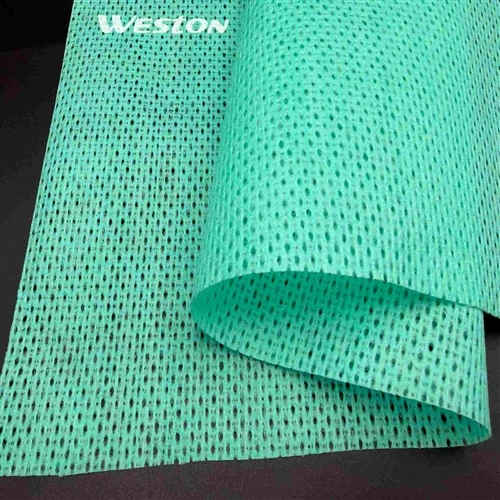
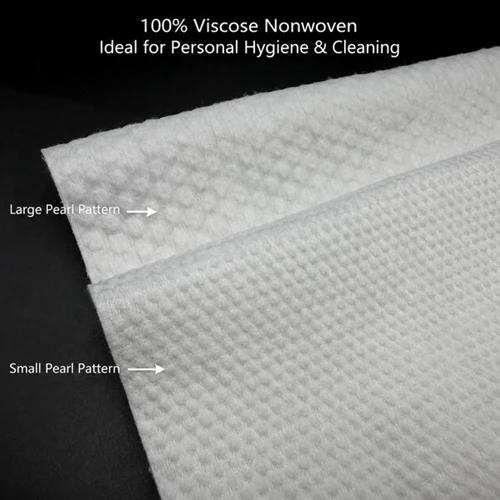
In spunlace production, high-pressure water jets entangle fibers without glue or thermal fusion. By adjusting jet pressure, belt pattern, and fiber blend, manufacturers can create controlled surface undulation.
This is where the keyword fits naturally:
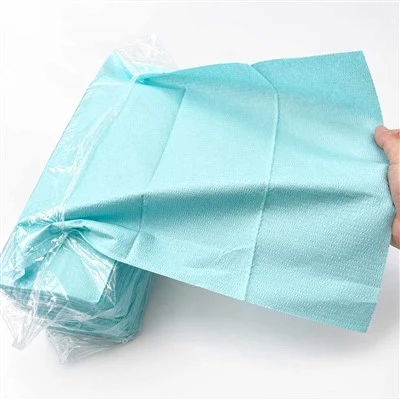
Wavy Fabric Pattern (Viscose Polyester) is a common outcome of spunlace engineering.
Viscose contributes softness and absorbency.
Polyester adds strength and recovery.
Together, they allow waves that are:
Stable
Functional
Repeatable at scale
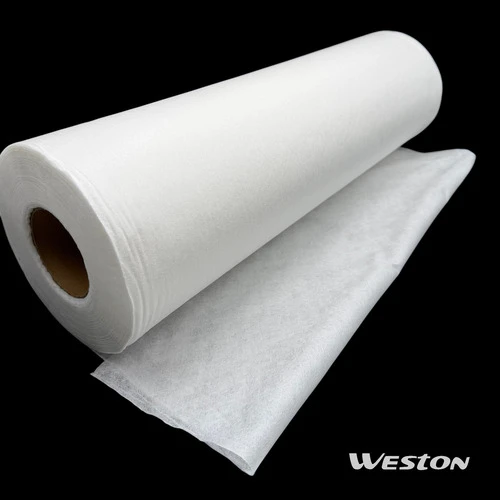
At Weston Nonwoven, this pattern is not cosmetic. It is designed for performance.
Why Wavy Fabric Patterns Exist at All
A flat fabric is easy to make.
A textured one exists for a reason.
Wavy surfaces can:
Increase surface area
Improve liquid uptake
Enhance grip during wiping
Allow better airflow
Reduce sticking between layers
These are practical advantages, not visual tricks.

Benefits and Trade-Offs of Wavy Fabric Structures
No structure is perfect. Wavy patterns solve some problems and introduce others.
Advantages
Better absorption compared to flat surfaces
Improved dirt and particle capture
Softer hand feel without added chemicals
Reduced slipping during use
Limitations
Slightly higher fiber usage in some designs
More complex process control
Not ideal where ultra-smooth contact is required
This balance is why wavy fabrics are common in cleaning, hygiene, and industrial wiping, but less so in applications demanding optical smoothness.
Practical Comparison: Wavy vs. Flat Fabric
|
Aspect |
Wavy Fabric Pattern |
Flat Fabric |
|
Surface structure |
Three-dimensional |
Two-dimensional |
|
Liquid handling |
Faster uptake |
Slower, directional |
|
Grip |
Higher |
Lower |
|
Air permeability |
Improved |
More restricted |
|
Visual appearance |
Textured |
Minimal |
The crossword clue points to this physical distinction, not a fashion trend.
Why the Crossword Rarely Explains This
The NYT Crossword assumes shared cultural exposure. It does not explain manufacturing science. The clue works because the answer lives in that middle ground between daily experience and technical reality.
Once you understand the structure, the clue feels obvious.
A Grounded Answer to the Original Question
So, what is the wavy fabric pattern in the NYT Crossword?
It is not decoration.
It is not a flaw.
It is a deliberate textile structure created through fiber behavior and manufacturing control.
In modern nonwoven production, especially in spunlace systems like those used at Weston Nonwoven, the Wavy Fabric Pattern (Viscose Polyester) is a practical solution to real performance needs.
That is why the crossword clue works.
And why the answer makes sense once you look beyond the surface.