A scrubbing wipe rarely fails because the fabric tears. It fails because the dots come off first. Once a dot lifts away from the base, that spot stops scrubbing, starts fraying, and the whole wipe gets thrown out - long before the fabric itself was actually worn out. At Weston Nonwoven, dot adhesion strength is treated as a core engineering variable, not a finishing detail.
What "Dot Adhesion" Actually Means
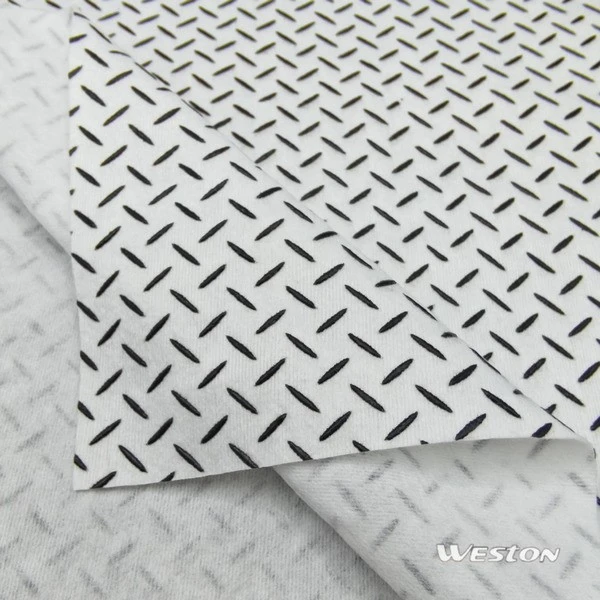
Dot adhesion is the bond strength between the raised plastic dot and the spunlace base fabric beneath it. It is a separate property from the fabric's own tensile strength or abrasion resistance - a fabric can be strong and still shed its dots if the bonding process, dot material, or base fiber were mismatched.
Three things happen when adhesion is too weak:
Edge lifting - dot edges peel up first, catching on surfaces and accelerating full detachment.
Core separation - the dot detaches from the middle outward, often invisible until the dot falls off entirely.
Fiber pull-through - the base fiber pulls apart under the dot rather than the bond itself failing, which usually signals the wrong base material was chosen for that dot type.

What Actually Weakens the Bond
|
Cause |
What Happens |
|
Base fiber mismatch |
Smooth, low-friction fibers (some polyester finishes) bond less firmly with plastic dots than fibers with a rougher, more absorbent surface |
|
Insufficient curing/cooling time |
Dots that aren't fully set before the fabric is rolled or cut can shift and weaken at the bond line |
|
Excess moisture during bonding |
Residual moisture in the base fabric interferes with dot adhesion during hot-press application |
|
Wrong weight-to-dot-size ratio |
A heavy dot on a light, low-density base fabric has less surface area to grip, so it shears off under load faster |
|
Repeated wet/dry cycling in use |
Water absorption and drying cause the base fabric to expand and contract, which stresses the bond line over time |
Why "One Adhesion Spec" Doesn't Work Across Applications
This is the part most buyers miss: dot adhesion isn't a single number to hit. The right adhesion strength - and the right way to test for it - depends entirely on how the wipe will actually be used.
Kitchen & Dish Scrubbing Exposure to hot water, dish soap, and grease repeatedly softens and re-hardens the bond area. A dot that adheres well dry can still fail after 20 hot-water cycles if the bonding agent isn't heat-stable. Kitchen-use fabric needs adhesion tested wet, hot, and repeatedly - not just once at room temperature.
Industrial & Automotive Wipes These Spunlace Abrasive Plastic Dots Wipes face solvents, oils, and high mechanical friction against metal or painted surfaces. Chemical exposure can break down certain bonding agents that would hold up fine in a kitchen setting. Adhesion here needs to be tested against the specific solvent the end customer actually uses, not a generic standard.
Pet Care Wipes Lower chemical exposure, but very high physical friction - repeated wiping against fur, claws, and skin folds. The stress here is mostly mechanical shear at odd angles, so dot shape (pet-shaped dots have more edge perimeter than round dots) directly affects how much edge-lifting risk the design carries.
Cosmetic & Facial Wipes Gentler use, but the tolerance for any dot residue or shedding is near zero, since it contacts skin directly. Adhesion specs here trade off strength for consistency - every dot needs to behave identically, since a single failed dot is a product safety complaint, not just a wear-and-tear issue.
How Weston Controls for This
Fiber-dot compatibility testing before any production run, matching base material (viscose, polyester, cotton, or blends) to the specific dot type ordered.
Wet-cycle adhesion testing, not just dry-state testing, for any fabric specified for kitchen or pet-care use.
Batch-level curing checks, since curing time and temperature drift is the single most common cause of adhesion inconsistency between production runs.
Application-specific test reports issued per order rather than one generic spec sheet, because a report built for industrial wipes doesn't tell a cosmetic wipe buyer what they actually need to know.
A Practical Comparison
|
Application |
Primary Stress on Bond |
What We Test For |
|
Kitchen wipes |
Heat + moisture cycling |
Adhesion after repeated hot-water exposure |
|
Industrial wipes |
Chemical + mechanical friction |
Adhesion after solvent exposure specific to end use |
|
Pet care wipes |
High mechanical shear, odd angles |
Edge-lift resistance on shaped dots |
|
Cosmetic wipes |
Skin contact, low tolerance for shedding |
Dot-to-dot consistency across a batch |
Frequently Asked Questions
Q: Can adhesion strength be improved without changing the base fiber?
A: Sometimes. Adjusting curing time and temperature can recover some adhesion loss, but if the base fiber's surface simply doesn't grip the dot material well, a fiber or blend change is usually the more reliable fix.
Q: Is a higher gsm fabric automatically better for dot adhesion?
A: Not automatically. Weight affects the fabric's overall durability, but adhesion depends more on the base fiber's surface texture and the curing process than on weight alone. A well-matched 80gsm fabric can outperform a poorly matched 120gsm one.
Q: How should we test adhesion before committing to a production order?
A: Request a sample tested under the actual conditions your product will face - wet-heat cycling for kitchen use, solvent exposure for industrial use, or repeated mechanical shear for pet care - rather than relying on a single generic dry-state test.
Q: Do temperature-changing dots have different adhesion behavior than standard dots?
A: The color-change function is built into the dot material itself, so the bonding process is similar to standard dots, but we still recommend requesting the specific adhesion report for that dot type before mass production, since formulation can vary by supplier batch.
Q: What's the most common mistake buyers make when specifying dot adhesion requirements?
A: Treating it as a single pass/fail spec rather than matching it to actual end-use conditions. A fabric that passes a standard adhesion test can still fail in the field if that test didn't reflect how the product is actually used.