What Is Bamboo Lyocell Fabric?
Bamboo Lyocell fabric is a blended nonwoven material made by combining bamboo fiber and Lyocell fiber at a specific ratio. The purpose of this blend is not simply to combine two plant-based materials, but to balance their individual characteristics and create a fabric with a controlled combination of softness, absorbency, strength, bulk, and processing performance. In spunlace nonwovens, the final performance depends not only on the fiber names, but also on the fiber ratio, fiber properties, basis weight, web structure, and hydroentanglement process.
This distinction is important because "Bamboo Lyocell" is sometimes misunderstood as the name of a single fiber. In practical nonwoven applications, it can refer to a Bamboo + Lyocell fiber blend, with the exact composition determined by the required end-use performance.
What Are Bamboo and Lyocell Fibers?
Before discussing the blended fabric, it is useful to understand the two components separately.
Bamboo Fiber
Bamboo fiber is derived from bamboo-based cellulose and can be processed into fibers suitable for textile and nonwoven applications. Depending on the manufacturing route, bamboo-derived fibers can have different structures and performance characteristics.
In absorbent nonwovens, bamboo fiber is valued mainly for its cellulose-based composition, softness, and affinity for water. However, the actual performance of a bamboo-containing fabric depends on the fiber type and manufacturing process rather than the word "bamboo" alone.
Lyocell Fiber
Lyocell is a regenerated cellulosic fiber made from cellulose. It is known for its soft feel, moisture absorption, and useful mechanical properties.
Lyocell fibers can be engineered for different applications by controlling parameters such as fiber fineness, length, and strength. This makes Lyocell useful not only in textiles but also in nonwoven products where absorbency, softness, and fabric integrity are important.
Therefore, Bamboo and Lyocell should be viewed as two different fiber components, rather than two names for the same material.

Why Blend Bamboo with Lyocell?
The most useful way to understand Bamboo Lyocell nonwoven fabric is to ask why manufacturers combine the two fibers in the first place.
A blended material allows the manufacturer to adjust the balance between different properties.For example, one formulation may prioritize:
- softness and skin comfort
- liquid absorption
- wet strength
- fabric bulk
- drape and flexibility
- web formation
- cost efficiency
Another formulation may use a different fiber ratio because the product will be exposed to more moisture, mechanical friction, or repeated wiping.This means there is no single "best" Bamboo Lyocell ratio for every product.
The right blend is the one that matches the performance requirements of the final application.
How Does the Fiber Ratio Affect Fabric Performance?
The fiber ratio is one of the most important factors buyers should understand.
A Bamboo-rich blend and a Lyocell-rich blend can behave differently during manufacturing and during use. Increasing the proportion of one fiber can change absorbency, softness, strength, texture, and web structure.
However, fiber ratio should never be evaluated in isolation.
For example, two fabrics with the same Bamboo/Lyocell percentage can still perform differently if they have different:
- fiber lengths
- fiber fineness
- GSM
- thickness
- web density
- hydroentanglement conditions
- finishing treatments
This leads to an important principle:
Fiber composition determines the material foundation, but fabric engineering determines how that foundation performs.
For buyers, asking only "What percentage of Bamboo and Lyocell does the fabric contain?" is therefore not enough.
Key Properties of Bamboo Lyocell Nonwoven Fabric
1. Good Moisture Absorption
Both Bamboo and Lyocell are cellulose-based fibers with hydrophilic characteristics. In a properly engineered nonwoven structure, this can support rapid liquid uptake.
For wipes and absorbent products, however, absorption should not be confused with wiping performance.
A fabric may absorb a large amount of liquid but still perform poorly during wiping if it lacks sufficient wet strength or has an unsuitable surface structure.
That is why absorbency should be evaluated together with:
- absorption speed
- liquid holding capacity
- wet strength
- wiping release
- drying characteristics
2. Soft and Flexible Hand Feel
The combination of fine cellulosic fibers can produce a soft, flexible fabric suitable for applications requiring comfortable contact with skin or delicate surfaces.
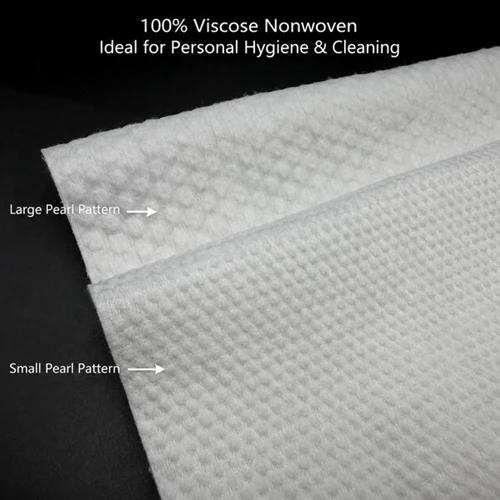
The final hand feel depends on more than fiber type. GSM, embossing, fiber fineness, and bonding conditions can all change whether the fabric feels smooth, bulky, firm, or cushioned.
3. Useful Wet Strength
Wet strength is particularly important for wipes.
When a nonwoven becomes saturated, its structure can weaken. Lyocell can contribute useful fiber strength, while the overall hydroentangled structure helps hold the web together.
The actual wet strength must still be measured on the finished fabric rather than assumed from the fiber name.
4. Flexible Fabric Design
One advantage of fiber blending is the ability to create different combinations of properties.
A manufacturer can adjust the Bamboo/Lyocell ratio and fabric construction according to whether the product needs to be:
- soft and drapable
- absorbent and bulky
- stronger for wiping
- lightweight and economical
- textured for cleaning
This flexibility is particularly useful for customized nonwoven products.

Bamboo Lyocell vs 100% Bamboo or 100% Lyocell
A blended fabric is not automatically better than a single-fiber fabric. Its advantage is balance and customization.
|
Material |
Main Advantage |
Potential Limitation |
|
Bamboo-rich blend |
Softness and cellulose-based absorbency |
May require formulation control for strength |
|
Lyocell-rich blend |
Strength, softness and moisture management |
May have a higher material cost |
|
100% Bamboo |
Strong plant-derived material positioning |
Performance depends heavily on fiber type |
|
100% Lyocell |
Consistent regenerated cellulose properties |
May not provide the same formulation flexibility |
The right material depends on the performance target rather than on choosing the material with the most appealing name.
Why Is Bamboo Lyocell Suitable for Spunlace Nonwovens?
Bamboo and Lyocell fibers can be used in spunlace production because the fibers can be formed into a web and mechanically entangled with high-pressure water jets.
During hydroentanglement, individual fibers become physically interlocked, producing a nonwoven structure without relying entirely on chemical binders.
The final properties are affected by:
Fiber blend → Web formation → Hydroentanglement → Fabric structure → Finishing → Final performance
This explains why two Bamboo Lyocell fabrics from different manufacturers can have noticeably different softness, strength, thickness, and absorbency even when their fiber composition appears similar.
Where Is Bamboo Lyocell Nonwoven Fabric Used?
The blend can be considered for applications where softness, absorbency, flexibility, and cellulose-based fiber content are important.
Personal Care
Potential applications include facial wipes, personal care wipes, baby-related products, and other soft-touch nonwovens.
Household Cleaning
Bamboo Lyocell blends can be used for cleaning wipes where absorbency and a soft but functional wiping surface are required.
Hygiene Products
The combination of cellulose-based fibers can be useful in absorbent disposable products, subject to the specific performance and regulatory requirements of the application.
Sustainable-Oriented Product Development
For manufacturers trying to reduce reliance on conventional synthetic fibers, Bamboo/Lyocell blends can be considered as part of a broader material-selection strategy.
What Should Buyers Check Before Purchasing Bamboo Lyocell Fabric?
A product specification should go beyond the words "Bamboo Lyocell."
At minimum, buyers should confirm:
Fiber Composition
Ask for the exact Bamboo/Lyocell percentage rather than a general material description.
Basis Weight
GSM affects thickness, absorbency, bulk, strength, and cost.
Fiber Specifications
Fiber length and fineness can influence web formation, softness, and mechanical performance.
Absorbency
Request actual test data where absorbency is important to the application.
Wet and Dry Strength
Especially important for cleaning wipes and products that will be handled when wet.
Surface Structure
Embossing, texture, and fabric construction influence both wiping efficiency and user perception.
Finished Product Composition
Check whether the final product contains binders, coatings, synthetic reinforcement fibers, or other components that may affect biodegradability claims.
What Buyers Often Miss About Bamboo Lyocell
The biggest mistake is treating the fiber name as a complete description of the material.
Three fabrics can all be marketed as Bamboo Lyocell but deliver different results because of differences in fiber ratio, GSM, web structure, bonding energy, and finishing.
Another common mistake is assuming that a higher proportion of one fiber automatically produces a better fabric. In reality, increasing one component can improve one property while reducing another.
For example, a formulation optimized for maximum softness may not be the best choice when high wet strength is required.
Therefore, the correct approach is to start with the application requirement, then determine the fiber blend and fabric construction.
Frequently Asked Questions
Is Bamboo Lyocell one type of fiber?
No. In blended nonwoven applications, Bamboo Lyocell refers to a fabric made by combining Bamboo fiber and Lyocell fiber according to a specified ratio.
Is Bamboo Lyocell the same as Lyocell?
No. Lyocell is one component of the blend, while Bamboo is the other fiber component.
Is Bamboo Lyocell better than 100% Lyocell?
Not necessarily. A blend is useful when the manufacturer wants to balance different properties for a specific application.
Is Bamboo Lyocell suitable for wipes?
Yes. Its cellulose-based fiber composition, softness, absorbency, and flexibility can make it suitable for various wipe applications when the fabric is engineered correctly.
Does a higher Bamboo content always mean better absorbency?
No. Absorbency depends on fiber characteristics and the finished fabric structure, including GSM, porosity, thickness, and bonding.
Is Bamboo Lyocell biodegradable?
A Bamboo/Lyocell fabric made entirely from appropriate cellulose-based fibers can be biodegradable, but the biodegradability of the finished product depends on its complete composition and processing.