What Happens at 240°C: Polymer Physics Behind Meltblown Fiber Formation
In meltblown nonwoven production, fiber formation is governed by a narrow process window rather than a single operating parameter. Temperature, airflow, polymer rheology, and solidification behavior interact continuously from die exit to web formation. Small deviations in this sequence can result in significant changes in fiber diameter, pore structure, and filtration performance.
Understanding the physics behind meltblown fiber formation is essential for producing filtration media that balance efficiency, pressure drop, and mechanical stability at scale.
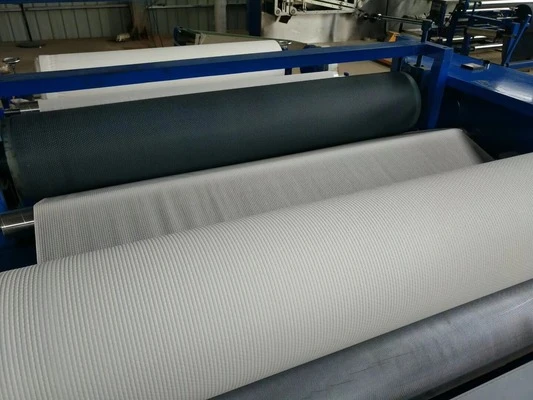
Melt Temperature, Viscosity, and Process Stability
The meltblown process begins with precise control of polymer melt temperature and viscosity. Polypropylene is widely used due to its stable thermal behavior, predictable melt flow characteristics, and suitability for high-rate fiber attenuation.
An operating temperature around 240 °C is commonly applied because it provides sufficient melt fluidity for fiber stretching while maintaining enough melt strength to prevent filament breakup. At this temperature range, the polymer can be attenuated into fine fibers under hot air without excessive degradation or instability.
Melt flow behavior and molecular weight distribution directly influence process stability. Polymers with overly low viscosity may stretch excessively and lose continuity, while overly viscous melts resist attenuation and produce coarser fibers. Maintaining a controlled viscosity window is therefore critical for consistent fiber formation.
Thermal history after extrusion further affects fiber properties. As fibers cool and crystallize, stiffness increases and inter-fiber bonding behavior evolves. These transitions determine web integrity, dimensional stability, and resistance to deformation under airflow during filtration use.
Fiber Diameter as a Structural Control Parameter
Fiber diameter is a primary determinant of meltblown filtration performance. Finer fibers increase specific surface area and reduce pore size, improving particle capture efficiency, particularly for sub-micron aerosols.
Standard meltblown processes typically generate fibers in the micron range. With optimized polymer rheology, air attenuation, and thermal control, fiber diameters can be reduced toward the sub-micron range. This shift significantly alters pore structure and airflow behavior within the web.
However, fiber fineness alone does not define performance. Excessively small fibers can increase pressure drop and reduce web durability if bonding and entanglement are insufficient. Effective meltblown design requires balancing fiber diameter with porosity, fiber distribution, and bonding strength across the web.
Role of Hot Air in Fiber Attenuation
Hot air plays an active role in shaping meltblown fibers rather than simply transporting them to the collector. Air temperature and velocity determine how rapidly the molten filament is stretched and thinned after leaving the die.
Higher air velocities generally promote finer fibers, but excessive turbulence can broaden diameter distribution and reduce uniformity. Stable air flow is therefore as important as air strength. Uniform attenuation leads to more consistent fiber diameters and predictable pore structures.
The die-to-collector distance controls the available time for attenuation and cooling. Longer distances allow extended fiber thinning but may reduce inter-fiber bonding if solidification occurs too late. Shorter distances improve cohesion but can limit attenuation. Optimal spacing is determined by the interaction between air temperature, polymer viscosity, and cooling rate.

Die Design and Fiber Uniformity
Die design directly affects fiber formation and web structure. Air slot geometry, flow convergence, and internal channel design influence how uniformly hot air interacts with the polymer stream.
Optimized dies maintain effective air velocity and temperature further below the die face, extending the attenuation zone without introducing excessive turbulence. This supports finer and more uniform fiber formation while preserving process stability.
Die configuration also influences fiber orientation and entanglement on the collector. These factors affect porosity distribution, pressure drop, and mechanical integrity of the finished nonwoven. As a result, die design is a critical engineering variable rather than a fixed component in meltblown production.
Material Selection and Functional Enhancement
While polypropylene remains the dominant meltblown material, modified formulations, blends, and bicomponent structures are increasingly explored to adjust melt behavior, crystallization kinetics, and mechanical performance.
Functional enhancements such as electret charging further extend filtration capability. By introducing electrostatic attraction, charged meltblown fibers capture fine particles more effectively without relying solely on physical interception. This approach improves filtration efficiency while maintaining acceptable airflow resistance, particularly in high-performance filtration media.
From Process Physics to Industrial Manufacturing
In industrial production, meltblown performance is achieved through coordinated control rather than optimization of a single parameter. Polymer selection, melt temperature, throughput, air pressure, die geometry, and cooling distance must operate within a defined process window.
Stable fiber diameter, controlled porosity, and consistent bonding determine whether a meltblown nonwoven performs reliably under real airflow conditions. When these variables are properly managed, the resulting material combines high filtration efficiency with mechanical stability and predictable pressure drop.
At scale, successful meltblown manufacturing is defined by repeatability. The underlying physics remain constant, but disciplined process control determines whether those principles translate into consistent, high-quality nonwoven filtration media.