What Are Food Contact Surfaces? How to Clean Them in a Commercial Kitchen
A food contact surface is any surface that food touches during preparation, cooking, storage or service, and also any surface that food can drip, splash or drain onto before it reaches the plate. Cutting boards, knives, slicers, prep tables, mixing bowls and storage containers all qualify. So do the hands and gloves of the people handling the food.
In a commercial kitchen, these surfaces need a two-stage routine: clean first to remove soil, then sanitize to reduce microorganisms to a safe level. Skipping or reversing those stages is the most common reason a surface that looks clean is not safe.
This guide explains what counts as a food contact surface, how to clean and sanitize each type, how often to do it, and what to check when you buy wiping cloths and wipes for this job.
What Counts as a Food Contact Surface?
Food safety rules generally split kitchen surfaces into two groups.
|
Group |
What it means |
Examples |
|
Direct food contact |
Food touches the surface |
Cutting boards, knives, slicer blades, mixing bowls, pans, tongs, food storage containers, prep counters, serving trays |
|
Indirect food contact |
Food can drip, splash or drain onto the surface, or the surface touches something that touches food |
Equipment handles and controls, shelves above open food, the inside of a prep refrigerator, the outer edge of a container, sink basins used for food |
|
Non-food-contact |
Food does not normally touch it |
Floors, walls, ceilings, the outside of cabinets, trash bins |
The second group is where kitchens most often slip. Handles, dials and shelf edges are touched constantly, then touched again by hands that go back to the food.
Hands and gloves also act as food contact surfaces. Cleaning a board perfectly does not help if the next person who handles the food has not washed their hands or has changed tasks without changing gloves.
A quick test for any surface
Ask three questions:
- Does food touch it during normal work?
- Can food splash, drip or drain onto it?
- Does it touch something in the first two groups, such as a hand, glove or cloth?
If the answer to any of these is yes, treat it as a food contact surface.
Why These Surfaces Cause Most of the Risk
Food safety problems in kitchens often come from cross-contamination, where microorganisms move from one food or surface to another. The most typical case is raw meat on a board that is then used for a ready-to-eat item such as salad or cooked food.
Several things make a surface harder to keep safe:
- Porous or damaged materials. Wood, scratched plastic and cracked containers hold residue in tiny grooves where a quick wipe cannot reach.
- Hard-to-reach design. Seams, corners, gaskets and slicer guards trap soil.
- Wet conditions. Standing water and damp cloths support microbial growth.
- Dirty cleaning tools. A cloth that has been used on several surfaces carries soil and microorganisms from one place to the next.
That last point is often overlooked. The wiping cloth is itself in contact with food surfaces, so it deserves the same attention as the surface it cleans.
How to Clean and Sanitize Food Contact Surfaces
The order matters. Sanitizers work poorly on a surface that still carries food residue, so cleaning always comes first.
Step 1: Remove loose soil
Scrape, brush or wipe off visible food debris. Disassemble equipment such as slicers and mixers where the manufacturer allows it, so that hidden surfaces can be reached.
Step 2: Wash
Use warm water and a detergent suitable for food areas. Apply friction with a brush, scrubber or cloth. The goal is to physically remove grease and soil, not just move it around.
Step 3: Rinse
Rinse away the detergent. Leftover detergent can interfere with some sanitizers, so check the sanitizer label.
Step 4: Sanitize
Apply a sanitizer approved for food contact surfaces in your market, at the concentration the label specifies. Test the concentration with the correct test strips if the product uses a diluted solution. Keep the surface wet for the full contact time stated on the label.
Step 5: Dry
Let the surface air dry where possible. Drying with a used towel can undo the work by transferring microorganisms back onto the surface.
A note on wipes that "do both"
Some products are marketed as combining cleaning and sanitizing in one step. Whether a particular product can legally and effectively do that depends on its formula and the registration or approval it carries in your country. Always read the label for the claims, the contact time and the surfaces it is approved for. A wipe that has no sanitizer on it cleans but does not sanitize.

How Often Should Food Contact Surfaces Be Cleaned?
Cleaning should be tied to events, not only to the clock.
|
When |
Why |
|
Before starting work |
Surfaces may have been contaminated overnight |
|
After each task or each use |
Prevents buildup and carry-over between tasks |
|
Between different food types, especially raw to ready-to-eat |
Prevents cross-contamination |
|
Any time contamination may have occurred |
After spills, drops, or contact with raw food |
|
At set intervals during continuous use |
Many food codes set a maximum interval, commonly four hours for items in constant use, so check the code that applies to you |
|
At the end of the shift |
Leaves a clean start for the next shift |
Use timers and checklists rather than judging by eye. A surface can look clean and still carry microorganisms.
Common Mistakes in Commercial Kitchens
Sanitizing before cleaning. Residue shields microorganisms from the sanitizer.
Wiping the sanitizer off too early. The surface needs to stay wet for the full contact time.
Wrong concentration. Too weak is ineffective. Too strong can leave residue and damage surfaces.
One cloth for everything. A cloth moved from the raw prep station to the salad station spreads contamination.
Leaving cloths in unchanged solution. Sanitizer in a bucket weakens as it gets dirty, so the solution needs checking and changing.
Ignoring indirect surfaces. Handles, dials and shelf edges get touched and then touch food again.
Keeping damaged equipment. Cracked boards and scratched containers cannot be cleaned properly.
No records. Without a checklist or a log, there is nothing to show an inspector or an auditor.
Choosing Cleaning Tools: Cloths, Wipes and Towels
The surface is only as clean as the tool that touches it. Kitchens generally choose between three options.
|
Option |
Strengths |
Watch out for |
|
Reusable cloths |
Lower cost per use |
Must be laundered and kept in sanitizer between uses. Easy to cross-contaminate |
|
Single-use wipes or cloths |
No carry-over from one task to the next, no laundering |
Cost per use, and waste that should be handled properly |
|
Paper towels |
Convenient |
Often shed lint and tear when wet. Not designed for scrubbing |
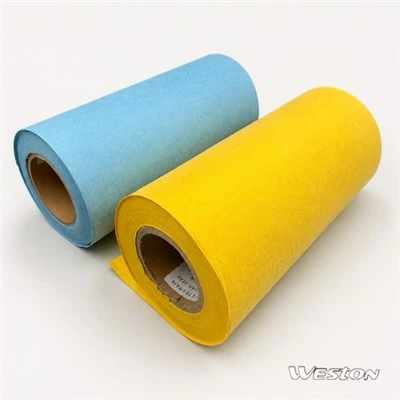
Many kitchens use a mix: single-use cloths for high-risk tasks such as raw meat stations, and reusable cloths in sanitizer for general wiping. Color coding, for example one color for raw food areas and another for ready-to-eat areas, helps staff stay consistent.
What to Check When Buying Wipes for Food Areas
For importers, distributors and kitchen-supply brands, "food safe" is not a label to accept at face value. A material that is suitable for one setting may not be suitable for another, and the wipe itself touches surfaces that touch food. These are the points buyers most often need answered.
1. What is the material?
Ask for the exact fiber composition and fabric type. Spunlace nonwovens are made by entangling fibers with water jets rather than with glues, which is one reason they are widely used for wipes. A blend of viscose and polyester is common because viscose absorbs liquid and polyester adds strength. Confirm the blend ratio rather than relying on a general description.
2. Does it leave lint or fibers behind?
Lint on a prep surface is a foreign-matter risk. Ask whether the supplier tests for lint or loose fibers, and how.
3. Are there residues from the manufacturing process?
Ask whether the fabric is free of added fluorescent whitening agents, and whether the supplier tests for transferable fluorescence, which indicates whether such agents can move onto a surface or onto skin. This is a basic check that is easy to request and easy to document.
4. How well does it hold up when wet?
Wet strength and absorbency affect whether a wipe tears while scrubbing grease or leaves fragments behind. Ask for test results rather than a general statement. A good supplier can give you the test method and the result.
5. What size, weight and format do you need?
Basis weight in grams per square meter, sheet size, and supply format all change how a wipe performs and what it costs.
|
Option |
What to confirm |
|
Basis weight (gsm) |
Heavier is generally sturdier but costs more per sheet |
|
Sheet size |
Large enough for tabletops, small enough to fold and use cleanly |
|
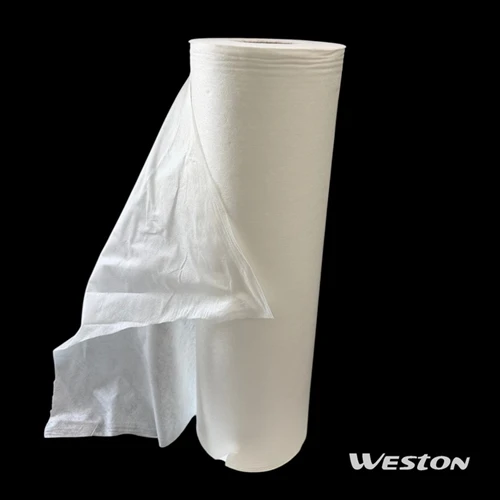
Supply format |
Pre-cut sheets, perforated rolls, jumbo rolls, folded packs |
|
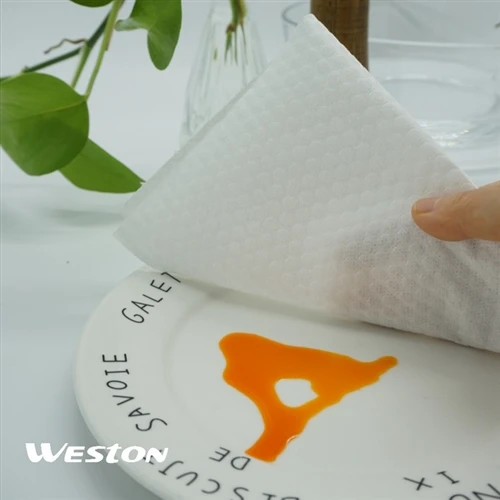
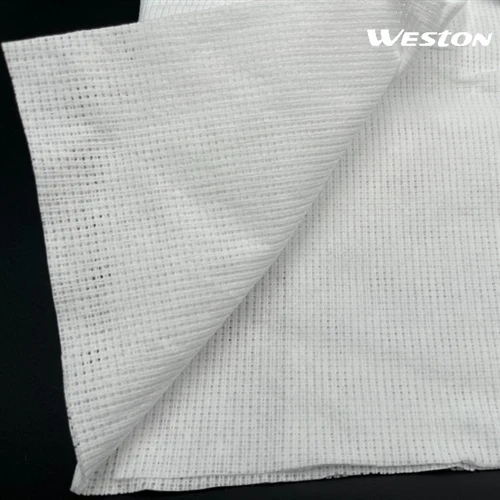
Surface pattern |
Embossing can improve scrubbing and grip |
|
Dry or pre-moistened |
Dry wipes can be used with your own approved sanitizer. Pre-moistened wipes carry the formula's claims and labelling requirements |
6. Does it work with your sanitizer?
A wipe or cloth is a carrier. Whether it works well with a particular sanitizer depends on the fabric and the sanitizer chemistry. Some sanitizers can interact with fibers or be absorbed by them, which can lower the concentration that reaches the surface. If you plan to pair a dry wipe with a specific sanitizer, ask the supplier whether compatibility has been tested, or run your own test.
7. What documentation is available?
Buyers commonly ask for:
- A product test report for the batch or the product type
- A material specification sheet
- Safety data sheets for any pre-moistened product
- Declarations or certificates required for food contact materials in your destination market
- Quality system certificates for the factory
Documentation requirements differ by country, so ask what the supplier can provide and compare it with what your market requires. Do not assume that a certificate issued for one product covers another.
8. Can it be customized?
Private label and OEM buyers often need their own size, embossing, color, count per pack, and packaging artwork. Ask what the minimum order quantity is for each option and how long samples take.
9. How is it packed and shipped?
Packaging affects hygiene and shelf life. Ask about pack format, carton specification, palletization and container loading.
A simple supplier checklist
- Fiber composition confirmed in writing
- Lint and fluorescence test results available
- Wet strength and absorbency test results available
- Sheet size, gsm and format meet your use
- Sanitizer compatibility tested or testable
- Documentation matches your destination market
- Sample approved before bulk order
- Customization and MOQ confirmed
If you are comparing suppliers, many kitchen-supply buyers start with a short list of food safe wipes and ask each supplier the questions above before ordering samples.
Wiping Cloths in a HACCP Plan
Under a HACCP approach, kitchens assess every item that can touch food or food surfaces, including the cleaning tools. Cloths, wipes and sponges belong on that list, alongside equipment and utensils.
Good practice includes:
- Approving cleaning tools before use, based on where they will be used and what evidence the supplier provides
- Keeping supplier documents on file
- Reviewing the approval when the material, the supplier or the process changes
- Replacing worn tools, since a fraying cloth or a worn scrubber can shed fibers
- Training staff on which tool is used for which area
Verifying That Surfaces Are Actually Clean
Visual inspection is a start but not a guarantee. Many kitchens add checks such as:
- ATP swabs, which give a quick reading of organic residue
- Sanitizer test strips, to confirm the solution concentration
- Visual inspection checklists, signed off per shift
- Periodic microbiological swabs, where the program calls for them
Record the results. Records show trends, help find weak points, and give you evidence during inspections.
Frequently Asked Questions
Q: What are food contact surfaces in simple terms?
A: Any surface that food touches, or that food can drip or splash onto, during preparation, cooking, storage or service. Hands and gloves count too.
Q: Is a kitchen counter a food contact surface?
A: Yes, if food is placed or prepared on it, or can splash onto it. It needs to be cleaned and sanitized as one.
What is the difference between cleaning and sanitizing? Cleaning removes visible soil, grease and residue. Sanitizing reduces microorganisms on the clean surface to a safe level. Both steps are needed, in that order.
Q: Can I use a regular wipe on food contact surfaces?
A: Only if it is suitable for the setting. Check the material, whether it leaves lint, and, for pre-moistened products, the label's stated uses. A wipe that does not carry a sanitizer will clean but will not sanitize.
Q: Do I need to rinse after sanitizing?
A: It depends on the sanitizer. Some are labelled as no-rinse for food contact surfaces, and others require rinsing. Follow the product label.
Q: How often should I replace wiping cloths?
A: Reusable cloths should be changed or laundered regularly and whenever they are visibly soiled or have touched raw food. Single-use wipes are discarded after use.
Conclusion
Food contact surfaces include far more than cutting boards: handles, shelves, containers, hands and the cleaning cloths themselves all play a part. The routine is simple to state: clean, rinse, sanitize, dry, and repeat at the right moments. It is harder to keep consistent, which is why tools, records and training matter.
For buyers sourcing wiping cloths, the same discipline applies to the supplier. Ask for specifications, tests and documents in writing before you commit.
Weston is a nonwoven and wipes factory that can produce disposable food service wipes in custom sizes, embossing patterns, formats and packaging for OEM and private label orders. Contact us with your requirements to discuss samples and specifications.