What Are Wood Pulp Polyester Industrial Wipes?
Wood pulp polyester industrial wipes are spunlace nonwoven wipes made by combining absorbent wood pulp fibers with durable polyester fibers. The wood pulp provides liquid absorption and pickup, while polyester contributes wet strength, dimensional stability, and resistance to tearing during wiping.
This combination makes wood pulp polyester a practical material for industrial cleaning, machinery maintenance, workshops, manufacturing facilities, and other applications where a wipe needs to absorb liquids but remain intact during use.
For buyers, however, the fiber combination alone does not determine wipe performance. Fiber ratio, basis weight, web structure, hydroentanglement, surface pattern, finishing, and converting method can all affect how the finished wipe behaves in real applications.
That is why two wipes described as "wood pulp polyester" may perform quite differently.
What Is Wood Pulp Polyester Nonwoven?
Wood pulp polyester nonwoven is a hybrid fiber material that combines a natural cellulose fiber with a synthetic fiber.
Wood pulp
Wood pulp is a cellulose-based fiber with a naturally hydrophilic structure. It contributes primarily to:
- Fast liquid pickup
- High absorbency
- Good retention of water-based liquids
- Soft hand feel
- Efficient pickup of oils and general contamination
The amount and distribution of wood pulp in the web directly influence the absorbent character of the material.
Polyester
Polyester is a synthetic fiber known for its strength, dimensional stability, and resistance to deformation.
In a wood pulp polyester wipe, polyester helps provide:
Better wet strength
Resistance to tearing during wiping
Improved structural stability
Greater durability during repeated strokes
Controlled lint performance when properly engineered
The purpose of combining the two fibers is therefore not simply to "mix two materials." It is to balance absorbency and durability in one nonwoven structure.

Why Are Wood Pulp and Polyester Combined?
Industrial wiping often requires two properties that are difficult to achieve with a single fiber.
A wipe may need to absorb oil or liquid quickly, but it must also withstand pressure, friction, pulling, folding, and contact with rough surfaces.
Pure cellulose-based materials can provide excellent absorbency, but their wet strength may not be sufficient for demanding wiping tasks.
Pure polyester, on the other hand, provides strong synthetic fiber performance but does not offer the same natural liquid absorption characteristics as wood pulp.
The hybrid structure addresses this trade-off.
Wood pulp contributes absorbency; polyester contributes strength and structural stability.
The actual performance depends on how these fibers are distributed and bonded within the nonwoven web.
This is an important distinction for industrial buyers: fiber composition is the starting point, not the complete specification.
How Are Wood Pulp Polyester Industrial Wipes Made?
Most industrial wood pulp polyester wipes are produced using a spunlace, or hydroentanglement, process.
1. Fiber preparation
The wood pulp and polyester components are prepared according to the required material specification.
The fiber selection and ratio can be adjusted according to the intended application. A wipe designed primarily for liquid absorption does not necessarily require the same structure as one designed for heavy-duty wiping or higher surface friction.
2. Web formation
The prepared fibers are formed into a controlled web.
At this stage, uniform fiber distribution is important because variations in the web can later appear as differences in:
- Thickness
- Basis weight
- Absorbency
- Strength
- Surface appearance
- Wipe-to-wipe consistency
3. Hydroentanglement
High-pressure water jets mechanically entangle the fibers.
Unlike adhesive-bonded nonwovens, hydroentanglement uses water jets to interlock the fibers and create the nonwoven structure.
The hydroentanglement conditions affect the final balance between softness, strength, surface structure, and fiber retention.
For industrial wiping materials, this consistency is particularly important because buyers normally need the same wiping behavior from one production batch to another.
4. Drying and finishing
After hydroentanglement, the material is dried and may undergo additional finishing processes.
Depending on the product specification, manufacturers can provide different:
- Basis weights
- Widths
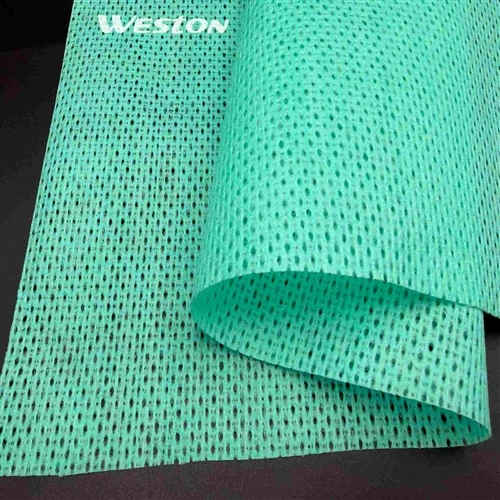
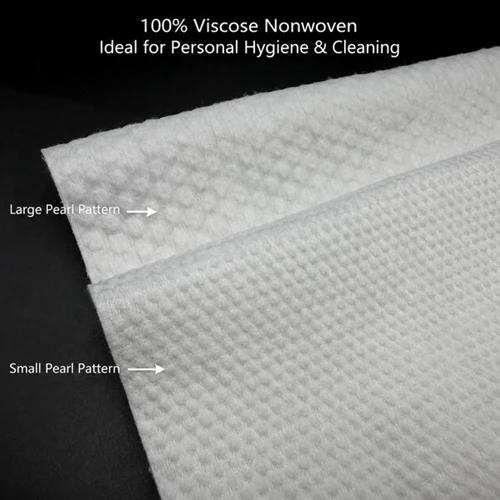
- Surface patterns
- Embossing structures
- Roll formats
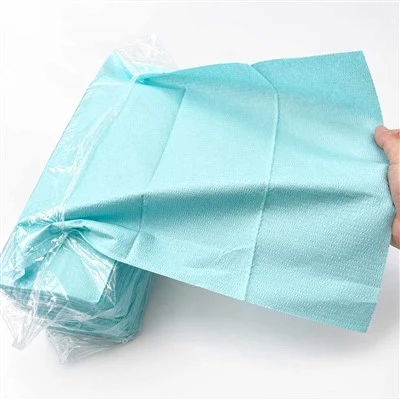
- Sheet sizes
- Folding configurations
- Finishing treatments
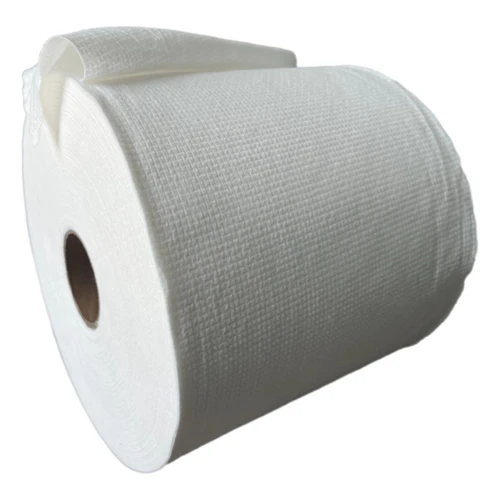
The finished jumbo roll can then be converted into industrial wipes or supplied directly as wiping substrate.
What Performance Properties Matter Most?
When purchasing wood pulp polyester industrial wipes, looking only at the fiber composition is not enough.
A more useful evaluation starts with the following properties.
Absorbency
Absorbency determines how effectively the wipe picks up water, oil, cleaning solutions, and other liquids.
Wood pulp generally increases the absorbent component of the material, but absorbency is also affected by basis weight, pore structure, fiber distribution, and processing.
For this reason, buyers should request actual absorbency data under defined test conditions rather than comparing products only by fiber percentage.
Wet strength
Industrial wipes are frequently used wet or saturated.
A wipe with insufficient wet strength may tear, deform, or leave fragments behind when the operator applies pressure.
Polyester helps maintain the structure of the wipe after wetting, making the material suitable for applications where both absorption and mechanical durability are required.
Lint and particle release
For industrial cleaning, lint can be as important as absorbency.
Loose fibers can become undesirable contamination on machinery, painted surfaces, optical components, electronic parts, or other sensitive surfaces.
Lint performance should therefore be evaluated under a defined test method and application condition.
A manufacturer should avoid simply describing a material as "lint-free" unless the claim is supported by an appropriate test standard and test conditions.
Basis weight
Basis weight, normally expressed as GSM, affects the amount of material available for absorption and the physical feel of the wipe.
Higher GSM does not automatically mean better performance.
A heavier wipe may provide greater capacity and durability, while a lighter material may be more economical for routine wiping and high-volume applications.
The correct GSM depends on the task.
Surface structure
Surface pattern can significantly influence wiping behavior.
A plain surface may be appropriate where smooth wiping and low surface disturbance are important.
Embossed or textured surfaces can increase contact with contamination and provide additional mechanical cleaning action.
For grease, dried residue, or heavily contaminated surfaces, surface structure can therefore be an important specification alongside fiber composition.
Wood Pulp Polyester vs. Other Industrial Wipe Materials
There is no single wipe material that is best for every industrial application. The correct choice depends on what the wipe must absorb, how much mechanical force it must withstand, and how sensitive the cleaned surface is.
|
Material |
Main Advantage |
Typical Limitation |
|
Wood pulp polyester |
Balanced absorbency and strength |
Not necessarily the best choice for every specialized environment |
|
Wood pulp PP |
High absorbency with good wiping strength |
Performance depends strongly on formulation and structure |
|
100% polyester |
High synthetic strength and controlled structure |
Lower inherent absorbency than cellulose-rich materials |
|
100% viscose |
High absorbency and softness |
Wet strength and dimensional stability may limit some heavy-duty uses |
|
Cotton rag |
Reusable and familiar |
Variable construction, lint, and inconsistent quality |
|
Paper towel |
Low-cost routine wiping |
Limited wet strength and durability |
The important point is that industrial wipe selection should be based on the required performance rather than simply choosing the strongest or most absorbent material.
When Is Wood Pulp Polyester a Good Choice?
Wood pulp polyester is particularly useful when a wiping task requires a combination of absorption and mechanical durability.
Machinery and equipment maintenance
Maintenance teams often need to remove oil, grease, coolant, water, and general workshop contamination.
A wood pulp polyester wipe can provide rapid liquid pickup while retaining enough strength for wiping around machinery components.
Automotive and mechanical workshops
Automotive maintenance involves oils, lubricants, grease, dirt, and metal residues.
For these applications, the wipe needs to absorb contamination while resisting tearing during repeated wiping.
Surface embossing can also be used where additional mechanical cleaning is required.
Manufacturing facilities
Production environments often need consistent wiping materials for routine equipment cleaning, workstation maintenance, and spill control.
Here, consistency between batches can be just as important as the basic absorbency of the wipe.
Commercial and food-service cleaning
Cellulose-rich wiping materials can provide useful liquid absorption for general surface cleaning and spill pickup.
However, the finished wipe must always be selected according to the specific hygiene, food-contact, chemical, and disposal requirements of the application.
Electronics and sensitive manufacturing
Wood pulp polyester can also be engineered for applications where particle control or static control is important.
In these cases, buyers should not assume that a standard wood pulp polyester wipe automatically qualifies as a cleanroom or ESD wiping product.
The complete material specification and relevant test data should be reviewed for the intended environment.

Why Can Two Wood Pulp Polyester Wipes Perform Differently?
This is one of the most important questions for industrial buyers.
Two suppliers may both offer a "wood pulp polyester wipe," but the finished products can behave differently because of differences in:
Fiber ratio
The relative proportion of wood pulp and polyester affects the balance between absorbency and strength.
Fiber characteristics
Fiber length, fineness, and physical characteristics influence web formation and final structure.
Web formation
A uniform fiber distribution can contribute to more consistent thickness and wiping behavior.
Hydroentanglement conditions
Water pressure, energy input, and processing conditions affect how the fibers become mechanically entangled.
GSM and thickness
A 60 GSM wipe and a 120 GSM wipe should not be expected to behave identically, even if their fiber ratios are similar.
Surface pattern
Embossing and texturing can change how the wipe contacts a contaminated surface.
Finishing and converting
Slitting, cutting, folding, perforation, and other converting processes can affect the finished product's usability.
This is why professional procurement should evaluate the complete technical specification rather than the material name alone.
What Should Buyers Ask a Manufacturer Before Ordering?
For bulk industrial wipe purchasing, the following questions can help prevent mismatched specifications.
1. What is the exact fiber composition?
Ask for the wood pulp/polyester ratio rather than accepting only the description "wood pulp polyester."
2. What is the basis weight?
Confirm the GSM and acceptable production tolerance.
3. What absorbency data is available?
Ask how absorbency was measured and under what test conditions.
4. What wet-strength performance can be provided?
This is particularly important for oil wiping, machinery maintenance, and wet cleaning.
5. What is the lint or particle performance?
If the wipe will be used on sensitive equipment, ask for relevant test data instead of relying on general "low-lint" claims.
6. Can the surface pattern be customized?
Different wiping applications may benefit from plain, striped, or embossed structures.
7. Can the material be supplied as jumbo rolls?
For converters and wet-wipe manufacturers, purchasing the spunlace substrate in roll form may be more practical than buying finished wipes.
8. Can the manufacturer produce finished wipes?
This matters when the buyer wants a complete OEM solution rather than only raw material.
How Weston Nonwoven Approaches Wood Pulp Polyester Industrial Wipes
At Weston Nonwoven, wood pulp polyester wiping material is produced as part of the company's spunlace nonwoven manufacturing capability.
The focus is not simply on producing a material with a particular fiber name. The material needs to be matched to the buyer's required combination of absorbency, strength, surface structure, basis weight, lint performance, format, and end use.
This allows buyers to discuss the specification at the substrate level before moving to finished-wipe production.
Depending on the project, Weston can support requirements involving:
- Wood pulp/polyester spunlace substrates
- Customized GSM
- Different surface patterns
- Jumbo roll supply
- Sheet and folded wipe converting
- Industrial oil and grease wiping applications
- OEM and private-label production
- Customized dimensions and packaging
This production model is particularly useful for buyers who need to develop a wipe rather than simply purchase an off-the-shelf product.
A Practical Way to Choose the Right Wood Pulp Polyester Wipe
Instead of starting with the question "What GSM should I buy?", industrial buyers can work backward from the actual cleaning task:
What contamination needs to be removed?
Oil, water, grease, solvent residue, dust, particulate, or general dirt can require different material characteristics.
How much mechanical force will be applied?
Light surface wiping and aggressive workshop cleaning have very different strength requirements.
Will the wipe be used dry, damp, or saturated?
Wet use makes wet-strength performance much more important.
Does lint or particle release matter?
If the wipe will contact sensitive equipment, painted surfaces, electronics, or controlled manufacturing areas, relevant particle and lint data should be reviewed.
Is surface texture important?
A textured or embossed wipe may provide more mechanical contact for demanding cleaning tasks.
Do you need the substrate or a ready-to-use wipe?
Converters may prefer jumbo rolls, while distributors and end users may need folded or rolled finished wipes.
This approach gives buyers a more useful specification than simply requesting "wood pulp polyester wipes."
Frequently Asked Questions
Are wood pulp polyester wipes biodegradable?
The answer depends on the complete material composition and the disposal environment. Because polyester is a synthetic fiber, a wood pulp polyester wipe should not automatically be described as biodegradable simply because it contains wood pulp.
Are wood pulp polyester wipes suitable for oil?
They can be suitable for oil and grease wiping because the wood pulp component provides liquid pickup while polyester helps maintain wipe integrity. The actual suitability should be confirmed through application testing, particularly for heavy oil loads or aggressive wiping.
Are wood pulp polyester wipes low lint?
They can be engineered for low-lint performance, but "low lint" should be supported by test data under defined conditions. Lint performance can vary with fiber selection, web formation, hydroentanglement, converting, and use conditions.
What GSM is best for industrial wipes?
There is no universal best GSM. Lower GSM materials may be suitable for routine wiping and high-volume use, while higher GSM materials can provide greater material capacity and durability. The appropriate GSM should be selected according to the contamination, wiping force, absorbency requirement, and target cost structure.
Can wood pulp polyester be used as a wet-wipe substrate?
Yes. Wood pulp polyester spunlace can be developed for certain wet-wipe applications, but the suitability depends on the required lotion compatibility, wet strength, absorbency, converting process, packaging format, and end-use requirements.
Can I buy wood pulp polyester spunlace in jumbo rolls?
Yes. Spunlace manufacturers can supply the substrate in jumbo-roll format for downstream converting. Roll width, GSM, surface pattern, perforation, and other specifications can be discussed according to the converter's equipment and finished-product requirements.
Is wood pulp polyester stronger than wood pulp PP?
Neither material is universally "stronger" in every test condition. Wood pulp polyester and wood pulp PP can be engineered with different fiber ratios and web structures. Buyers should compare actual tensile strength, wet strength, absorbency, lint, and application performance rather than selecting solely by fiber name.
What information should I send a manufacturer for a custom industrial wipe?
A useful inquiry should include the intended application, contamination type, required wipe size, target GSM, preferred surface pattern, dry or wet use, required packaging, estimated annual volume, and whether you need jumbo-roll substrate or finished wipes.
For a new OEM project, providing an existing sample or technical specification can make material matching and development much more precise.