Redefining Hygiene and Sustainability: The Scientific Breakthrough of Plant-Based Wipes
For decades, the wipe in your hand was a simple trade-off: convenience now, consequence later. Polyester and polypropylene fibers gave wipes their strength and softness, but they also gave landfills and sewer systems a problem that would outlive the product's five-second use by centuries. That trade-off is now being rewritten - not by marketing departments, but by fiber engineers.
The global wipes market is on track to grow from $5.48 billion in 2026 to $9.20 billion by 2034, but the real story is inside that number: the biodegradable segment is expanding even faster, from $2.8 billion in 2025 to a projected $5.6 billion by 2035, at a 7% compound annual growth rate. This is no longer a niche for eco-conscious early adopters. It is a structural reorientation of an entire industry's raw material base - and it raises a question most coverage of "plant-based wipes" never actually answers: biodegradable how, exactly, and at what cost to performance?
The Environmental Reckoning: Why the Old Fiber Model Is Collapsing
The pressure did not originate in a lab. It originated in wastewater treatment plants and coastlines. Conventional synthetic-fiber wipes - engineered for tensile strength, not end-of-life breakdown - have become a well-documented source of sewer blockages and marine microplastic pollution. Regulators have responded accordingly. Northern Ireland's DAERA introduced new rules in November 2025 banning the sale and supply of wet wipes containing plastic. The UK's broader Plastic Wipes Ban takes effect in May 2027. The EU's Single-Use Plastics Directive continues to tighten formulation requirements across the bloc, while several U.S. states have moved on wipe composition independently of federal action.
What is striking is how consumer sentiment has moved in parallel with regulation rather than lagging behind it. Over 30% of consumers globally now state an explicit preference for sustainable wipe formats - a preference that has already reshaped retail shelf space in Western Europe, where demand for plastic-free, plant-based wipes is strongest in Germany, the UK, and France. Sustainability, in other words, has stopped being a claim on packaging and become a specification in the purchase order.
The Performance Argument Nobody Makes Loudly Enough
Here is where most articles on this topic stop - at the environmental case - as though sustainability were the entire value proposition. That framing undersells what is actually happening in product development labs. The more interesting claim, and the one with real commercial teeth, is this: plant-based substrates are outperforming synthetic ones on skin, not just on soil.
Formulators are increasingly pairing biodegradable fiber substrates with biotechnology-derived actives - hyaluronic acid, ceramides, plant-fermented extracts - precisely because natural cellulosic fibers hold and release these actives more gently than synthetic ones. Fragrance-free, quat-free, pH-balanced formulations are gaining ground fastest in the categories where skin sensitivity is non-negotiable: baby care and feminine hygiene. The market has already priced this in. Premium biodegradable baby wipes now command a 20–35% retail premium over conventional synthetic-fiber wipes - not despite their plant-based composition, but because of it. Consumers are not paying more to feel virtuous. They are paying more because they perceive - correctly, the formulation science suggests - a gentler product.
The Engineering Problem the Industry Doesn't Like to Simplify
This is the argument this piece wants to put on the table: "biodegradable wipe" is not one technical achievement. It is at least two, and they solve different problems using different fiber chemistry, different process engineering, and different certification pathways. Conflating them - as most consumer-facing content does - obscures the actual R&D difficulty involved, and undersells how much precision fiber science now goes into a product most people use once and throw away.
Path One: Engineering for Dispersal, Not Just Decay
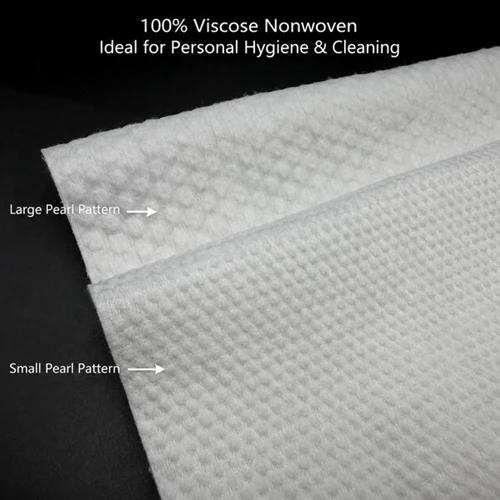
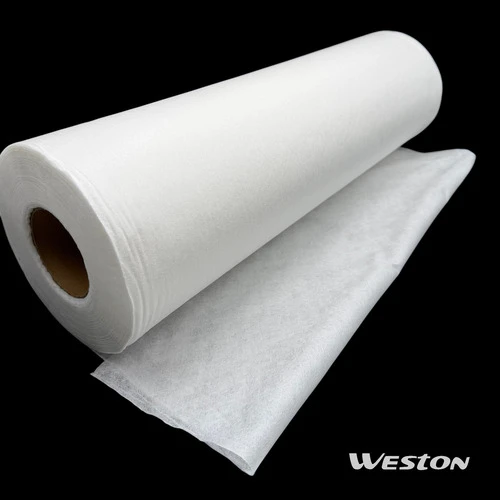
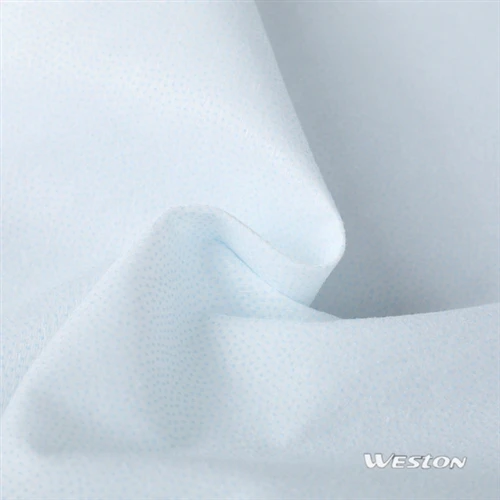
The first path solves for what happens immediately after use: can the fabric safely enter the sewer system without causing a blockage? This is the domain of flushable spunlace nonwoven fabric, built through hydroentanglement - a process where high-pressure water jets interlock short-cut wood pulp and viscose fibers without adhesives or heat bonding. The engineering challenge here is a genuine paradox: the fabric must be strong enough to survive being wet, stretched, and used, yet structurally engineered to lose that integrity within minutes of contact with moving water. Manufacturers tune this balance through fiber length control and pulp-to-viscose ratio - industry practice commonly favors blends around 75:25 pulp-to-viscose for flushable grades, versus roughly 50:50 for standard, non-flushable wipes. Get the ratio wrong in either direction and you either get a wipe that falls apart mid-use, or one that survives the toilet and clogs the pipe it was designed to avoid.
Path Two: Engineering for Full Biodegradation, Not Dispersal
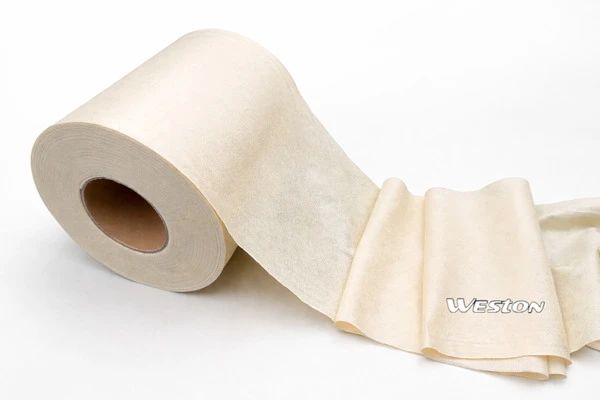
The second path is not concerned with the sewer at all. It solves for a different endpoint: can the fabric return fully to soil or compost, with no microplastic residue, regardless of how it's disposed of? This is where plant-extracted fiber substrates - bamboo, cotton, and regenerated cellulosics such as lyocell - do their work, engineered for complete breakdown rather than rapid dispersal. This path unlocks a different certification stack entirely: OEKO-TEX Standard 100 for harmful-substance testing, GOTS for organic cotton sourcing, FSC for responsible fiber chains, and OK Biobased for verified bio-content. It is the path retail dry and wet wipes are increasingly built on, where the design priority is compostability rather than flushability.
These are not interchangeable solutions to the same problem - they are different problems wearing the same marketing label. A manufacturer chasing flushability with a fiber blend optimized for soil biodegradation will produce a wipe that clogs pipes. A manufacturer chasing full compostability with a blend optimized for rapid water dispersal will produce a wipe that degrades too early on the shelf. Solving for both, in parallel, across a single production platform, is the real R&D frontier in this category.
It is a frontier that spunlace nonwoven manufacturers like Weston have approached by treating fiber selection as a design variable rather than a fixed input - running both engineering paths side by side rather than committing a single production line to one philosophy. On the dispersal side, that has meant continued refinement of wood pulp-viscose blends for flushable-grade fabric. On the full-biodegradation side, it has meant expanding into substrates purpose-built for soil breakdown and certification: Lyocell and Bamboo Fiber Spunlace for a soft, closed-loop cellulosic option; Pulp Lyocell Spunlace as a wood-pulp-based alternative aimed at absorbency without synthetic content; and Unbleached 100% Cotton for brands prioritizing minimal processing and chemical-residue-free claims. Parallel exploration extends further into fiber types still gaining commercial traction - bamboo and bamboo charcoal for their natural antibacterial properties, PLA for compostable synthetic-alternative strength, 100% viscose for cost-effective softness, and emerging entrants like seaweed-derived (alginate) fiber and hemp fiber, both being evaluated for their low-input cultivation and inherent biodegradability. The point is not any single fiber. The point is that a fabric platform capable of moving fluidly between "engineered to disperse" and "engineered to decompose" is what separates genuine sustainable innovation from a single reformulated SKU.

The Trust Gap Nobody Has Closed
None of this matters commercially if the consumer can't tell the difference - and right now, most can't. "Flushable," "biodegradable," and "compostable" are routinely used interchangeably in retail marketing, despite referring to distinct testing standards (EN13432, ASTM D6400, GD4/INDA dispersibility guidelines) and, critically, distinct disposal instructions. This is not a minor labeling nuance. A fully compostable wipe flushed down a toilet fails exactly the way a non-biodegradable one does - it just takes slightly longer to cause the blockage. Closing this education gap is arguably as important to environmental outcomes as the fiber science itself; the most advanced substrate in the world still ends up in the wrong waste stream if the label doesn't tell the consumer where it belongs.
The Real Competitive Battleground
The broader biodegradable wipes category is forecast to nearly double, from $6.8 billion in 2025 to $13.4 billion by 2034. That growth will not be won by whoever claims "plant-based" loudest. It will be won by manufacturers who understand - and can execute against - the fact that dispersibility engineering and full-biodegradation engineering are two distinct disciplines, each with its own fiber chemistry, process controls, and certification logic, and who can deploy the right one against the right product application rather than defaulting to a one-size-fits-all green claim.
The next time you reach for a wipe, the label will tell you it's sustainable. What it won't tell you is which of two very different engineering problems its fibers were built to solve - and that, increasingly, is where the real innovation in this category is happening: not on the package, but inside the weave.