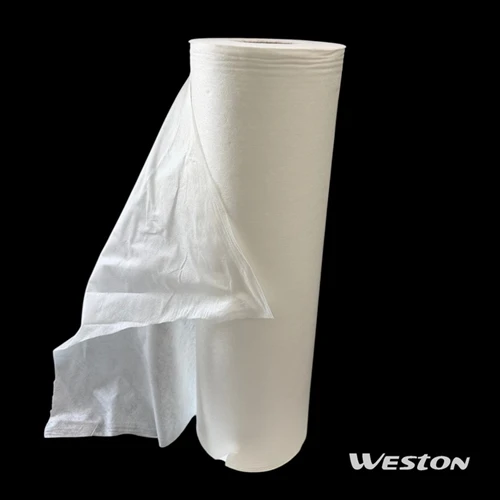
Is Spunlace Biodegradable? What Wipe Buyers Must Verify Before Specifying "Eco" Fabric
Spunlace is a manufacturing process, not a material, so it is biodegradable only if every fiber in the fabric is. Spunlace made from 100% viscose, lyocell, cotton or wood pulp is biodegradable and, with proper certification, compostable. Spunlace containing PET, PP or other synthetic fibers is not, however the product is labeled. For buyers, the useful question is not "is it biodegradable?" but "under which test, in which environment, on which finished product?"
Key takeaways
- Fiber composition decides the answer. The spunlace process does not.
- A credible claim needs a named test and a named environment.
- Verify the finished wipe, not only the fabric roll.
- "Flushable" is a separate claim with separate tests.

Which spunlace fabrics are biodegradable, and which only look green
Spunlace (also called hydroentangled nonwoven) bonds fibers with high-pressure water jets instead of chemical binders or heat. That is why it can run on 100% natural or cellulosic fibers and still deliver good strength, which is a big reason it has become the standard fabric for wipes. Industry analysts at Smithers put spunlace at 12.7% of global nonwovens volume in 2023, with a forecast of 14% by 2028.
Because the process is neutral, everything depends on what goes into the card or the wet-laid line.
Fiber-by-fiber verdict
|
Fiber in the spunlace |
Biodegradable? |
Compostable? |
Suited to flushable use? |
Typical use |
|
Viscose (rayon) |
Yes |
Yes, with certification |
Limited, depends on design |
Baby, facial, household |
|
Lyocell |
Yes |
Yes, with certification |
Possible in pulp-rich designs |
Premium baby, facial, beauty |
|
Cotton |
Yes |
Yes |
Not typically |
Cosmetic, medical-adjacent |
|
Wood pulp (wet-laid spunlace) |
Yes |
Yes |
Yes, in dispersible designs |
Flushable and household |
|
Bamboo viscose |
Yes (it is viscose) |
Yes, with certification |
Limited |
Personal care |
|
PLA |
Industrial compost only, in general |
Industrial only |
No |
Niche eco lines |
|
PET |
No |
No |
No |
Durable and industrial wipes |
|
PP |
No |
No |
No |
Hydrophobic and industrial |
|
Viscose/PET blend |
No |
No |
No |
Low-cost "eco-look" wipes |
The blend problem: how 30% polyester breaks a 100% claim
The most common problem in "eco" spunlace is the blend. A fabric that is 70% viscose and 30% PET behaves well and costs less, but it is not biodegradable. The cellulose breaks down and the polyester remains as fragments. Wording such as "partly biodegradable," "up to 100% natural" or "eco-friendly blend" usually points to this. If your product claims biodegradability, the fiber declaration should read 100% cellulosic or another fully biodegradable fiber.
Why "bamboo spunlace" is usually just viscose
Bamboo wipes are widely marketed as a different category. In practice, bamboo fibers used in wipes are normally regenerated cellulose, which means bamboo viscose, and turning bamboo into a usable substrate needs significant chemical processing. It biodegrades like other viscose. Its sustainability profile depends on the fiber producer's chemistry and sourcing, not the plant name. Ask for the fiber origin and for FSC or PEFC chain-of-custody documents.
Beyond fiber: dyes, printing, wetting agents and lotions
Spunlace has an advantage over chemically bonded nonwovens because it needs no binder. The finished wipe still adds other components: the lotion, preservatives, fragrance, dyes or printing, and the packaging. Each can affect a biodegradability or compostability claim, which is why the next section matters.
"Biodegradable," "compostable," "flushable," "plastic-free": four claims, four proofs
These words are often used as if they were interchangeable. They are not, and they are tested differently.
|
Claim |
What it means |
Typical standard or test |
Who usually needs it |
|
Biodegradable |
Microbes convert the material to CO₂, water and biomass in a defined environment |
ISO 14855 (composting), ISO 14851/14852 (aqueous), ISO 17556 (soil) |
Brands making environmental claims |
|
Compostable (industrial) |
Disintegrates and biodegrades in industrial composting within set limits |
EN 13432, ASTM D6400 |
EU and US brands, retailers |
|
Compostable (home) |
Same idea at lower temperatures and longer timeframes |
OK compost HOME (TÜV Austria / Vinçotte) |
Consumer brands |
|
Biodegradable in soil or water |
Biodegradation in soil, freshwater or marine conditions |
OK biodegradable SOIL, WATER, MARINE |
Outdoor and travel products |
|
Flushable |
Clears toilet and drain lines, disintegrates, settles, does not harm sewer systems |
IWSFG PAS 1–3, INDA/EDANA GD4 |
Flushable wipe brands |
|
Plastic-free |
No synthetic polymer in the product |
Fiber declaration, lab fiber analysis |
EU and UK-facing brands |
Under EN 13432, a product must disintegrate within 12 weeks and reach 90% biodegradation within six months under composting conditions. Biodegradation tests do not by themselves prove flushability, and a flushable pass does not by itself prove compostability.
Why a fabric test report does not automatically cover your finished wipe
A test report on the base fabric is a good start, but the claim you print on a pack applies to the finished product. Lotion chemistry, additives, colorants and the pack format can all change test outcomes, and certification marks are often tied to a specific product or composition. If you sell a wet wipe, make sure the report or certificate covers the wipe as sold, or that the supplier can support the extension of the claim in writing.
Regulations buyers should check now
Rules on wipes and environmental claims are changing quickly. Before you print a claim, review the current position in each market:
EU: the single-use plastics rules require specific marking on wet wipes that contain plastic. EU Directive 2024/825 on environmental claims also restricts generic claims that are not specified or substantiated, and terms such as "biodegradable" can fall into that area. It applies from September 2026.
UK: the UK has moved to restrict wet wipes containing plastic. Confirm the current legal status before you ship.
US: several states have flushable-labeling laws that affect how you can market and label wipes.
This is general information, not legal advice. Check with your legal or regulatory team.
Biodegradable where? Landfill, compost, sewer, soil, water
Where wipes actually end up
Most used wipes go to landfill or incineration, and a smaller share ends up in compost or in sewers. A lab result showing biodegradation under industrial composting conditions does not describe what happens in a landfill. When you write a claim, name the environment it was tested for.
What "decomposes in weeks" really means
Figures such as "breaks down in a few weeks" come from controlled tests with set temperature, moisture and microbial activity. They are useful for comparing materials, but they are not a promise about a backyard pile or a river. Home composting is slower than industrial composting, and soil or marine conditions differ again.
Do not market an end-of-life route your customer cannot provide
If a wipe is only certified for industrial composting, do not suggest consumers can toss it in a garden bin. If it is not flushable-certified, do not imply it can go down the toilet. Over-claiming creates legal and reputational risk for the brand, and it is the most common avoidable mistake we see in wipe projects.

Performance trade-offs that "eco" brochures leave out
Wet strength, lint and absorbency compared with PET-rich spunlace
Cellulosic fibers absorb well and feel soft, but they are weaker when wet than polyester. The usual levers for closing that gap inside a fully biodegradable fiber set are basis weight, fiber length, entanglement energy, and surface pattern. In a switch from a PET-blend to 100% viscose or lyocell, plan for a short trial to retune gsm and pattern.
Choosing gsm and pattern by application
|
Application |
Typical gsm range |
Pattern |
Wet strength priority |
Lint sensitivity |
|
Baby wipes |
40–60 |
Plain or fine pearl |
High |
Medium |
|
Facial and beauty salon wipes |
35–60 |
Plain, fine mesh |
Medium |
High |
|
Household wipes |
45–70 |
Mesh, embossed |
High |
Medium |
|
Kitchen wipes |
50–80 |
Mesh, embossed |
High |
Low |
|
Industrial wipes |
60–100 |
Embossed |
Very high |
Low |
|
Disinfectant wipes |
45–70 |
Mesh, plain |
High |
Medium |
These are typical starting points, not fixed rules. Final specs depend on lotion, pack format and the converting line.
Disinfectant wipes: why cellulose can reduce active-ingredient availability
Cellulosic fibers can adsorb cationic actives such as quaternary ammonium compounds, which may lower the amount of active available at the surface. Formulators deal with this through dosing, fiber choice and validation testing. If you plan a disinfectant wipe on a biodegradable substrate, include efficacy testing on the actual combination early.
Lotion, preservative and pH compatibility
Fiber choice interacts with preservative systems, pH and alcohol content. Test the lotion on the substrate for stability, release, odor and skin compatibility before scaling.
Runnability on converting lines
Wet strength, static, stiffness and roll hardness all affect folding, cutting and stacking speeds. Share your line type and speed with us at the start so we can match the fabric to it.
Viscose, lyocell, cotton and pulp: cost and sourcing
Compare cost per 1,000 wipes, not price per kg
A heavier but cheaper fabric can cost more per wipe than a lighter, stronger one. Calculate cost on a per-wipe basis, using gsm and wipe size, and include yield loss on the converting line. A small gsm reduction made possible by better entanglement or fiber choice often outweighs a small price difference per kilogram.
Forest sourcing and chemistry
For cellulosic fibers, ask for evidence of responsible sourcing: FSC or PEFC chain of custody, and information on the fiber producer's chemical management and closed-loop processes (lyocell typically uses a closed-loop solvent system). Ask for documents, not just logos.
Price volatility, lead times and MOQ
Cellulosic fiber prices move with pulp markets, and lyocell usually carries a premium over viscose. Agree on pricing mechanisms, planning horizons and minimum order quantities early, especially for specialty fibers.
How to verify a supplier's biodegradable claim: buyer checklist
Documents to request in an RFQ
Fiber composition declaration, by weight percent.
Third-party test reports showing scope, standard used and sample identification.
Certificate numbers you can check in the issuer's public registry.
REACH and SVHC statements.
Batch certificate of analysis.
Traceability information from fiber to roll.
Red-flag phrases in supplier copy
"Eco-friendly" with no standard named.
"Degradable" rather than "biodegradable."
"Up to 100% biodegradable" or "partly biodegradable."
"Bamboo" with no fiber origin.
Certificates with no number, date or scope.
Incoming-inspection checks
Quantitative fiber analysis (ISO 1833), microscopy or FTIR can confirm that the fabric matches its declaration. A simple burn test can screen out obvious synthetic content, but it is only a screen. None of these replace certification.
How Weston Nonwoven makes biodegradable spunlace
Weston Nonwoven is a spunlace factory that supplies roll goods for wipes. We work with buyers to match fiber, weight and pattern to the end use, and to support the claims they plan to make. Our environmentally focused spunlace range includes:
Viscose spunlace for baby, household and personal care wipes, available in plain, mesh and embossed patterns.
100% lyocell spunlace for premium wipes where softness, wet strength and a closed-loop fiber story matter.
Cotton and cotton-blend spunlace for cosmetic and facial applications.
For projects built around a distinctive cellulosic fiber, we develop Seaweed Fiber Lyocell Nonwoven Fabric, which uses a lyocell fiber that incorporates seaweed in its cellulose. It is still a cellulosic fabric, so we ask for the fiber producer's biodegradability documentation for the exact fiber grade and confirm it before any claim is made.
For flushable and dispersible projects, we offer a Woodpulp Lyocell Flushable Wipes Substrate that combines wood pulp with lyocell in a wet-laid and hydroentangled structure. Flushability has to be proven on the finished wipe, so we support customers with testing against IWSFG or GD4 methods rather than claiming a pass in advance.
Whatever fiber you choose, we provide a fiber composition declaration and supporting test documents on request, and we are open about where a particular claim needs finished-product testing.
Custom development and sampling
Tell us your application, target gsm, pattern, lotion type and converting line. We propose a fiber set and structure, supply samples for lab and line trials, and adjust specs based on your results.
When our biodegradable spunlace is not the right choice
If your product needs very high wet strength, aggressive disinfectant compatibility or a very low price point, a synthetic or blended fabric may fit better. We will say so. A fully biodegradable claim is only worth making if the product performs.
FAQ
Q: Is spunlace nonwoven fabric biodegradable?
A: Only if all its fibers are. Spunlace from 100% viscose, lyocell, cotton or wood pulp is biodegradable. Spunlace with PET, PP or other synthetics is not.
Q: Is viscose spunlace compostable at home?
A: It can be, if the specific fiber and product carry a home-compost certification such as OK compost HOME. Without certification, do not assume it.
Q: Is polypropylene or PET spunlace biodegradable?
A: No. PP and PET are synthetic polymers that do not biodegrade in normal composting, soil or water conditions.
Q: Can spunlace wipes be flushed?
A: Only products designed and tested for flushability should be flushed, and testing is done on the finished wipe against standards such as IWSFG PAS 1–3 or GD4. Most spunlace wipes are not flushable.
Q: How long does a spunlace wipe take to break down?
A: It depends on the fiber and the environment. Under EN 13432 industrial composting, the benchmark is disintegration within 12 weeks and 90% biodegradation within six months. Home, soil and landfill conditions are slower or different.
Q: Is bamboo spunlace better than viscose?
A: Bamboo spunlace is generally bamboo viscose, so it biodegrades like other viscose. Its environmental profile depends on the fiber producer's chemistry and sourcing.
Q: What is the difference between spunlace and spunbond?
A: Spunlace bonds staple fibers with water jets and gives a soft, cloth-like fabric. Spunbond extrudes continuous polymer filaments and bonds them with heat, typically giving a stiffer, plastic-based fabric.
Q: Is PLA spunlace a good alternative?
A: PLA is bio-based and can be industrially compostable, but it generally does not biodegrade in home compost, soil or water conditions, so it is not a drop-in replacement for cellulosic fibers.