Many of the items we use daily-from supermarket shopping bags and household water pipes to fruit protective covers-are related to HDPE. Yet, when people touch soft HDPE products, a common question arises: Is this material plastic or rubber? To answer this correctly, we can't rely on surface traits like "softness" or "elasticity." Instead, we need to dive into deeper dimensions: molecular structure, physical properties, and processing methods.
Let's Start by Clarifying: Softness/Hardness Isn't the Key to Distinguishing Plastic from Rubber
A common misconception is that "hard materials are plastic, and soft ones are rubber." From a scientific perspective, the core difference between plastic and rubber lies in the "connection method" and "mobility" of their molecular chains.
First, consider the degree of cross-linking in molecular chains. Rubber molecules resemble a fishing net where each thread (molecular chain) is linked by numerous "hooks" (cross-link bonds). This structure allows rubber to stretch significantly-for example, a regular rubber band can stretch 3 to 5 times its original length without breaking and snap back instantly when released. This is called "high elastic recovery." In contrast, plastic molecular chains are mostly "linear" or "slightly branched," like a pile of unknotted ropes. While they can stack to form a certain hardness, there are far fewer "hooks" (cross-links) between the chains.
Next is the glass transition temperature (simply put, the temperature at which a material becomes brittle). Rubber has an extremely low glass transition temperature-ordinary rubber only turns brittle below -50°C, so it retains elasticity even in winter. Plastic, however, has a much higher glass transition temperature. For HDPE, temperatures below -40°C cause it to become brittle and prone to cracking.
Processing methods also differ drastically. Rubber requires "vulcanization" to become a finished product: heating creates more cross-link bonds between molecular chains, an irreversible process. Once vulcanized, rubber cannot be melted or reshaped. Most plastics (including HDPE) are thermoplastic: they melt when heated to a specific temperature, harden when cooled, and can be reshaped repeatedly. For instance, recycled HDPE shopping bags can be reprocessed into plastic buckets.
These three factors-molecular cross-linking degree, elastic recovery, and process reversibility-are the true keys to distinguishing plastic from rubber, not how soft or hard the material feels.
HDPE's "Identity Card": Why It's Plastic, from a Molecular Perspective
HDPE stands for "High-Density Polyethylene." To confirm its "plastic identity," we first look at its molecular structure.
HDPE has a typical linear molecular structure. Among the polyethylene family, HDPE has extremely low branching-its molecular chains are "straight" with few side branches. This straight-chain structure allows molecules to pack tightly, resulting in high crystallinity (usually 70%-90%). High crystallinity directly gives HDPE greater hardness and strength than ordinary plastics: for example, HDPE sheets of the same thickness can withstand more pressure without deforming than PP (polypropylene) sheets.
Compare this to rubber's molecular structure: rubbers (such as natural rubber or styrene-butadiene rubber) have highly branched molecular chains that require vulcanization to form numerous cross-links. No matter how HDPE is processed, stable cross-links never form between its molecular chains. Even when HDPE products (like thin HDPE cling film) feel soft, this is only due to their thinness and relatively loose molecular arrangement-their core remains a linear structure, completely different from rubber's cross-linked structure.
HDPE's processing method further confirms it is a thermoplastic plastic. To produce HDPE products, factories heat HDPE pellets to 130°C-180°C until they melt into a fluid, then shape them via extrusion, injection molding, or blow molding. For example, blow molding creates HDPE plastic bottles, while extrusion produces HDPE pipes. These processes are reversible: recycled HDPE waste can be reheated and reprocessed. Rubber, by contrast, must be shaped via vulcanization-once vulcanized, it cannot melt (only burn) when reheated, the exact opposite of HDPE's processing characteristics.
From molecular structure to processing methods, HDPE fully meets the scientific definition of plastic and shares no core traits with rubber.
A Common Confusion: HDPE Has "Elasticity," but It's Not the Same as Rubber's
Some might argue: "I've pulled thin HDPE bags-they stretch and shrink a little when released. Isn't that elasticity? Could it be rubber?" In reality, HDPE's "elasticity" is fundamentally different from rubber's "high elasticity."
HDPE's "elasticity" is essentially temporary molecular deformation. Since HDPE's molecular chains are linear (no cross-links to restrict them), pulling stretches the tightly packed molecules-like loosening a pile of ropes. Weak intermolecular forces (van der Waals forces) cause slight recovery when released, but the material never fully returns to its original length. For example, if you stretch an HDPE shopping bag by 10%, it may only shrink back 3%-5% when released; the remaining deformation becomes permanent (called "plastic deformation").
Rubber's high elasticity, however, comes from elastic recovery of cross-linked molecular chains. Cross-links between rubber molecules act like springs: pulling stretches the cross-links and molecular chains, but the cross-links' "tension" pulls the chains back to their original position instantly when released, with almost no plastic deformation. A rubber band stretched by 200%, for instance, snaps back to its original shape immediately-this is rubber's unique "high elastic recovery."
A simple test highlights this difference: Pull an HDPE product and a rubber product 10 times repeatedly. The HDPE product will loosen gradually (even develop cracks) after a few pulls. Rubber, as long as it doesn't exceed its breaking limit, will recover fully after each pull with no noticeable accumulated deformation. This is the essential distinction between their "elasticity."
HDPE Applications: From Daily Life to Agriculture, Leveraging Plastic's Strengths
Because HDPE is plastic-with high strength, chemical resistance, and recyclability-it has an extremely wide range of applications, from everyday items to industrial equipment and even agriculture.
In daily life, HDPE's high hardness and impact resistance are fully utilized: Household plastic buckets made of HDPE can hold dozens of kilograms of water without deforming; HDPE bathroom mats are waterproof and withstand frequent stepping without damage; HDPE pipes are lighter than metal pipes, resistant to acid and alkali corrosion, and can last for decades underground.
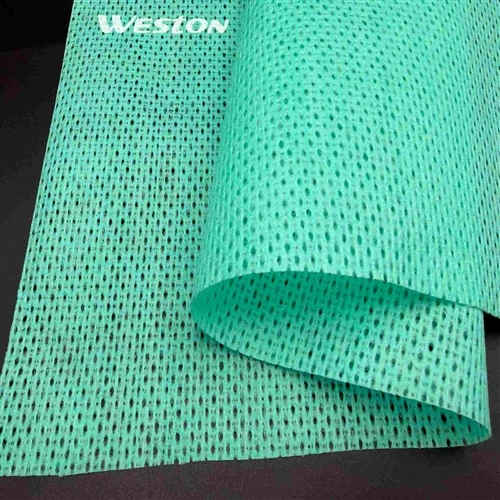
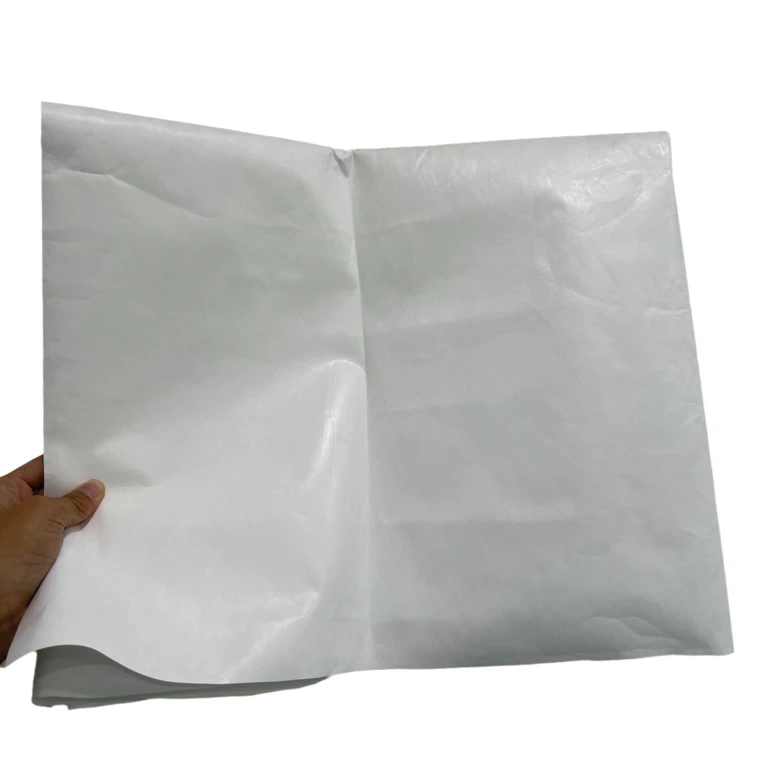
In agriculture, HDPE's weather resistance (resistance to sun, rain, and wind) and breathability become key advantages-creating opportunities for products from Weston Nonwoven. For example, the factory's Duprotex Flash-spun HDPE Nonwoven uses a special flash-spinning process. It retains HDPE plastic's anti-aging properties while adding fabric-like breathability. The Flash Spun Material For Fruit Bags made from this material covers fruit to block pests, wind, and rain, while still allowing sunlight to penetrate (critical for fruit ripening). The Color-Coded HDPE Nonwoven Fruit Covers adapt to different fruit growth needs: light-colored covers reflect sunlight (ideal for heat-sensitive fruits), while dark-colored ones absorb heat (suited for heat-loving crops). These products leverage HDPE plastic's strengths while avoiding the poor breathability of traditional plastic films-clever innovations in HDPE applications.
A Balanced View of HDPE: Pros and Cons as a Plastic
To understand HDPE fully, we must acknowledge both its advantages and limitations as a plastic.
Advantages:
High Strength + Light Weight: HDPE has a density of only 0.94-0.96g/cm³ (lighter than water) but a tensile strength of 20-30MPa-equivalent to withstanding 20-30kg of pressure per square centimeter. This makes it ideal for load-bearing parts that need to be lightweight.
Chemical Resistance: HDPE is immune to acids, alkalis, and salts. Even when immersed in hydrochloric acid or sodium hydroxide solutions, it does not corrode-explaining its use in chemical storage tanks and laboratory reagent bottles.
Good Recyclability: As a thermoplastic, HDPE retains most of its properties after recycling and can be reprocessed repeatedly. Many HDPE products now carry "recyclable" labels, aligning with environmental trends.
Relatively Good Low-Temperature Resistance (vs. Other Plastics): While HDPE becomes brittle below -40°C, it outperforms plastics like PVC (polyvinyl chloride) in low temperatures and remains usable in northern winters.
Limitations:
Poor High-Temperature Resistance: HDPE softens at around 110°C and melts above 120°C. It cannot hold boiling water or be heated in microwaves.
Brittleness in Low Temperatures: Uninsulated HDPE pipes in northern China's harsh winters may crack due to low-temperature brittleness.
Mediocre UV Aging Resistance: Long-term sun exposure causes HDPE to become brittle and fade. Outdoor HDPE products typically require UV stabilizers to extend their service life.

Compared to rubber, HDPE excels in strength, chemical resistance, and recyclability but lags in elasticity and temperature resistance (both high and low). Rubber, meanwhile, offers high elasticity and low-temperature resistance but is weaker, non-recyclable, and prone to chemical corrosion. Neither is "better"-they simply suit different scenarios: HDPE for high-strength, corrosion-resistant needs (e.g., pipes, chemical containers) and rubber for high-elasticity needs (e.g., seals, tires).
Understand Its "Identity" to Use HDPE Well
By now, it should be clear: HDPE is strictly plastic, not rubber. The key to distinguishing them lies in molecular cross-linking, elastic recovery, and processing methods-not softness or hardness. HDPE's linear molecular structure and reversible thermoplastic processing are entirely different from rubber's cross-linked structure and irreversible vulcanization.
It is precisely because HDPE is plastic that it delivers unique value in daily life, industry, and agriculture. Products like Weston Nonwoven's Duprotex Flash-spun HDPE Nonwoven and Flash Spun Material For Fruit Bags use HDPE plastic's weather resistance and breathability to solve real agricultural challenges. For more details on these HDPE products or to request free samples, contact info@westonmanufacturing.com.
Both plastic and rubber are materials born from human chemistry knowledge. When we understand their "identities" and properties, we can put them to work in the right places-that's the true value of learning about HDPE.