GSM Guide for Wood Pulp Spunlace Cleaning Fabrics: How to Choose Between 35gsm and 120gsm for Your Application
Weston Nonwoven · Technical Guide
One number - grams per square meter - decides whether your cleaning wipe holds up through a tough shift or falls apart on first contact with liquid. This guide walks you through what GSM actually means, how it behaves across the full weight range, and how to match the right fabric to your real-world task.
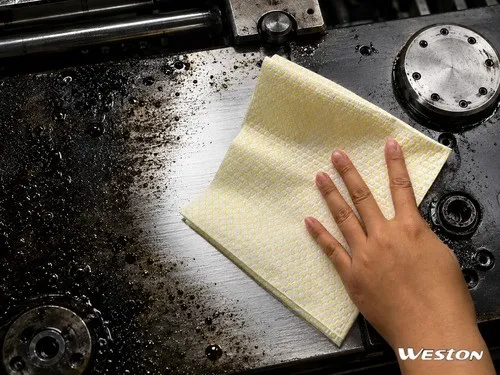
What Is GSM - and Why It's More Than a Weight Spec
GSM stands for grams per square meter. It's the most direct way to describe how much fiber is packed into a fabric - and for nonwovens, that single number has a surprising amount of downstream consequences.
Think of it this way: take a square piece of fabric exactly one meter on each side, put it on a kitchen scale, and read the number in grams. That's its GSM. A 35gsm fabric feels light, almost papery. A 120gsm fabric feels substantial - closer to a thick cotton washcloth.
But GSM doesn't just describe feel. In a spunlace nonwoven made from wood pulp, that number controls how much liquid the fabric can absorb, how well it holds together when wet, and whether it's worth using once or multiple times. Choosing the wrong weight doesn't just affect performance - it affects your cost-per-task, your waste output, and in some industries, your hygiene compliance.
Why Wood Pulp Spunlace Specifically?
Wood pulp fiber is naturally cellulosic - structurally similar to cotton, but sourced from processed wood. That means it's hydrophilic from the start: it attracts water rather than repelling it. When that fiber is entangled through the spunlace (hydroentanglement) process - using high-pressure water jets rather than chemical binders or heat - the result is a soft, strong, highly absorbent fabric that contains no synthetic additives.
Why this matters for GSM selection:
Because wood pulp fiber is inherently absorbent, a 40gsm wood pulp spunlace wipe will absorb significantly more liquid than a 40gsm polyester wipe of the same size. This means GSM benchmarks from synthetic nonwovens don't translate directly. You're working with a different material baseline - and that's largely an advantage, once you understand it.
The Science: How GSM Changes What a Fabric Can Do
More fiber per unit area means more of almost everything: more absorption capacity, more mechanical resistance, more surface contact during wiping. But it also means tradeoffs worth understanding.
Absorption Capacity vs Absorption Speed
Wood pulp spunlace fabrics can absorb between 3 to 8 times their own weight in liquid - with the specific multiplier tied directly to GSM. Lighter fabrics (30–45gsm) tend to fall in the 3–5× range. Heavier fabrics (80–120gsm) can reach 6–8× absorption capacity under controlled conditions.
A heavier fabric absorbs more total liquid, but it doesn't always absorb faster. A light, open-structured 40gsm fabric wicks liquid quickly across its surface. A dense 100gsm fabric holds more, but the tight fiber matrix can slow initial uptake.
Tensile Strength and Wet Durability
A fabric's dry strength and its wet strength are two different things - and for cleaning applications, wet strength is what actually matters. As GSM increases, the fiber-to-fiber entanglement in a spunlace fabric becomes denser, which directly improves wet tensile strength.
A 35gsm fabric under significant mechanical pressure while saturated with water or solvent can tear. A 90gsm+ fabric in the same conditions will hold its form and allow repeated passes.
"GSM doesn't just tell you how heavy the fabric is. It tells you how long it will last under the conditions that actually stress it."
Linting and Surface Sensitivity
Lint - loose fibers that transfer from the wipe to the surface - is a legitimate concern in electronics assembly, optics, automotive finishing, and cleanroom environments.
Counter-intuitively, heavier fabrics can shed more loosely bonded surface fiber than mid-weight fabrics, because the outer fiber layer has more material to release before the entangled core takes over. For sensitive surfaces, a well-processed 50–65gsm spunlace often performs better than a 100gsm fabric with poor bonding uniformity.
The Full Spectrum: 35gsm to 120gsm, Zone by Zone
30–45gsm - "The Sprinter"
Absorption: 3–5× own weight
Wet Strength: Low–moderate
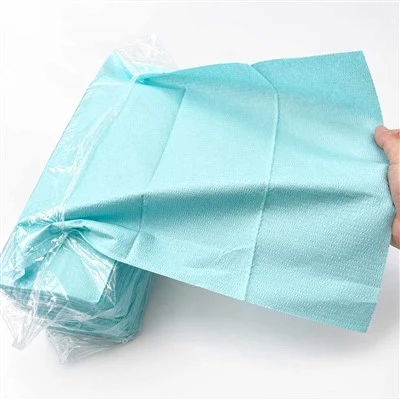
Best For: Light household wipes, facial wipes, disposable single-use applications
50–65gsm - "The All-Rounder"
Absorption: 4–6× own weight
Wet Strength: Moderate
Best For: Commercial kitchen wipes, janitorial use, general surface cleaning
70–90gsm - "The Workhorse"
Absorption: 5–7× own weight
Wet Strength: Good
Best For: Foodservice, industrial cleaning, Grease Absorbent Wipes for kitchen equipment
100–120gsm - "The Heavy Lifter"
Absorption: 6–8× own weight
Wet Strength: High
Best For: Automotive detailing, healthcare, Solvent Resistant Wipes Material, multi-pass industrial use
Note on absorption figures:
The 3–8× absorption range quoted above represents the measured capacity for Weston Nonwoven's wood pulp spunlace line under standard test conditions. Actual performance varies with fiber blend ratio, liquid type, and test method.
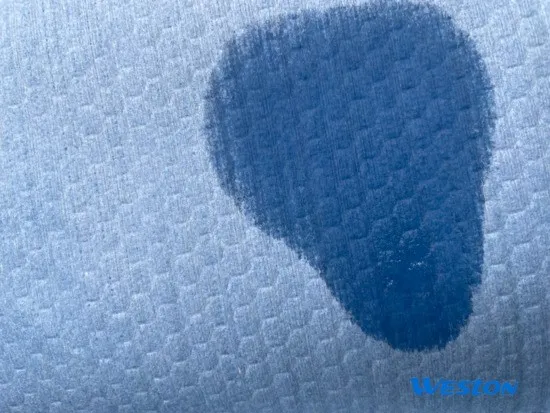
Match the Weight to the Job: Real Application Examples
Household and Light Commercial Cleaning (35–55gsm)
For countertop wipes, general surface cleaning, and single-use household products, the 35–55gsm range covers the vast majority of needs.
Food Processing and Commercial Kitchens (60–80gsm)
In professional food environments, wipes face grease, high temperatures, and repeated mechanical wiping. This is where Grease Absorbent Wipes in the 60–80gsm range earn their place.
Medical and Cleanroom Environments (70–100gsm)
Healthcare cleaning demands consistent wet strength, controlled lint release, and compatibility with disinfectants and cleaning agents.
Automotive and Industrial Applications (90–120gsm)
Automotive detailing, parts cleaning, and workshop maintenance involve contact with solvents, cutting fluids, and surface coatings that would dissolve or weaken a lighter fabric.
Baby Wipes and Personal Care (40–60gsm)
Softness and gentleness dominate the selection criteria here. At 40–55gsm, a well-processed wood pulp spunlace achieves an exceptionally soft hand feel with 3–4× absorption.
35gsm vs 120gsm: Head-to-Head Comparison
35gsm:
3–5× absorption
Fast initial wicking
Lower wet strength
Disposable single-use
Lower cost per sheet
Best for household and personal care
120gsm:
6–8× absorption
Higher wet strength
Multi-pass capable
Better solvent resistance
Higher cost per sheet
Best for industrial and healthcare use
The cost-per-use reality:
A 120gsm sheet may cost more per unit, but if it handles four passes through a task that would require four separate lighter wipes, the actual cost-per-clean task can be lower.
The Mistakes People Make When Buying by GSM Alone
Assuming Higher GSM Always Means Better Quality
It doesn't. The right GSM depends on the application.
Ignoring Fiber Blend Ratios
A 70gsm fabric made from 70% wood pulp / 30% polyester behaves differently from a 100% wood pulp fabric.
Overlooking Wet Tensile Strength Data
Two 50gsm fabrics from different manufacturers can have dramatically different wet tensile strength.
Buying by Touch, Not by Application Test
A fabric that feels soft in hand may not perform well under real cleaning conditions.
The blend ratio trap:
Some suppliers increase synthetic fiber content to hit a GSM target more cheaply, changing absorption and softness performance.
Buying Checklist: Three Questions Before You Specify a GSM
Q1: What surface am I cleaning, and how much liquid is involved?
Light liquid on smooth surfaces → 35–50gsm
Heavy grease or oil residue → 70–90gsm
Industrial solvent contact → 100–120gsm
Q2: Will this fabric be used once, or across multiple passes?
Single-use disposable → lighter GSM
Multi-pass or rinse-and-reuse → 80gsm+
Q3: What is my true cost per completed task?
Calculate cost based on actual usage efficiency, not just roll price.
Also ask your supplier for wet tensile strength data alongside GSM.
Weston Nonwoven: Factory Capabilities at a Glance
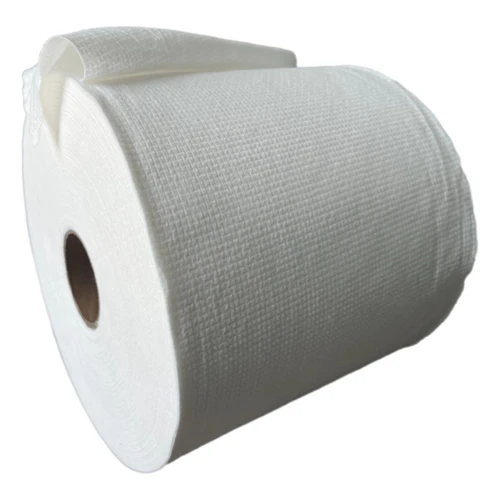
Machine Width: 3,500 mm
Fabric Width Range: 100 – 3,100 mm
Grammage Range: 30 – 120 gsm
Lapping Options: Parallel / Cross-lapped
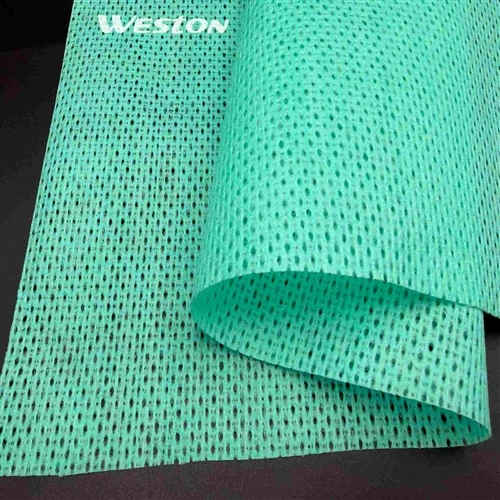
Color: Fully customizable
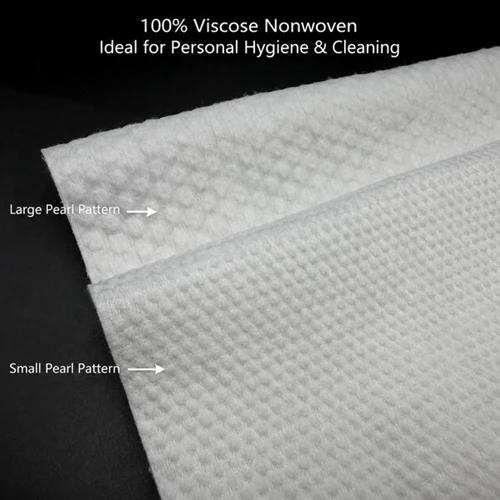
Embossing: Custom patterns available
Parallel vs Cross-Lapped
Parallel lapping produces higher strength in the machine direction.
Cross-lapped construction provides more balanced strength in multiple directions.
Embossing and Color
Custom embossing improves grip and liquid wicking. Color coding supports hygiene management in foodservice and healthcare environments.
Sampling recommendation:
Weston Nonwoven recommends application testing before volume production, especially for Grease Absorbent Wipes, Solvent Resistant Wipes Material, and High-Tensile Wood Pulp Fabric applications.
Closing: GSM Is a Starting Point, Not an Answer
GSM is the most useful single number for comparing nonwoven fabrics, but it only matters when matched to the right application.
A 40gsm wood pulp spunlace wipe in the correct environment can outperform a 100gsm fabric used in the wrong one.
The right GSM is the one that completes your task efficiently without unnecessary material waste or cost.
Wood pulp spunlace combines 3–8× absorption capacity, natural softness, and binder-free spunlace construction into a highly versatile cleaning material platform.