What Is Non-Woven Fabric Used For? 9 Industries, Real Examples & 2026 Trends
Non-woven fabric is everywhere, yet almost nobody notices it. It's the soft layer inside a diaper, the sterile wrap around a surgical tray, the filter behind a car's cabin vent, and the sheet mask on a bathroom shelf. Technically, it's any fabric-like material made by bonding fibers together with heat, chemicals, mechanical pressure, or high-pressure water jets, instead of weaving or knitting yarn first.
Here's the part most explainers skip: "non-woven" isn't a single material, it's a manufacturing category, and that distinction matters more than it sounds. A tissue-thin air filter and a face-mask sheet that feels like real cotton are both technically non-woven, made through very different processes. Melt-blown fabric is engineered for filtration, spunbond for strength at low cost, and spunlace, fibers entangled with fine water jets rather than glue or heat, for the softness and drape needed against skin. Which process a manufacturer chooses is really what decides which industry the fabric ends up in. That's the thread running through the nine categories below.
1. Personal Care, Hygiene & Beauty
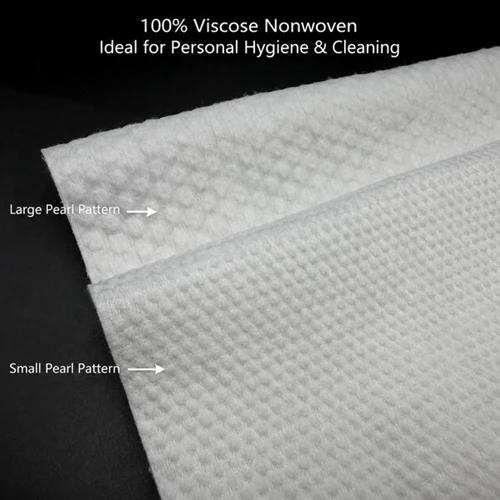
Diapers, sanitary pads, incontinence products, wet wipes, and cosmetic sheet masks all use non-woven top-sheets because they need to pull moisture away from skin fast while staying gentle on contact. Spunlace dominates this category for a simple reason: water-jet bonding leaves no adhesive residue against skin, which is part of why it now accounts for roughly 82% of Europe's wet wipes production. Some wood-pulp-viscose blends used in today's wipes absorb more than 13 times their own weight in liquid, an easy detail to overlook until you're the one buying the wipes.
2. Healthcare & Medical
Surgical gowns, drapes, face masks, and wound dressings need non-wovens engineered as barriers, not just fabrics. Layered spunbond-meltblown-spunbond (SMS) composites block fluid and bacteria while staying breathable enough to wear through a full shift. Because these products are single-use by design, non-woven construction also removes the cross-contamination risk that comes with laundering reusable cloth between patients. The same water-jet technology used in beauty wipes shows up in hospital wards too, in antibacterial-treated, rinse-free bathing gloves now rated above 99.9% bacterial reduction.

3. Household & Everyday Cleaning
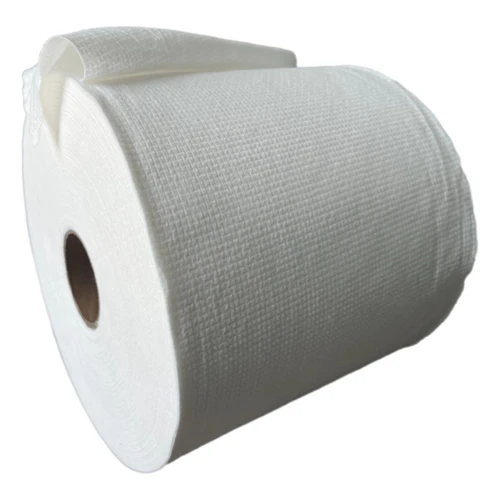
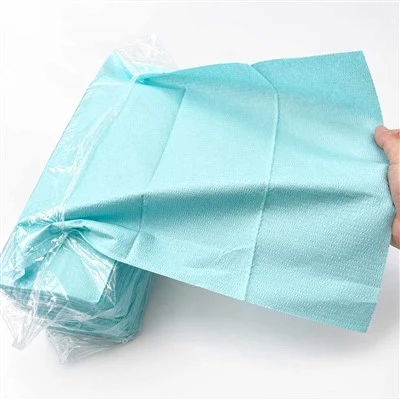
The disposable dusting cloths, kitchen wipes, and all-purpose rolls sold in any supermarket are usually cross-lapped spunlace or wood-pulp composites, chosen because they keep absorbing even when fully soaked, unlike paper towels. Manufacturers tune the fiber blend to the job: a soft viscose-polyester wipe for scratch-free glass and stainless steel, a heavier wood-pulp version where sheer capacity matters more, and a textured, embossed surface where the goal is lifting dust rather than soaking up liquid.
4. Food Processing & Foodservice
Commercial kitchens and food plants favor food-contact-safe wiping rolls and oil-absorbent cloths for one practical reason: non-wovens can be made lint-free and thrown away after one use, which matters more in a hygiene audit than any reusable rag could. Center-feed wiper rolls, in particular, have become a foodservice standard, since one roll replaces dozens of cloth towels and skips the laundering cycle reusable textiles require.
5. Precision Manufacturing & Electronics
Cleanrooms, SMT assembly lines, and printer maintenance all demand a fabric that leaves nothing behind, since a handful of stray fibers can short a circuit board or scratch a lens. Low-lint spunlace wipes made from continuous microfilament or pulp blends are built specifically to meet that bar, and are tested for particle release with roughly the same rigor used to test the electronics they're meant to clean.
6. Heavy-Duty Industrial Cleaning & Maintenance
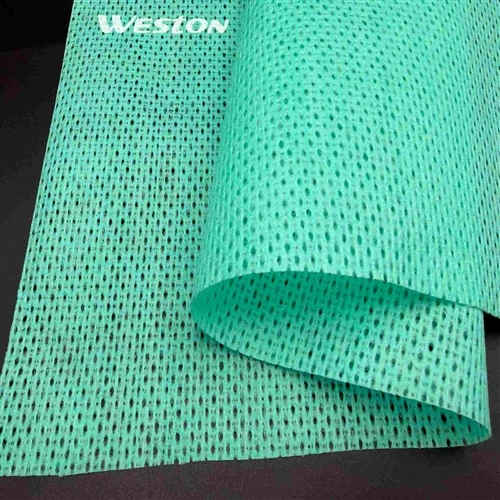
Auto shops, aerospace maintenance bays, and heavy machinery workshops need something tougher: a wipe that survives solvents, oil, and repeated abrasion without falling apart mid-task. Double-layer composites, often a wood-pulp-and-polypropylene blend, are built to resist exactly those conditions, trading some of the softness used in hygiene products for tear strength instead.
7. Automotive & Transportation
Beyond the interior trim, headliners, and trunk liners non-wovens have filled for decades, the fastest-growing use in this industry isn't hygiene-adjacent at all. Automakers are turning to lightweight non-woven composites for interior insulation and acoustic damping in electric vehicles, one of the fastest-growing uses for the material beyond its traditional hygiene and medical base, and non-woven separators, long used in industrial batteries, are drawing fresh attention as EV makers look for ways to shave weight without cutting safety margins.
8. Filtration & Environmental
Air filters, HVAC systems, and respirator masks rely on melt-blown non-woven layers, whose ultra-fine fibers, engineered down to fractions of a micron, trap particles that woven fabric simply can't catch. The same principle scales down to coffee filters and tea bags, and up to industrial oil and water filtration, making melt-blown arguably the least visible but most functionally critical non-woven type on this list.
9. Agriculture, Construction & Geotextiles
Crop covers, frost-protection blankets, road-base stabilizers, and drainage layers use a different family entirely, usually needle-punched or spunbond rather than spunlace, chosen for bulk, UV resistance, and outdoor durability rather than softness. It's a useful reminder of just how wide this category stretches: from a delicate facial wipe to a fabric buried under a highway.
What's Changing in 2026
The industry's next growth chapter isn't coming from hygiene or medical use, both are already large, mature markets. It's coming from three directions instead. Regulation is one: single-use plastic restrictions and extended producer responsibility programs are expanding into more jurisdictions worldwide, pushing manufacturers toward bio-based fibers like PLA, bamboo, and wood pulp in place of standard polypropylene. Function is another: functional coatings and antimicrobial treatments are increasingly built into non-woven fabrics rather than treated as an afterthought. The third, and least expected, is that non-wovens are turning up in categories with no hygiene connection at all, EV interiors, industrial filtration, and building insulation among them, as engineers realize a fiber-bonded material can be lighter and cheaper to shape than whatever it's replacing.
Frequently Asked Questions
Is non-woven fabric the same as felt?
Not quite. Felt is traditionally wool fibers matted together with moisture, heat, and pressure. Non-woven fabric is the modern, broader category, covering multiple bonding methods (spunlace, spunbond, meltblown, needle-punch) and fiber types, each engineered for a specific job rather than one traditional process.
Is non-woven fabric biodegradable or eco-friendly?
It depends on the fiber. Standard polypropylene non-wovens aren't biodegradable, though some grades are recyclable. Fabrics made from PLA, bamboo, wood pulp, or cotton are compostable or biodegradable, and demand for these materials is rising quickly as plastic regulations tighten worldwide.
Can non-woven fabric be washed and reused, or is it always single-use?
Both exist. Most hygiene and medical non-wovens are single-use by design, to avoid cross-contamination. But heavier microfiber and spunlace blends are engineered specifically for repeated washing, and are common in household cleaning cloths and industrial wiping products.
What's the difference between spunlace and spunbond nonwoven fabric?
Spunlace fibers are entangled with high-pressure water jets, producing a soft, cloth-like fabric with no adhesive residue, ideal for skin contact. Spunbond fibers are heat-bonded right after extrusion, producing a stiffer, lower-cost material better suited to structural uses like bag fabric or diaper backsheets.
Is non-woven fabric safe for skin and medical use?
Yes, when it's manufactured for that purpose. Medical-grade and cosmetic-grade non-wovens are tested for skin contact, absorbency, and sometimes sterility or antibacterial performance. Certifications such as OEKO-TEX or ISO help confirm that a specific fabric meets those safety standards.
How is non-woven fabric made, in simple terms?
Fibers are laid into a loose web, then bonded using mechanical entanglement (water jets or needles), heat, or chemical adhesives. There's no spinning into yarn and no weaving, which is exactly what makes non-woven fabric faster and cheaper to produce than traditional textiles.
Why do face masks and wet wipes use different types of non-woven fabric?
Because they solve different problems. Face masks need meltblown layers with ultra-fine fibers to filter airborne particles. Wet wipes need spunlace fabric for softness and high liquid absorption. Matching the bonding method to the job is what non-woven fabric selection really comes down to.