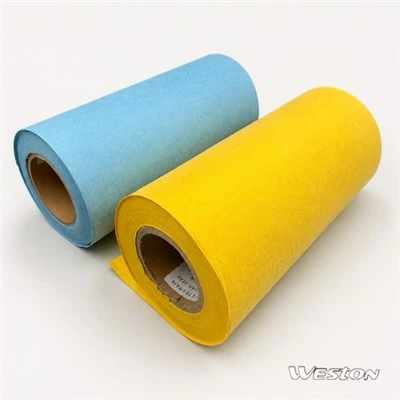
Cotton vs. Viscose vs. PET Spunlace: Which Nonwoven Fits Your Wipes?
Short Answer
Choose the fiber by the job the wipe must do, not by the fiber's reputation.
- Cotton suits wipes that touch skin and must stay strong when wet: facial, baby and intimate care.
- Viscose suits wipes that must absorb and hold the most liquid, with a smooth, drapey feel: makeup removal and general personal care.
- PET (polyester) suits wipes that must scrub, resist tearing and keep costs low: household and industrial cleaning.
- Blends (usually viscose/PET) are the market default because they balance cost and performance. Pure cotton is a deliberate choice for brands that want a single, natural, plastic-free fiber.
|
Your priority |
Best starting point |
|
Strength when wet, natural single-fiber positioning |
Cotton |
|
Maximum liquid pickup and soft drape |
Viscose |
|
Scrubbing power and lowest unit cost |
PET |
|
Balance of cost and absorbency |
Viscose/PET blend |
Why the Three Fibers Behave So Differently
The differences start at the fiber, because spunlace only entangles fibers with water jets and adds no binder to compensate. Whatever the fiber does, the fabric does.
Cotton: natural cellulose, short fibers
Cotton is a natural cellulose fiber with a hollow, twisted structure. Its fibers are short, roughly 1 to 3 cm. It absorbs well, and it is one of the few fibers that gets stronger when wet. Short fibers also mean more loose ends at the surface, which is why lint control is a bigger topic for cotton than for long synthetic fibers.
Viscose: regenerated cellulose, long and uniform
Viscose is made by dissolving wood pulp and spinning it back into fiber. It is cellulose like cotton, but the fibers are long (typically 38 to 51 mm), uniform and smooth. Its structure holds more water than cotton, which makes it very absorbent. The trade-off is that viscose loses a large share of its strength when wet.
PET: synthetic and hydrophobic
PET is a synthetic polymer. It is long, strong, uniform and does not change strength when wet, but it does not absorb water on its own because the fiber is hydrophobic. In wipes, its job is structure, abrasion and cost control rather than absorbency.
Blends: why most wipes are not pure anything
Blending viscose with PET gives wet-wipe makers absorbency from the viscose and strength and economy from the PET. This is why a buyer comparing "cotton vs. viscose vs. PET" is often really comparing three positions: premium single-fiber, mid-range cellulose, and engineered blend.


Head-to-Head Comparison
The values below are typical ranges for each fiber type. Actual fabric performance depends on basis weight, web formation and process control, so always confirm with batch data.
|
Property |
Cotton |
Viscose |
PET |
|
Fiber origin |
Natural cellulose |
Regenerated cellulose (wood pulp) |
Synthetic polymer |
|
Typical staple length |
Short (about 1 to 3 cm) |
Long (about 38 to 51 mm) |
Long (about 38 to 51 mm) |
|
Moisture regain |
About 8% |
About 11 to 13% |
Below 0.5% |
|
Liquid absorbency |
High, fast wicking |
Highest, holds the most liquid |
Low on its own |
|
Strength wet vs. dry |
Higher when wet |
Drops sharply when wet |
Unchanged |
|
Lint tendency |
Higher |
Moderate |
Lowest |
|
Scrubbing ability |
Low to moderate |
Low |
Highest |
|
Typical hand feel |
Soft, dry, natural |
Smooth, silky, drapey |
Ranges from soft to crisp, more synthetic |
|
Plastic content |
None |
None |
Yes |
|
Biodegradability |
Cellulose, can biodegrade (claims need testing) |
Cellulose, can biodegrade (claims need testing) |
Does not biodegrade |
|
Typical cost position |
Generally highest, tied to cotton market |
Mid |
Generally lowest |
The Five Jobs a Wipe Does
Most selection mistakes happen because buyers compare fibers on one attribute. A better method is to rank the five jobs your wipe must do, then see which fiber wins each one.
Job 1: Pick up and hold liquid
Viscose holds the most, cotton is close behind and wicks quickly, and PET holds the least. If the wipe must carry a lot of lotion or soak up a spill, cellulose fibers win. If you need a wipe that feels drier in use, PET content helps.
Job 2: Stay intact when wet
This is where the fibers split most clearly. Cotton gains strength when wet, PET keeps its strength, and viscose weakens. A viscose-rich wipe used for wiping, rubbing or pulling from a tub can tear in use unless its basis weight or PET content compensates. If wet performance is your top need, cotton and PET have the structural advantage.
Job 3: Scrub
PET fibers are stiff and abrasion-resistant, so PET-rich fabrics lift dirt best. Cotton and viscose are gentle and not designed for abrasive cleaning. For hard-surface or kitchen wipes, PET content is functional, not just a cost measure.
Job 4: Stay lint-free
Long fibers lock into the web more securely. PET and viscose generally shed less than short cotton fibers, so cotton buyers should ask for lint data when the wipe is used on lenses, screens or cosmetic applications.
Job 5: Feel right on skin
Hand feel is partly fiber and partly fabric design (basis weight, pattern, density). Cotton gives a dry, natural touch, viscose a smooth drape, and PET can feel more synthetic. For a skin-contact product, the feel and the brand story often point to cotton or viscose.

Match the Material to the Wipe Type
|
Wipe type |
What matters most |
Typical fit |
|
Baby wipes |
Gentle feel, wet strength, natural positioning |
Cotton, or viscose-rich blends |
|
Facial cleansing and makeup removal |
Liquid pickup, soft hand, low lint |
Cotton or viscose |
|
Dry facial towels |
Softness, dry strength, low lint |
Cotton |
|
Feminine and intimate care |
Gentle feel, strength when wet |
Cotton or viscose |
|
Household and kitchen cleaning |
Scrubbing, tear resistance, cost |
PET or PET-rich blend |
|
Industrial and cleanroom wiping |
Low lint, cleanliness, strength |
Mostly PET or PET-rich blends |
|
Disinfecting wipes |
Liquid holding, chemical exposure |
Blends chosen to suit the formula |
Cost: Compare Cost per Usable Wipe, Not Price per Kilogram
This is where many comparisons mislead. Price per kilogram ignores three things.
The basis weight you actually need
Long fibers reach a given strength at a lower basis weight than short fibers. A cotton fabric may need a higher gsm to match the strength a PET-rich blend achieves at less weight. A cheaper kilogram is not a cheaper wipe if you need more kilograms per thousand wipes, and the reverse is also true.
The liquid the fabric consumes
A wet wipe is fabric plus lotion. Fabrics that hold more liquid take more lotion per wipe, which raises formula cost. Compare finished wipes at equal performance, not bare fabric prices.
Material price stability
Cotton prices follow the agricultural market and can move noticeably, while PET follows petrochemical markets. Ask suppliers how they handle price fluctuation on long contracts.
Claims and Compliance: Three Different Claims, Three Different Tests
Fiber choice decides which marketing claims you can support. These three are often confused.
Plastic-free
Cotton and viscose contain no plastic. Any PET content means the wipe contains plastic. Regulators, especially in the EU, require labeling on certain plastic-containing wet wipes, and some jurisdictions are restricting them further, so confirm the rules for each target market before choosing a blend.
Biodegradable
Cellulose fibers can biodegrade, but "can" is not a claim. A biodegradability statement needs a recognized test on the finished product, including any additives, and the conditions (soil, compost, water) must be specified. PET does not biodegrade.
Flushable
Biodegradable is not flushable. Flushability means the wipe breaks apart quickly in sewage systems and passes specific disperse tests. Spunlace wipes, including 100% cotton, are generally entangled to stay together in use and are not designed to be flushed unless they have passed those tests. Do not print "flushable" without a test report.
Common Misconceptions
"Natural is always softer." Hand feel depends on basis weight, pattern and finishing as much as on fiber. A well-made viscose can feel softer than a coarse cotton.
"Viscose is cheap cotton." It is a different fiber with different strengths and a clear weakness (wet strength). Treat it as its own category.
"PET means a low-quality wipe." For scrubbing and tear resistance, PET is often the technically correct choice.
"Pure cotton is the best wipe." It is the best fit for some jobs, not all of them. The most useful question is what the wipe must do first.
A Five-Minute Hand Check for Incoming Samples
Before sending samples to a lab, compare candidate fabrics at equal size and basis weight.
- Drop test: place a water drop on each sample and time how long it takes to soak in. PET-rich fabrics will bead or absorb slowly.
- Wet pull: soak each sample, then pull by hand in both directions. Note which tear or stretch first.
- Rub test: rub a wet sample on a dark surface or cloth and check for visible fibers.
- Squeeze test: squeeze a soaked sample and see how much liquid it releases.
This will not replace laboratory tests, but it quickly eliminates unsuitable candidates.
A Simple Decision Path
- Is scrubbing or lowest cost the main goal? Start with PET or a PET-rich blend.
- Must the wipe be plastic-free? Choose cotton or viscose.
- Will the wipe be used wet and pulled hard? Prefer cotton, or add PET to viscose.
- Does it need maximum liquid pickup and drape? Choose viscose.
- Do you want a single natural fiber for brand positioning? Choose cotton and plan the basis weight and lint specification around it.
FAQ
Which is better for wipes, cotton or viscose?
Neither is better overall. Cotton keeps its strength when wet and suits skin-contact wipes that are pulled and wiped. Viscose absorbs and holds more liquid with a smoother drape but loses strength when wet.
Is PET spunlace bad for sensitive skin?
PET is not inherently irritating, but sensitive-skin products usually choose cellulose fibers for their feel and for plastic-free positioning. The safety of a finished wipe depends on the fabric and the formula and should be tested.
Why are most wet wipes made from viscose/PET blends?
Viscose adds absorbency, PET adds strength and lowers cost. The blend delivers acceptable performance at a price most mass-market wipes require.
Are cotton spunlace wipes biodegradable?
Cotton is a natural cellulose fiber that can biodegrade, but any biodegradable claim needs a recognized test on the finished wipe.
Can I flush cotton or viscose spunlace wipes?
Not unless the specific product has passed flushability testing. Biodegradable and flushable are separate claims.
Does cotton need a higher basis weight than PET?
Often, to reach the same strength, because cotton fibers are shorter. Confirm with strength data at your target basis weight.
Choosing Cotton Deliberately
Cotton is the right choice when the wipe touches skin, must stay strong when wet and benefits from a single natural fiber with no plastic. It is not the right choice when scrubbing power or the lowest cost matters most. If your product fits the first case, Weston supplies Cotton Spunlace Nonwoven Fabrics in the basis weights and patterns you need. Request samples and specifications at info@westonmanufacturing.com.