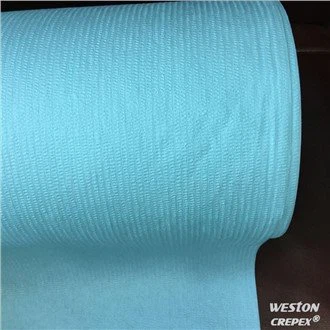
Weston Twin-spinning pulp polypropylene microfiber nonwovens
Toilet paper, facial tissue, kitchen paper and wet wipes and other household paper and sanitary products are closely related to people's lives. According to statistics, we usually use paper towels more than 20 times per day, and we need paper towels everywhere in our lives. However, for ordinary consumers, how to choose a healthy and environmentally friendly household paper and sanitary product still requires careful identification and careful selection. After all, products that look soft and white and harmless to humans and animals may be the murderer who quietly strangles your health! In this regard, Weston, which has always adhered to the concept of "environmental protection, degradable, and sustainable development", has independently innovated and developed a new technology product "W-tex 1st Generation Nonwoven Fabric" for the public to fully protect their healthy lives.
Twin spinning technology is a new force born in the nonwoven fabric industry in recent years. It is a new nonwoven material technology that combines microfiber fibers produced by meltblown technology with natural wood pulp fibers and other functional fibers through dry process. It can achieve high efficiency and energy saving in the production process, no pollutant emissions, and the discarded materials after use are degradable and will not cause environmental pollution. This also coincides with Weston's original intention of always insisting on developing green, environmentally friendly, healthy and degradable materials, allowing users and partners to truly feel comfortable, natural, safe and assured, and jointly attach importance to environmental protection and practice low-carbon life.
Good technology makes good products. With the support of the new technology of dual spinning, "1st generation nonwoven fabric" has the characteristics of wrinkle resistance, stretchability, super water absorption and water retention of meltblown nonwoven fabrics and spunlace nonwoven fabrics, and has a delicate and smooth touch, which is healthier and safer. Many indicators are better than international standards. It is worth mentioning that in terms of cleaning power, "W-tex 1st generation nonwoven fabric" can be regarded as the ceiling of the industry. According to laboratory test data, the structural components of "W-tex 1st generation fabric" are compared with the full viscose spunlace nonwoven fabric of the same basis weight. The cleaning efficiency is increased by 25%; compared with traditional wet wipes, the cleaning efficiency is increased by 38%.
At present, the twin-spinning technology is still in its infancy in China, but because it can use natural wood pulp, it is rich in microfiber fibers that are one order of magnitude thinner than ordinary chemical fibers, and it has strong developability. At the same time, it is suitable for personal care wet wipes products and diversified life scenarios. It is of great significance to promote the gradual marketization of wet wipes products and twin-spinning raw materials. In this regard, Weston will continue to adhere to the market orientation and continuously build high-end, intelligent, and green advanced manufacturing capabilities, thereby promoting the continuous improvement and iteration of the company's product development capabilities and core competitiveness, promoting scientific and technological progress, achievement transformation and product innovation, better meeting the personalized needs of users, and leading a green and healthy lifestyle. Twin-spinning pulp polypropylene nonwoven fabric is a nonwoven material produced by an advanced dry process by combining microfiber fibers produced by meltblown technology with a diameter of only 1/8 of that of man-made fibers, with wood pulp fibers and other functional fibers. The nonwoven material contains both continuous filament fibers and discontinuous virgin wood pulp fibers, and can add a certain proportion of functional fibers, polymer absorbent resin SAP/SAF and other auxiliary materials according to different application requirements, so that it has excellent performance and enriches product diversity.
Twin-spun nonwoven fabrics are developed based on the traditional meltblown nonwoven fabric process, and its products have the characteristics of meltblown nonwoven fabrics and spunlace nonwoven fabrics.
Advantages of twin-spun pulp polypropylene nonwoven fabrics
Compared with traditional nonwoven fabric technology, twin-spun nonwoven fabrics have the following advantages:
(1) Wide range of product applications
It can not only replace the spunlace nonwoven fabrics and air laid paper products currently widely used in the disposable sanitary products and medical consumables market, but also can be used in other industrial application fields with broad market prospects such as liquid absorption, industrial filtration, sound insulation and heat insulation, such as wet wipes substrates, absorbent cores of disposable sanitary products, etc.
(2) Advanced production technology, no three wastes
The online spinning and dry hot hybrid composite process is adopted, which has fewer steps than the traditional multi-step forming methods such as spunlace, gluing and comprehensive forming, and no pollutants are discharged during the production process.
(3) Green and environmentally friendly
The raw materials use virgin wood pulp fibers and bio-based raw materials such as polylactic acid (PLA) and polycarboxyl fatty acid esters (PHA) to replace chemical fibers such as polyester (PET/PBT), polyethylene (PE), and polypropylene (PP) used in traditional non-woven fabrics, and the product waste is degradable.
Application of twin-spinning non-woven fabrics
Twin-spinning is still in its infancy in China. Equipment manufacturers and material manufacturers in the spunmelt industry have been involved in research and development and have produced a small amount of twin-spinning non-woven fabrics of PP + wood pulp fibers.
New trends:
PLA can be used to replace PP as the main material and add wood pulp fiber to develop a variety of new popular cleaning materials such as all-biobased non-woven materials, flushable non-woven fabrics, and absorbent composite cores, and are mainly used in the following 5 fields:
(1) Wiping materials: such as baby wipes, makeup remover wipes, household wipes, industrial wipes, etc.;
(2) Absorbent core and diversion layer materials for disposable sanitary products: such as sanitary napkins, baby diapers, adult incontinence products, napkins/tablecloths, meat/poultry absorbent pads, mops, wound care, nursing pads, etc.;
(3) Liquid absorption and diffusion materials: medical bandages, surgical curtains, hole towels, absorbent felts, oil-absorbing materials, etc.;
(4) Sound insulation and heat insulation materials: such as automotive sound insulation cotton, clothing heat insulation materials, etc.;
(5) Filter materials: water filtration, air filtration materials, etc.
Hot Tags: twin-spinning pulp meltblown microfiber nonwovens, China, manufacturers, factory, customized, wholesale, Household Cleaning Wood Pulp Spunlace Fabrics, High Tensile Wood Pulp Fabric, Non woven Spunlace Dust Cover, Absorbent Nonwoven Fabric For Diaper Core, Spunbond Nonwovens, Refreshing Cooling Wet Wipes