The Scientific Significance of Diaper Raw Materials
Diapers are precision-engineered products where raw material selection directly impacts infant skin health, leak-proof performance, and user comfort. Unlike superficial lists of components, understanding diaper materials requires analyzing how each layer interacts at the molecular and structural levels-from absorbing and locking moisture to minimizing friction and irritation. Below is a systematic breakdown of key raw materials, their scientific principles, advantages, disadvantages, and innovative applications.

Core Absorbent Layer: The "Moisture-Locking Engine"
The core absorbent layer is the most critical component of a diaper, responsible for quickly absorbing urine and preventing rewetting. Its performance depends on the synergy of two primary materials: Super Absorbent Polymer (SAP) and fibrous carriers (e.g., wood pulp, nonwoven fabrics).
1. Super Absorbent Polymer (SAP)
SAP is a cross-linked polymer with a three-dimensional network structure, capable of absorbing 300–1,000 times its weight in water. When in contact with urine, its hydrophilic groups (e.g., carboxyl, hydroxyl) form hydrogen bonds with water molecules, expanding into a gel-like substance that locks moisture.
Advantages: Exceptional water retention (reduces rewetting), small volume (thins diapers), and long-lasting dryness.
Disadvantages: Poor initial absorption speed (relies on fibrous carriers to guide liquid); excessive SAP may cause gel blocking (clumping), reducing overall absorbency.
2. Fibrous Carriers: Guiding and Stabilizing Absorption
Fibrous materials (e.g., wood pulp, nonwoven fabrics) act as "liquid conductors" and "SAP stabilizers." They disperse urine evenly to SAP, prevent gel clumping, and maintain the core's structural integrity.
Traditional Wood Pulp:
Advantages: High liquid conductivity, low cost, and good biodegradability.
Disadvantages: Prone to compaction (loses absorbency over time) and fluff leakage (irritates skin).
Innovative Nonwoven Carriers:
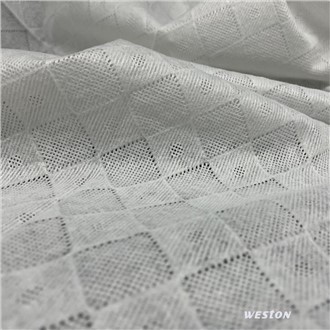
Weston nonwoven factory addresses these flaws with Triple Layer Bamboo Fiber Wood Pulp Spunlace Fabric-a composite material that combines bamboo fiber's breathability, wood pulp's absorbency, and spunlace technology's structural stability.
Advantages: Bamboo fiber's natural antibacterial properties reduce skin irritation; the triple-layer structure prevents compaction; spunlace bonding eliminates fluff leakage.
Disadvantages: Slightly higher processing complexity than traditional wood pulp (requires precision control of fiber blending ratios).
Topsheet & Backsheet: Balancing Skin-Friendliness and Leak-Proofing
The topsheet (inner layer) and backsheet (outer layer) form the "protective envelope" of a diaper, addressing two conflicting needs: maximizing skin comfort and minimizing leaks.
1. Topsheet: The "Skin Interface"
The topsheet directly contacts infant skin, requiring excellent liquid permeability, softness, and non-irritation. It is typically made of spunbond nonwoven fabric or hydroentangled (spunlace) nonwoven fabric.
Spunbond Nonwoven:
Advantages: High strength (resists tearing), low cost, and uniform pore size (facilitates liquid penetration).
Disadvantages: Slightly rough texture (may cause friction irritation for sensitive skin).
Hydroentangled Nonwoven:
Advantages: Ultra-soft (mimics cotton texture), good breathability, and low skin irritation.
Disadvantages: Lower abrasion resistance than spunbond (prone to pilling with frequent movement).
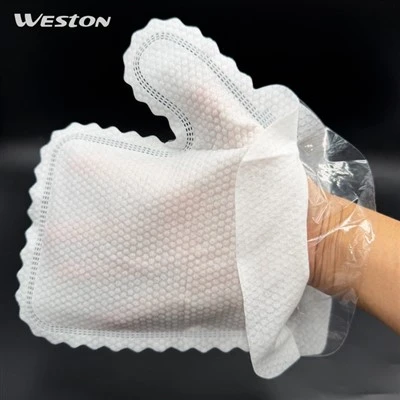
For complementary care, Baby Wipes 100% Cotton Vacuum Sealed (from Weston nonwoven factory) aligns with the topsheet's skin-friendly goal: 100% cotton ensures hypoallergenicity, while vacuum sealing preserves freshness and prevents bacterial contamination-avoiding the irritation caused by chemical preservatives in ordinary wipes.
2. Backsheet: The "Leak Barrier"
The backsheet prevents urine leakage and is usually a composite of polyethylene (PE) film and breathable nonwoven fabric.
PE Film:
Advantages: Impermeable to liquids (100% leak-proof), lightweight, and low cost.
Disadvantages: Poor breathability (traps heat and moisture, leading to diaper rash).
Breathable Composite Backsheet:
Structure: PE film with micro-pores (allows water vapor to escape) + spunbond nonwoven (enhances durability).
Advantages: Balances leak-proofing and breathability (reduces skin moisture buildup).
Disadvantages: Higher production cost than pure PE film; micro-pores may be blocked by SAP gel (reducing breathability over time).

Safety & Sustainability: Deepening Raw Material Selection
Modern diaper raw material development extends beyond functionality to two critical dimensions: biological safety and environmental impact-factors often overlooked in superficial analyses.
1. Biological Safety: Beyond "Non-Toxic"
Infant skin is 30% thinner than adult skin, making it highly vulnerable to irritants. Raw materials must undergo rigorous testing:
Skin Sensitization Test: Ensuring no allergic reactions to SAP, nonwoven binders, or dye residues.
Heavy Metal & Formaldehyde Detection: Prohibiting heavy metals (lead, mercury) and formaldehyde (a common preservative) in wood pulp and cotton materials.
Microbial Control: Vacuum-sealed products like Baby Wipes 100% Cotton Vacuum Sealed eliminate microbial growth during storage, avoiding secondary skin infections.
2. Sustainability: Reducing Environmental Footprint
Traditional diaper materials (e.g., petroleum-based SAP, non-biodegradable PE) pose long-term environmental risks (e.g., landfill accumulation). Innovative materials address this:
Renewable Fibers: Bamboo fiber in Triple Layer Bamboo Fiber Wood Pulp Spunlace Fabric is fast-growing (matures in 3–5 years) and requires no pesticides-reducing reliance on deforestation for wood pulp.
Biodegradable SAP: Emerging plant-based SAP (derived from corn starch) decomposes in soil within 180 days, compared to 200+ years for petroleum-based SAP.
Trade-Offs: Biodegradable materials often have lower absorbency than synthetic alternatives; renewable fibers (e.g., bamboo) require more water during processing-highlighting the need for balanced innovation.
Integrating Science into Practical Applications
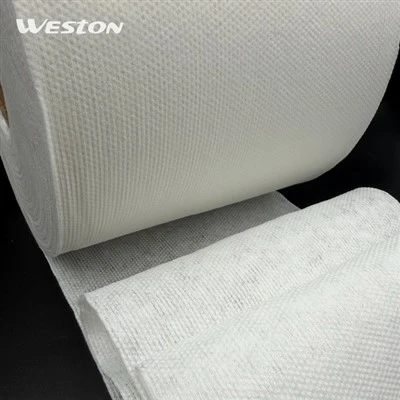
Weston nonwoven factory's Baby Diaper Raw Material portfolio embodies these scientific principles: Absorbent Nonwoven Fabric For Diaper Core optimizes SAP-fiber synergy to enhance absorption efficiency; Triple Layer Bamboo Fiber Wood Pulp Spunlace Fabric resolves the trade-off between absorbency and skin comfort; and Baby Wipes 100% Cotton Vacuum Sealed complements diaper use with safe, preservative-free care.
For manufacturers seeking to apply these scientific raw material solutions, free samples of Weston's products are available via: info@westonmanufacturing.com.