Understanding Eco-Efficiency in Nonwoven Manufacturing
Eco-efficiency in nonwovens is often misunderstood as a purely environmental concept. In practice, it is a production logic-how much functional output can be achieved using fewer resources, less energy, and fewer process interruptions.
For converters, eco-efficiency shows up in very practical ways:
Stable web runnability
Predictable converting behavior
Lower waste rates
Balanced cost versus performance
Spunlace structures made from cellulose-based fibers have become part of this discussion because they allow performance to be achieved without heavy reliance on synthetic polymers or chemical binders.

What Is a Wood Pulp & Lyocell Spunlace Structure
A wood pulp & Lyocell spunlace nonwoven is produced by hydroentanglement, where high-pressure water jets mechanically entangle fibers into a coherent web.
Wood pulp fibers are short, highly absorbent, and cost-efficient
Lyocell fibers are long, uniform, and mechanically strong
Water jets replace chemical bonding agents
The result is a fabric whose strength comes from fiber interlocking, not resin content.
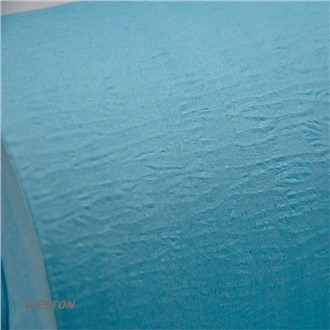
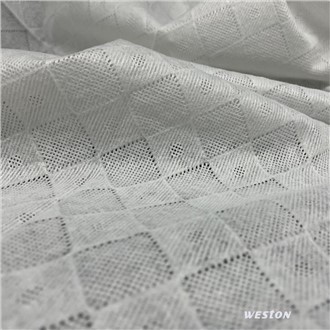
This structure is commonly supplied to converters as Spunlace Nonwoven Wood Pulp Lyocell Blend Rolls, allowing downstream processes such as slitting, folding, and impregnation to be performed with minimal adjustment.
Why Lyocell Performs Differently from Conventional Viscose
While both Lyocell and viscose originate from cellulose, their performance in spunlace structures differs noticeably.
Lyocell fibers:
Are produced in a closed-loop solvent system
Have higher molecular alignment
Retain strength more effectively when wet
In pulp-rich webs, Lyocell functions as a structural backbone, limiting fiber shedding and improving tensile stability-especially important for high-speed converting lines.
This does not make Lyocell "superior" in all cases, but it addresses specific weaknesses found in traditional pulp-viscose blends.
Fiber Interaction: How the Blend Balances Performance
The value of this material lies not in individual fibers, but in how they interact under hydroentanglement.
Wood pulp creates micro-voids for liquid uptake
Lyocell fibers bridge pulp zones and distribute stress
Water-jet entanglement locks the blend into a uniform matrix
This synergy results in a fabric that:
Absorbs quickly
Maintains integrity during saturation
Releases liquid in a controlled manner
Performance Advantages in Real Converting Conditions
Key Advantages
High absorbency with moderate basis weight
Improved wet tensile strength without synthetic reinforcement
Reduced linting compared to pure pulp structures
Softer surface compared to PET-reinforced spunlace
Practical Limitations
Lower abrasion resistance than polyester-based wipes
Not suitable for extreme solvent exposure
Higher raw fiber cost compared to pure wood pulp
Strength still lower than PP-reinforced composites in heavy-duty use
Eco-efficient does not mean "universal."
It means optimized for the right application range.
Production Efficiency from a Converter's Perspective
Converters typically evaluate materials based on line stability rather than fiber origin.
Wood pulp & Lyocell spunlace rolls offer:
Uniform roll density
Clean edges after slitting
Reduced dust accumulation
Fewer web breaks during impregnation
These factors translate into:
Less downtime
Lower waste percentages
More consistent finished products
Eco-efficiency is often realized after installation-when daily production becomes more predictable.
Environmental Logic Without Overstatement
From a lifecycle standpoint, pulp-Lyocell spunlace materials:
Rely primarily on renewable cellulose sources
Avoid chemical binders
Reduce dependency on petroleum-based fibers
However, environmental performance still depends on:
Fiber sourcing
Energy mix at the mill
End-of-life handling
This structure should be viewed as an improvement over conventional options, not a perfect solution.
Visual Comparison: Fiber Role & Performance Contribution
Table 1. Functional Contribution of Each Fiber Type
|
Property |
Wood Pulp |
Lyocell |
Combined Effect |
|
Absorbency |
Very High |
Moderate |
Fast uptake + retention |
|
Wet Strength |
Low |
High |
Balanced durability |
|
Lint Control |
Low |
High |
Reduced fiber loss |
|
Softness |
Moderate |
High |
Skin-friendly surface |
|
Cost Impact |
Low |
Medium |
Controlled material cost |
(Illustrative reference for converter decision-making)
Typical Application Scenarios
This material is commonly selected for:
Household and kitchen wipes
Disposable cleaning cloths
Personal care and hygiene substrates
Food-contact wipe applications (subject to compliance)
In many cases, it replaces PP-heavy or PET-reinforced structures where softness and absorbency matter more than extreme mechanical strength.

What Converters Should Evaluate Before Adoption
When selecting Spunlace Nonwoven Wood Pulp Lyocell Blend Rolls, converters should focus on:
Fiber ratio consistency
Cross-direction weight uniformity
Wet tensile repeatability
Proven performance on existing lines
Laboratory data is useful, but trial runs reveal the real value.
A Note on Manufacturing Capability
Experienced spunlace producers can fine-tune:
Fiber distribution
Entanglement intensity
Surface texture
Weston Nonwoven operates as a dedicated spunlace manufacturer supplying Spunlace Nonwoven Wood Pulp Lyocell Blend Rolls for converting applications, with production parameters adjusted to balance absorbency, strength, and runnability rather than pursuing extreme specifications.
For converters evaluating material compatibility, free sample requests can be directed to:info@westonmanufacturing.com
Moving Toward Practical Eco-Efficiency
Wood pulp & Lyocell spunlace blends represent a measured step forward-not driven by trends, but by manufacturing logic.
They offer:
Functional efficiency
Production stability
A more rational material footprint
For modern converters, eco-efficient substrates are not about marketing claims.
They are about making daily production smoother, cleaner, and more predictable.