How Do Different Layer Configurations Affect Diaper Absorbency Performance?
Diaper absorbency depends less on any single material and more on how the acquisition, distribution, and core layers work together. In general:
Triple-layer structures (separate acquisition, distribution, and retention layers) deliver the fastest intake, the lowest rewet, and the most even fluid distribution - but at higher material cost.
Dual-layer structures balance performance and cost, and are the most common configuration in mid-to-premium disposable diapers today.
Single-layer cores are the lowest cost but are prone to channeling, pooling, and early leakage under repeated loading, which is why they are mostly limited to entry-level or thin-profile products.
The acquisition layer's nonwoven structure (fiber type, basis weight, and cross-section) is often the limiting factor for intake speed - even a high-capacity core cannot perform well if fluid is not delivered to it quickly.
The sections below break down the mechanics, the layer-by-layer roles, and the trade-offs buyers and product engineers should weigh when selecting a layer configuration.

1. Why Layer Configuration Determines Absorbency Outcomes
A diaper is not a single absorbent block - it is a layered fluid-management system. Each layer has one job: move fluid from the skin surface, through the structure, into a storage matrix, without letting it come back out under pressure (sitting, crawling, sleeping). When any one layer underperforms, the whole system underperforms, regardless of how much superabsorbent polymer (SAP) is in the core.
This is why two diapers with the same total SAP loading can perform very differently - the difference is almost always in layer architecture, not raw material quantity.
Performance in this article is discussed against the commonly used industry test framework for nonwoven and absorbent hygiene materials, the WSP (Worldwide Strategic Partners) test methods, jointly maintained by EDANA and INDA, which cover intake rate, rewet, and absorbent capacity testing for hygiene products.
2. Fluid Mechanics in Diaper Structures
Three metrics define absorbency performance:
|
Metric |
What It Measures |
Why It Matters |
|
Intake Rate (g/s) |
Speed at which fluid is drawn away from the skin surface |
Determines leakage risk during rapid voiding |
|
Retention Capacity (g/g) |
Total fluid held per gram of absorbent material |
Determines total capacity / time between changes |
|
Rewet Value (g) |
Fluid that returns to the surface under pressure |
Determines skin dryness and comfort |
Fluid entering the diaper follows a defined path:
Topsheet → Acquisition Layer → Distribution Layer → Core (fluff + SAP) → Backsheet (barrier)
A bottleneck at any stage causes fluid to pool at the surface or channel unevenly through the core, both of which lead to leakage even when total absorbent capacity is technically sufficient.
3. Layer-by-Layer Functional Breakdown
|
Layer |
Function |
Key Material Property |
Typical Spec Range |
|
Acquisition Layer |
Rapidly pulls fluid away from skin and passes it downward |
Fiber hydrophilicity, basis weight, void volume |
30–80 gsm; spunlace or airlaid nonwoven |
|
Distribution Layer |
Spreads fluid laterally to reduce channeling |
Wicking rate, lateral permeability |
20–50 gsm; typically wet-laid or spunlace |
|
Core Layer |
Stores fluid long-term via gel formation |
SAP concentration, fluff/SAP ratio |
30–60% SAP by weight is common in modern thin cores |
|
Backsheet/Outer Layer |
Prevents leakage while allowing vapor transfer |
Moisture vapor transmission rate (MVTR) |
Breathable PE film or nonwoven laminate |

4. Comparative Performance: Single vs. Dual vs. Triple-Layer Systems
The table below reflects generally observed, industry-typical performance patterns across these three configurations (based on published WSP-method testing across the hygiene nonwovens industry), rather than results from a single proprietary study. Actual values vary by SAP grade, basis weight, and construction, and should be verified through direct testing for any specific product.
|
Configuration |
Relative Intake Speed |
Relative Rewet |
Leakage Risk Under Load |
Relative Cost |
|
Single-Layer Core |
Slower |
Higher |
Higher - prone to channeling |
Lowest |
|
Dual-Layer Core |
Moderate–Fast |
Moderate |
Moderate |
Mid |
|
Triple-Layer System |
Fastest |
Lowest |
Lowest - even gel distribution |
Highest |
Why the difference occurs: In single-layer designs, fluid enters and swells SAP near the entry point first, which can cause "gel blocking" - swollen SAP particles physically obstruct fluid from reaching unused SAP deeper in the core. Multi-layer systems reduce this by physically separating the fast-intake function from the storage function, so fluid is distributed before it ever reaches the SAP-rich zone.
5. SAP Behavior Under Real-World Conditions
SAP absorption capacity is highly sensitive to test conditions, which is a common source of confusion when comparing spec sheets:
|
Test Condition |
Typical Capacity |
|
Deionized water, free swell |
~300 g/g |
|
Saline (0.9% NaCl), free swell |
~50 g/g |
|
Saline under load (0.7 psi) |
~40 g/g |
The gap between free-swell and under-load capacity is the reason core engineering matters as much as SAP selection. A high-capacity SAP tested only in deionized water can still underperform in a finished product if the surrounding layers don't manage pressure and fluid delivery correctly.
Crosslink density trade-off: Higher crosslinking produces a firmer gel (better under-pressure retention, less risk of gel migration) but lower total swelling capacity. Lower crosslinking increases capacity but risks softer, less stable gels that can be squeezed out under load. Core designers typically select crosslink density based on the product's primary use case (e.g., overnight vs. daytime) rather than maximizing capacity alone.
6. Material Innovation Driving Layer Performance
Hydrophilic Nonwoven Fabrics - surface treatments and fiber selection that reduce the contact angle between fiber and fluid, accelerating initial uptake into the acquisition layer.
Spunlace Nonwovens - hydroentangled fiber structures offering high wet strength, softness against skin, and consistent porosity - commonly used in acquisition and topsheet applications where both comfort and intake speed matter.
Tri-lobed / Hollow-Cross-Section Fibers - non-round fiber geometries that increase capillary channels along the fiber surface, improving lateral wicking speed in the distribution layer.
7. Durability and Comfort Under Wear
Absorbency engineering doesn't stop at first fluid contact - the structure must maintain performance through movement, sitting pressure, and multiple voids:
Compression Resilience - core structure must resist permanent collapse so void space remains available for later fluid loads.
Breathability - controlled moisture vapor transmission through the backsheet reduces the risk of skin maceration during extended wear.
Zonal Porosity - varying density across the core helps manage heat and moisture vapor dissipation, particularly relevant for overnight products.
8. Environmental and Safety Considerations
Biodegradable Additives - next-generation SAP and nonwoven treatments are being developed to reduce environmental persistence; buyers evaluating these should request compostability data referenced against recognized standards (e.g., ISO 14855, OK Compost).
Dermatological Safety - hypoallergenic topsheet and acquisition layer treatments reduce contact irritation risk, particularly important for sensitive-skin product lines.
9. Frequently Asked Questions
What is the best layer structure for overnight diapers?
Triple-layer structures with a higher SAP concentration in the core and a dedicated distribution layer are generally preferred for overnight use, since they minimize rewet over longer wear periods and manage larger cumulative fluid loads.
How does SAP placement affect rewet value?
Concentrating SAP too close to the top of the core increases gel blocking risk and raises rewet, since swollen particles near the surface can trap fluid rather than pulling it downward. Layering SAP deeper in the core, behind a distribution layer, typically reduces rewet.
What testing standards measure diaper absorbency?
The WSP (Worldwide Strategic Partners) test method series, maintained jointly by EDANA and INDA, is the most widely referenced framework, covering intake rate, absorbent capacity, and rewet under load testing for hygiene nonwovens and cores.
How many layers does a premium diaper core typically have?
Most premium disposable diapers today use a dual- or triple-layer approach: a fast-intake acquisition layer, an optional distribution layer, and a SAP-enriched retention core, sometimes combined with a thin fluff-based support layer.
Does more SAP always mean better absorbency?
No. Without adequate acquisition and distribution layers to deliver and spread fluid, additional SAP can go underutilized due to gel blocking, so layer architecture often has a larger practical impact than total SAP loading alone.

10. Procurement Checklist for Diaper Manufacturers and Buyers
When evaluating nonwoven materials or finished absorbent cores, request the following from suppliers:
[ 1 ] Intake rate data (g/s), tested per WSP method, at stated basis weight
[ 2 ] Retention capacity (g/g) under both free-swell and load conditions
[ 3 ] Rewet value under simulated body pressure
[ 4 ] Basis weight consistency across production batches
[ 5 ] Fiber composition and any surface treatment specifications
[ 6 ] Compression recovery / resilience data for extended-wear applications
11. Weston Nonwoven's Role in the Layer Stack
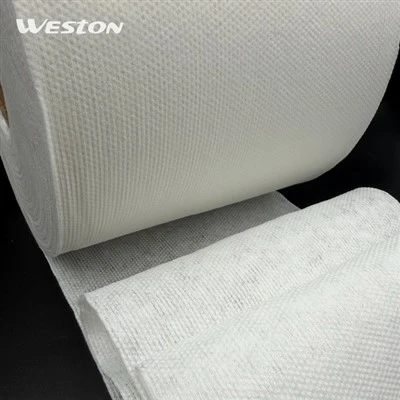
Weston Nonwoven produces spunlace nonwoven fabrics used in the acquisition and core-support layers of disposable diaper structures, where fast fluid uptake and consistent porosity are the primary performance requirements.
Relevant product lines include:
Absorbent Nonwoven Fabric for Diaper Core - engineered for high intake speed and fluid transfer into the core structure.
Baby Diaper Raw Material - formulated to support even SAP distribution and reduce channeling risk.
Manufacturers evaluating layer configurations for new or reformulated products are welcome to request technical specification sheets or material samples for pilot testing.
For samples or technical data sheets: info@westonmanufacturing.com
Sources and Referenced Standards
WSP (Worldwide Strategic Partners) Test Methods - jointly maintained by EDANA (Europe) and INDA (North America), covering absorbent hygiene product testing
ISO 14855 - Determination of ultimate aerobic biodegradability of plastic materials
OK Compost certification framework (TÜV Austria)
Data ranges cited in this article reflect commonly published industry benchmarks for hygiene nonwovens and absorbent cores. Actual performance varies by specific material grade, construction, and test conditions - buyers should request product-specific test data for procurement decisions.