From Trial to Long-Term Partnership: Scaling a Startup Brand with Reliable Spunlace Supply
In industrial supply chains, trust is not built through presentations or promises. It is built on-site, through materials that perform as expected, and through decisions that balance cost with real-world use.
This is the story of how a startup brand, focused on serving heavy machinery clients in India, moved from a single factory visit to a three-year supply partnership with Weston Nonwoven-by focusing on what truly matters: material performance, pricing logic, and honest technical communication.

A Referral That Led to the Factory Floor
The client was not new to industrial wiping products, but they were new to sourcing at scale. Their entry point came through a finished-product partner who had already worked with Weston Nonwoven.
Instead of starting with samples by mail, the client chose a more direct route:
they visited the factory.
At Weston's production site, they were shown a full process line-from fiber preparation to hydroentanglement, and finally to slitting and roll conversion. What stood out was not just the machinery, but the transparency. Every step was open for inspection.
During the visit, one specific material caught their attention:
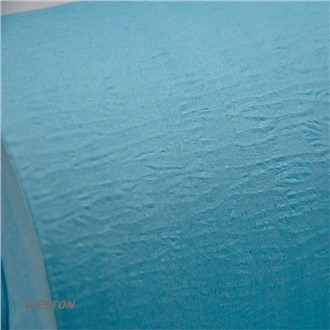
a lake-blue spunlace roll made from wood pulp and polypropylene (PP).
Understanding the Real Application: Heavy Machinery Cleaning
The client's target market was clear and demanding-industrial cleaning for heavy machinery manufacturing in India.
This application required more than basic wiping performance.
Key performance requirements included:
High abrasion resistance for repeated surface contact
Strong oil absorption for grease and lubricant removal
Low linting to avoid contamination of mechanical parts
Cost efficiency for large-scale industrial use
These are not cosmetic or consumer-grade expectations. Materials used in this field must hold up under pressure, friction, and continuous use.
The First Recommendation-and Why It Was Rejected
Based on the application, Weston's technical team initially recommended meltblown nonwoven material.
From a purely technical perspective, this made sense:
Meltblown fabrics offer excellent oil absorption
Fine fiber structure enhances liquid retention
Suitable for precision cleaning environments
However, the client raised a practical concern: price.
For high-volume industrial wiping, even small cost differences per unit can scale into significant expenses. The client made it clear that while performance mattered, the material had to align with their market pricing.
This moment defined the direction of the project.
Shifting Strategy: Finding the Right Balance
Instead of pushing a higher-cost solution, Weston's team adjusted the approach.
They introduced an alternative:
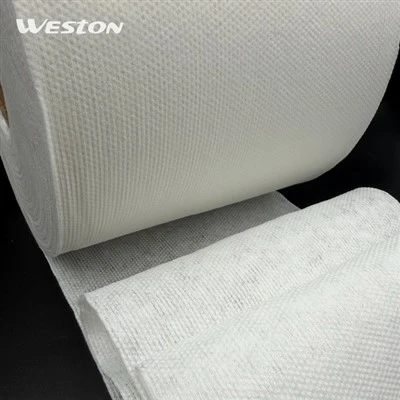
a wood pulp + PP spunlace nonwoven with a higher friction surface structure.
This material was not positioned as the most advanced option-but as the most balanced one.
Why this solution worked:
Wood pulp fibers provide strong oil absorption
PP fibers add structural strength and durability
Hydroentangled structure improves fabric integrity without chemical binders
Textured surface increases friction, improving cleaning efficiency on rough surfaces
In practical terms, this meant the fabric could remove grease effectively while withstanding repeated use on metal parts and equipment surfaces.

On-Site Validation: Seeing Is Deciding
Rather than relying on datasheets alone, the client observed the material directly during production.
They watched:
- Fiber blending and web formation
- High-pressure water entanglement
- Final roll slitting and packaging
This process visibility allowed them to evaluate not just the product, but the consistency of manufacturing.
For industrial buyers, consistency is often more important than peak performance. A slightly less advanced material that performs reliably across every batch is far more valuable than a high-end option with variability.
From Sample Testing to Market Fit
After the factory visit, the client moved forward with trial orders.
The material was tested in real working conditions within heavy machinery environments. Feedback from end users confirmed several key points:
- The fabric maintained integrity during use
- Oil absorption met operational needs
- The surface friction improved cleaning efficiency
- Cost structure supported competitive pricing
This validation phase was critical. It confirmed that the selected material was not only technically viable but also commercially sustainable.
Scaling Up: A Three-Year Supply Agreement
With consistent performance and stable supply, the partnership naturally expanded.
What began as a trial evolved into a three-year contract, covering regular supply of spunlace nonwoven rolls for industrial wiping applications.
As an Industrial Cleaning Fabric Supplier, Weston Nonwoven's role extended beyond production. The company became part of the client's supply chain strategy-providing:
- Stable production capacity
- Customizable specifications
- Reliable lead times
- Ongoing technical support
This level of integration is often what distinguishes a short-term vendor from a long-term partner.
Why This Case Matters
This case is not about breakthrough innovation or premium materials. It is about decision-making grounded in reality.
Three factors made the difference:
1. Transparent communication
No overpromising, no forced upgrades-just clear discussion of options.
2. Material selection based on use, not theory
The final choice was driven by actual working conditions, not lab performance alone.
3. Cost-performance balance
The selected spunlace material delivered what the client needed-without unnecessary cost burden.
A Practical Takeaway for Growing Brands
For startup brands entering industrial markets, the lesson is straightforward:
- Do not chase the most advanced material by default
- Focus on what your end users actually need
- Work with suppliers who are willing to adjust, not just sell
- Reliable supply is not about finding a perfect product. It is about building a system that works-consistently, economically, and at scale.
Weston Nonwoven's experience in spunlace manufacturing shows that sometimes, the most effective solution is not the most complex one, but the one that fits the job-every time.