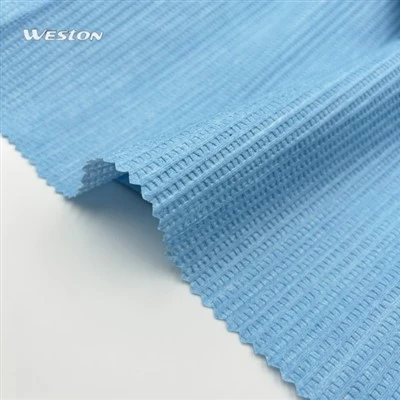
Eco-Conscious Single Layer Composite Spunlace Nonwoven Fabric | Weston Factory Sustainable Option
Product Basics - Key Specifications Table
|
Attribute |
Specification |
|
Product Name |
Eco-Conscious Single Layer Composite Spunlace Nonwoven Fabric |
|
Composition |
80% wood pulp + 20% PP |
|
Construction |
Single-layer composite, hydroentangled (spunlace), binder-free |
|
Basis Weight (Standard) |
50 gsm |
|
Standard Width |
3.2 m |
|
Standard Color |
White |
|
Surface Profile |
High-friction, soft-touch, low-lint |
|
Fluid Behavior |
Rapid uptake with controlled release; strong wet integrity |
|
Formats |
Jumbo rolls, slit rolls, sheets, pre-cut formats |
|
Custom Options |
GSM, width, color, emboss/texture, roll length, core size, packaging |
|
Optional Treatments |
Hydrophilic/hydrophobic tuning, antistatic adjustment, additive compatibility |
|
Processing Fit |
Saturation/coating, high-speed slitting, laminating, die-cutting |
|
Typical Uses |
Precision wiping, surface prep, auxiliary process layers, light-duty filtration |

Product Narrative: What Makes This Fabric Different
Weston Nonwoven's Single Layer Composite Spunlace Nonwoven Fabric is a purpose-built platform for modern converting lines and demanding end-use environments. Rather than stacking multiple plies with adhesives, Weston forms a unified web by hydroentangling pulp and PP fibers into a single matrix. This construction removes inter-ply slip and delamination pathways, resulting in cleaner edges, lower lint, and more predictable mechanical behavior.
Material balance at the fiber level: Wood pulp confers capillary absorbency, matte microtexture, and naturally higher friction-fostering secure handling and rapid fluid pick-up. Polypropylene contributes wet-strength retention, tensile resilience, and durability under mechanical stress without imposing a plastic-like feel.
Process predictability: Tight basis weight uniformity and controlled porosity provide consistent saturation during lotioning, surfactant dosing, or solvent impregnation, translating to stable product quality and better line efficiency.
Real-world payoff: Reduced micro-marring on delicate surfaces, lower particulate-induced defects, steadier converting tension profiles, and fewer stoppages-all of which support higher throughput and reliable outcomes.
Engineering, Hydroentanglement, and Material Science Benefits
Soft Traction, Not Abrasion
Pulp-rich micro-asperities increase friction for confident wet/dry handling while remaining skin-friendly and finish-safe.
Low-Lint Cleanliness
Binder-free fiber interlocking reduces free ends and particulate release-critical for optics, coatings, and precision assemblies.
Wet Strength That Holds Up
PP bridges maintain mechanical integrity under load when saturated, minimizing tear and edge crumble.
Efficient Absorb/Release Dynamics
Even porosity allows fast uptake and controllable release across a range of chemistries, helping maintain uniform wipe laydown.
Converter Stability
Consistent caliper and GSM help maintain web tension, reduce telescoping, limit dusting on slitter blades, and support precise die-cutting.
Compatibility Window
PP component contributes resilience to many shop-floor fluids and moderate temperatures, broadening use across industrial and commercial tasks.
Pro tip for impregnation and coating operations: For impregnation, run a trial to set target wet pick-up and dial in uniformity; expect even distribution thanks to the fabric's consistent porosity.
Visual Snapshot - Comparative Feature Matrix
|
Performance Aspect |
This Product |
Typical Multi-Ply Laminate |
|
Construction |
Single-layer, hydroentangled |
Multi-ply with adhesive interfaces |
|
Lint Potential |
Low (binder-free entanglement) |
Higher (interfacial shear, adhesive dust) |
|
Wet Integrity |
Strong (PP-reinforced) |
Variable (risk of ply slip) |
|
Converting Stability |
High (uniform GSM/caliper) |
Mixed (inter-ply slippage) |
|
Surface Grip |
High-friction, soft-touch |
Often grip or softness, not both |
|
Sustainability Angle |
Material-efficient single layer |
Additional adhesive/process steps |
Ideal For A Wide Range of Industrial and Commercial Uses
The friction-forward softness, low lint, and wet-integrity profile make Single Layer Composite Spunlace Nonwoven Fabric a versatile choice across sectors:
Precision Manufacturing
Component and housing wiping, optics-support tasks; reduces particulate and micro-scratch risk.
Automotive & Coatings
Panel prep prior to adhesive or clear-coat application; solvent-compatible wiping with less marring.
Food-Adjacent Facility Care
Non-contact equipment wipe-downs where cleanliness and lint control are important.
Healthcare-Adjacent Support Roles
Ancillary, non-contact applications such as tray liners and facility care where hygienic appearance matters.
Industrial MRO
Water- and oil-based spill pickup, equipment care wraps, and confident wet-grip handling.
Printing & Graphics
Press cleanup and printhead-adjacent wiping requiring soft, low-lint contact.
Converting for Consumer/Professional Wipes
Substrate for wet/dry wipes needing consistency, gentle hand-feel, and durable wet strength.
Performance Rationale: The Deeper Why
Friction–Softness Duality
Microtexture delivers traction without aggressive abrasion, enabling safe, confident handling for sensitive surfaces.
Single-Layer Efficiency
No adhesive interfaces means fewer failure modes, cleaner edges, and more stable dimensional performance.
Uniformity Drives Quality
Even basis weight and porosity increase repeatability in saturation/coating steps and improve line speed robustness.
Responsible Materials Strategy
80% wood pulp moderates polymer use while 20% PP sustains strength-supporting sustainability goals with practical durability.
Process Integration and Quality Controls
Inline Basis Weight Monitoring
Tight CV for consistent roll-to-roll behavior.
Controlled Deckle & Precision Slitting
Minimizes edge fuzz and debris, protects downstream optics and coatings.
Surface Cleanliness Protocols (Optional)
Post-process cleaning available to further limit loose fibers where needed.
Saturation/Coating Compatibility
Validated for common wipe chemistries; maintains hand-feel and tensile after treatment.
Traceability
Batch-level identification supports audits and continuous improvement.

Handling, Storage, and Converting Guidance
Storage
Keep in cool, dry areas away from direct sunlight to preserve fiber integrity.
Conditioning
Acclimate rolls to floor humidity and temperature before converting to minimize curl and web wander.
Tension & Nips
Use moderate, even tension; set nip pressure to protect surface texture.
Cutting/Die-Cutting
Use sharp tooling and proper anvil hardness for crisp edges with minimal fuzzing.
Impregnation/Coating
Run trials to establish target wet pick-up and uniformity-benefit from consistent porosity for even distribution.
Sustainability Perspective
Materials Mix
80% wood pulp reduces polymer dependency; 20% PP preserves wet/dry strength and service life.
Process Efficiency
Single-layer hydroentanglement eliminates adhesive bonding steps compared with multi-ply approaches.
Logistics
50 gsm enables more square meters per pallet, supporting reduced transport intensity.
End-of-Life
Streamlined composition can support responsible waste strategies under local guidelines.
(Testimonials / Case Studies)
Electronics Facility - Precision Wiping Conversion
Challenge: Lint-driven defects on high-gloss housings and inconsistent wet-out.
Weston Move: Adopted 50 gsm Single Layer Composite Spunlace Nonwoven Fabric with tuned hydrophilicity.
Outcome: Significant reduction in rework events, smoother converting at higher speeds, operator endorsement of soft grip.
Automotive Paint Prep Line
Challenge: Slip during wet wiping and fiber traces near clear-coat stages.
Weston Move: Implemented pulp-forward, PP-reinforced single-layer composite for wet-stage integrity.
Outcome: Fewer micro-marring incidents, more controlled solvent usage, improved finish consistency.
Hospitality & Janitorial Program
Challenge: Operator fatigue and variable performance across dry/damp tasks.
Weston Move: Leveraged high-friction softness and low-lint stability.
Outcome: Better user feedback, fewer sheet failures, more uniform chemical release.
Precision Printing House
Challenge: Need low lint near printheads without abrasive feel.
Weston Move: Deployed 50 gsm single-layer spunlace substrate.
Outcome: Reduced maintenance interruptions, cleaner color transitions.
Note: Examples illustrate typical contexts for Single Layer Composite Spunlace Nonwoven Fabric performance.
Related Weston Spunlace Recommendations (Mentioned Briefly)
Nonwoven Medical Protective Clothing Fabric
Disposable Medical Nursing Pads
Microfiber Medical Device Packaging
Meltblown Nonwoven For Disposable Wet Wipes
People Also Ask
Q1: What makes Single Layer Composite Spunlace Nonwoven Fabric different from multi-ply laminates?
A1: It's a single, hydroentangled matrix-not layers glued together-so it avoids inter-ply slip and delamination. You get cleaner edges, lower lint, and more stable converting and wet performance.
Q2: How does the 80% wood pulp + 20% PP blend achieve both grip and softness?
A2: Wood pulp provides matte microtexture and capillary absorbency for high friction and a gentle touch. PP reinforces the structure, preserving softness while maintaining wet and dry strength.
Q3: Can this fabric handle both water-based and many solvent-based wiping tasks?
A3: Yes. The pulp delivers fast uptake, and PP helps retain integrity under common water-based and many solvent-based chemistries. Always validate with your specific formulation.
Q4: Why is low lint so important for precision manufacturing?
A4: Particulate can cause defects-swirls on coatings, inclusions under films, fouling near optics. Low-lint substrates reduce rework, protect finishes, and help keep lines running.
Q5: Is the 50 gsm format suitable for high-speed slitting and automated converting?
A5: Yes. Uniform GSM and controlled caliper support stable tension, reduce telescoping, and keep blade dust down, enabling higher throughput with predictable quality.
Q6: How does hydroentanglement provide strength without binders?
A6: High-pressure water jets mechanically interlock fibers into a cohesive web. This binder-free structure reduces free ends, lowers lint, and maintains breathable porosity.
Q7: What customization options are available?
A7: GSM, width (beyond the 3.2 m standard via slitting), colors, emboss/texture, roll length, core size, packaging, and functional treatments like hydrophilic/hydrophobic or antistatic tuning.
Q8: Which industries gain the most value from the high-friction, soft-touch surface?
A8: Precision manufacturing, automotive coatings, printing/graphics, industrial MRO, hospitality, and converting for consumer/pro wipes all benefit from the dual grip-and-gentle profile.
Q9: What does "trial wet pick-up" mean during impregnation?
A9: It's a small-scale test to determine the optimal liquid load the fabric should hold after squeeze or nip. Dialing this in ensures uniform distribution-supported by the fabric's consistent porosity.
Hot Tags: single layer composite spunlace nonwoven fabric, China, manufacturers, factory, customized, wholesale, Mint Green Embossed Wood Pulp Polyester Spunlace Rolls, Heavy Duty Degreasing Wipes, Household Cleaning Wood Pulp Spunlace Fabrics, Outdoor Nonwoven Fabric Rolls, Double Layer Wood Pulp PP Spunlace Nonwoven For Oil Cleaning, Red Woodpulp PP Spunlace For Surface Wiping