Why Sink Time Is the Most Overlooked Specification When Sourcing Household Cleaning Nonwovens
The spec nobody asks about - until the wipes don't work
Picture this. A buyer finalizes an order of Household Cleaning Wood Pulp Spunlace Fabrics after a thorough sourcing process. The GSM is right. The tensile strength passes. The color matches the brand palette. The price fits the budget. Samples were approved three weeks ago and the production run has already shipped.
Then the feedback starts coming in.
Not complaints about durability. Not about color bleeding or sizing inconsistency. The feedback is harder to pin down: the cloth feels slow. It touches a spill and for a moment - just a moment - nothing seems to happen. The liquid sits there. The user presses harder, wipes again, wonders why this cloth doesn't feel as responsive as the paper towels they replaced it with. They cannot name what is wrong. They just know something is.
That delay is measurable. It has a standard test method. It produces a single number in seconds. And in the vast majority of sourcing conversations for Household Cleaning Wood Pulp Spunlace Fabrics and Pop-Up Dishwashing Cloths, nobody asks for it.
The specification is called sink time. This article explains what it measures, why it gets skipped, what drives it at the fiber level, and why it quietly determines whether a cleaning fabric feels satisfying or frustrating in the hands of the person actually using it.

Section 1: What Sink Time Actually Measures
One second or ten seconds - here's why that gap matters in your kitchen
Sink time is straightforward to define. When a sample of nonwoven fabric is placed flat on the surface of still water, sink time is the number of seconds that pass before the fabric becomes fully wetted and drops below the surface. In Chinese national standards, the test method is GB/T 24218.6-2010. The acceptable threshold for household cleaning applications is ≤10 seconds. Fabrics that perform well in this category typically achieve sink times of 1 to 3 seconds.
That is the definition. What matters more is understanding what sink time is actually telling you - and what it is not.
Sink time does not measure total liquid absorption capacity. That is a separate specification called water absorbing capacity, expressed as grams of liquid absorbed per gram of fabric. A fabric can have excellent total absorption capacity and still have a slow sink time. These two values measure different things. Water absorbing capacity tells you how much liquid the fabric can hold at saturation. Sink time tells you how quickly the fabric begins the process of absorbing at all. In household cleaning applications, both matter. But they answer different questions, and conflating them is one reason sink time gets underweighted in sourcing evaluations.
A helpful way to think about it: a thick cotton bath towel has high total absorbency. If you have ever pulled one fresh from the packaging and noticed that water briefly beads on its surface before soaking in, you have experienced a sink time problem. That hesitation exists because the cotton fibers have not yet been washed enough to remove the surface finishes applied during manufacturing. The towel will absorb - eventually. But the initial response is slow, and it is perceptible.
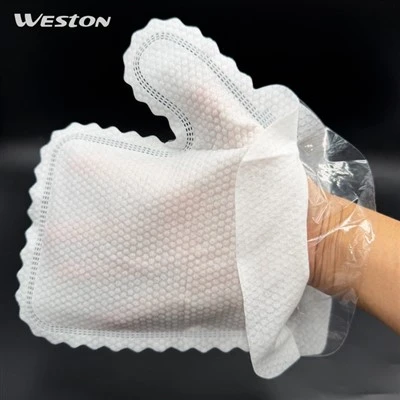
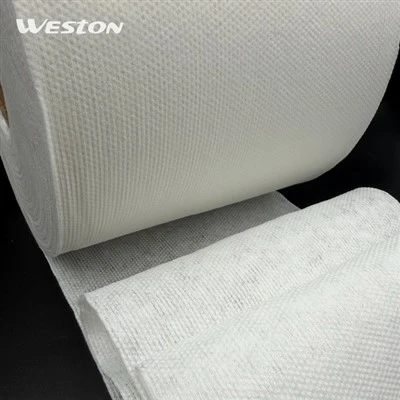
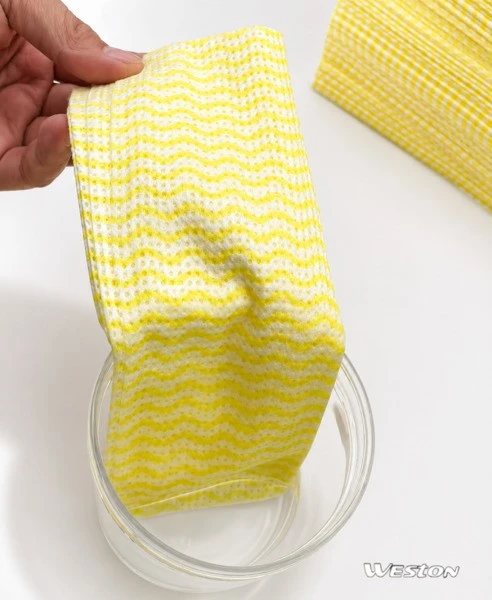
In Pop-Up Dishwashing Cloths and Household Cleaning Wood Pulp Spunlace Fabrics used in kitchen and bathroom environments, that same hesitation is directly felt by the end user on every single wipe. A sink time above five seconds is usually noticeable even to someone who has never heard of the specification. A sink time at or near one second - the result Weston's standard hexagonal embossed Household Cleaning Wood Pulp Spunlace Fabric achieves under GB/T 24218.6-2010 testing - means the fabric responds to contact immediately, which is what gives a cleaning cloth the feeling of actually working rather than merely existing.
Section 2: Why Buyers Skip It - and Why That Is Understandable
GSM is easy to specify. Sink time feels harder to explain to a purchasing team.
This is not a criticism. The reasons sink time gets overlooked during sourcing are real and understandable, and it is worth being honest about them.
The first reason is visibility. GSM - grams per square meter - is the specification that drives most initial conversations because it is intuitive. A heavier fabric feels more substantial when you hold a sample. You can feel the difference between 60 gsm and 115 gsm without a test instrument. Tensile strength can at least be roughly approximated by pulling a sample with your hands. Sink time requires a container of water, a sample, a timer, and a standardized procedure. It does not translate into a sensory impression during a sample review meeting.
The second reason is datasheet design. When suppliers provide product documentation for Household Cleaning Wood Pulp Spunlace Fabrics, the headline numbers are almost always GSM, tensile strength, and sometimes pH. Sink time is present in a full test report - it appears in Weston's complete product documentation - but it is rarely pulled forward into a summary sheet or product listing. If a specification does not appear prominently in the documentation a buyer receives, the buyer has to know to ask for it specifically. Most do not know to ask.
The third reason is sourcing pressure. Buyers evaluating nonwoven cleaning fabrics are typically managing a range of competing priorities: cost per roll, minimum order quantities, lead time, color consistency, packaging format, and certification requirements. Functional performance specifications get evaluated later in the process, sometimes after a purchase order has already been placed. In that environment, specifications that are not explicitly flagged as critical get deprioritized - not through negligence, but through the ordinary mechanics of how procurement decisions get made under time and budget pressure.
None of this reflects poorly on buyers. It reflects the structure of standard sourcing conversations, and the solution is straightforward: the specification needs to be talked about more, explained more clearly, and included in documentation more prominently. That is what this article is attempting to do.
Section 3: How Fiber Composition Directly Controls Sink Time
Wood pulp changes everything here - and here is the science behind it
This is where the sourcing conversation gets interesting, because sink time is not an arbitrary number. It is a direct consequence of what the fabric is made of and how it is constructed. Once you understand the fiber-level mechanism, you can use sink time not just as a pass/fail threshold but as a diagnostic for material quality.
Wood pulp fibers are inherently hydrophilic. Their cell wall structure contains hydroxyl groups - chemically, OH groups bonded to the cellulose polymer chain - that form hydrogen bonds with water molecules on contact. This means liquid is drawn into the fiber structure almost instantaneously rather than sitting on the surface and waiting for capillary forces to pull it in. This is the primary reason Household Cleaning Wood Pulp Spunlace Fabrics and Pop-Up Dishwashing Cloths made with a high wood pulp content consistently achieve fast sink times compared to fabrics composed primarily of synthetic fibers.
Polypropylene behaves differently. PP is hydrophobic - it actively repels water at the molecular level. In a wood pulp PP composite fabric, the PP spunbond layer provides structural strength, tear resistance, and the dimensional integrity that allows the fabric to withstand repeated wet scrubbing. The wood pulp layer drives liquid uptake. The composite structure is the engineering solution that allows a single fabric to deliver both properties: the absorbency of a natural fiber and the durability of a synthetic one.
But the ratio and distribution of these two components matter enormously, and this is where manufacturing quality becomes visible through sink time data.
In Weston's Household Cleaning Wood Pulp Spunlace Fabrics, the composition is 74% wood pulp and 26% polypropylene, verified per GB/T 2910-2009. Production uses a two-step hydroentanglement process. In the first step, wood pulp fibers are formed into a wet-laid substrate through a papermaking-derived method, establishing fiber uniformity and the pore structure that governs liquid transport. In the second step, this substrate is bonded to a PP spunbond layer through high-pressure water jets - the hydroentanglement step - which creates a three-dimensional fiber interlock throughout the fabric cross-section. The wood pulp fibers end up distributed through the material, not concentrated on one surface layer.
This matters for sink time because it means that whichever face of the fabric contacts a spill, it immediately engages with hydrophilic wood pulp fibers. There is no hydrophobic surface layer to overcome.
A fabric where wood pulp is poorly distributed - a quality control problem that is common in lower-cost manufacturing where fiber uniformity is less tightly controlled - can pass a visual inspection and even a tensile strength test while producing inconsistent or slow sink times. Sink time, in this sense, is an indirect quality indicator for the consistency of the hydroentanglement process itself. A fabric that achieves 1 second in testing is a fabric where the fiber architecture is doing what it is supposed to do. A fabric that achieves 8 seconds in the same test, while still technically passing the ≤10 second threshold, is a fabric where something in the manufacturing process is less controlled than it should be.
Weston's standard hexagonal embossed Household Cleaning Wood Pulp Spunlace Fabric achieves a tested sink time of 1 second against the ≤10 second requirement of GB/T 24218.6-2010. That result is not a coincidence. It is a consequence of wood pulp content, fiber distribution quality, and process control during hydroentanglement.
Section 4: Sink Time in Real Use - What It Feels Like on the Other End
The person using the cloth does not know about GB/T 24218.6. They just know it works or it does not.
Standards and test methods are important. But at the end of the supply chain, there is a person standing at a kitchen counter, dealing with a spill, using a Pop-Up Dishwashing Cloth or a cut sheet of Household Cleaning Wood Pulp Spunlace Fabric. That person has no awareness of any specification. What they have is an experience, and that experience is shaped directly by sink time.
Consider two side-by-side scenarios.
In the first, a person wipes a wet countertop with a fabric that has a sink time of 1 second. The cloth touches the surface. Liquid transfers into the fabric immediately. The motion feels controlled - the cloth is pulling the liquid in as it moves across the surface rather than pushing it around. The job is done in one or two passes. The cloth feels satisfying to use.
In the second scenario, the same motion with a fabric where sink time is 7 or 8 seconds. The cloth makes contact. For a fraction of a second that is perceptible but hard to describe, the liquid hesitates. It smears slightly before being absorbed. The user instinctively applies more pressure, or makes an extra wipe, compensating for a lag they cannot quite identify. The countertop gets clean. But something felt off, and that feeling compounds over hundreds of uses.
This gap between performing and satisfying is where sink time lives. And for brands and retailers sourcing Pop-Up Dishwashing Cloths or Household Cleaning Wood Pulp Spunlace Fabrics under a private label, it is a gap that shows up not in the incoming quality inspection but in consumer reviews, return rates, and repeat purchase data - well after the sourcing decision has been made and acted upon.
Consumers comparing a nonwoven cleaning cloth to paper towels - which have very fast initial absorption due to their cellulose fiber structure - are making an implicit sink time comparison every time they use the product. If the nonwoven feels slower than a paper towel, the product feels like a downgrade even if its total absorbency, durability, and cost per use are objectively better. That perception problem is real, and it is avoidable. Specifying sink time during sourcing is how you avoid it.
Section 5: How to Evaluate Sink Time When Sourcing
Ask for the number. Then ask what drives it.
The practical guidance here is simple. When evaluating samples or requesting documentation from a nonwoven fabric supplier, ask specifically for a full product test report that includes sink time. The number should be expressed in seconds and attributed to a recognized test standard - GB/T 24218.6-2010 is the relevant Chinese national standard. ISO equivalents exist for buyers working within European or international procurement frameworks.
For Household Cleaning Wood Pulp Spunlace Fabrics and Pop-Up Dishwashing Cloths intended for household use, interpret the results as follows. A sink time at or below 3 seconds is a strong result and will be imperceptible to end users - the fabric will feel immediately responsive. A result between 3 and 10 seconds is within the acceptable range by standard but may be noticeable in demanding applications or when compared directly to faster-performing alternatives. A result above 10 seconds is a wettability problem. It will not improve through downstream processing such as cutting, embossing, or packaging, and it should be treated as a rejection criterion rather than a negotiating point.
If a supplier cannot provide a sink time figure, or does not include it in standard test documentation, treat that absence as informative. It indicates either that sink time is not being tested as a production variable, or that it is not being controlled to a consistent standard. Neither situation is acceptable for a product where end-user experience depends on immediate liquid response.
There is a second question worth asking, and it is the more revealing one: does sink time remain consistent across colorways?
In Household Cleaning Wood Pulp Spunlace Fabrics, different color variants are not always produced through identical processes. Pigments are added, and in some production methods, surface treatments are applied to fix color or improve color uniformity. These treatments can affect surface wettability - a fabric that achieves 1 second in white or natural may achieve 4 or 5 seconds in a treated color variant, not because the fiber structure has changed, but because the surface chemistry has.
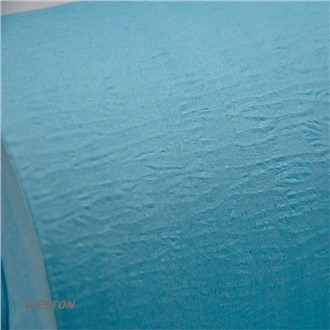
This is a quality control point, not an assumption. At Weston, food-contact test reports and performance specifications including sink time are documented individually for each color variant of the hexagonal embossed Household Cleaning Wood Pulp Spunlace Fabric - red, blue, green, and yellow. This is not standard industry practice. It is a deliberate decision based on the recognition that color consistency and performance consistency are separate quality dimensions that both require verification.
When requesting documentation, ask for test reports specific to the colorway you intend to purchase. A supplier who can provide them has tested systematically. A supplier who provides a single report for all colorways and asserts consistency without data is asking you to trust an assumption.
Section 6: Sink Time Alongside the Specifications That Do Get Checked
It does not replace GSM. It completes the picture.
Sink time is one specification among several that together define whether a Household Cleaning Wood Pulp Spunlace Fabric or Pop-Up Dishwashing Cloth will perform well in use. It is not the only specification that matters, and framing it as such would be overstating the case. What is true is that it is the specification most consistently absent from sourcing conversations, and its absence leaves a gap in the evaluation framework.
A complete evaluation of Household Cleaning Wood Pulp Spunlace Fabrics for kitchen and household cleaning applications should consider at minimum the following dimensions together.
Weight (GSM) determines the physical feel of the fabric in hand, its cost per square meter, and its thickness in use. Weston's household cleaning fabric is available from 35 to 120 g/m², with the standard tested variant at 115 g/m² and a measured thickness of 0.78 mm at that weight.
Tensile strength in both machine direction (MD) and cross direction (CD) determines how the fabric holds up under the mechanical stress of scrubbing. Weston's standard 115 gsm fabric achieves 112 N/5cm in MD and 72 N/5cm in CD, tested per GB/T 24218.3-2010. The higher CD elongation - 88% versus 35% in the MD - means the fabric flexes and conforms to curved surfaces without tearing, which is directly relevant for cleaning applications involving bowl interiors, curved faucets, and sink edges.
Water absorbing capacity tells you how much liquid the fabric can hold at saturation. Weston's standard fabric achieves 3.4 g/g under GB/T 24218.6-2010 testing. This figure indicates how much liquid a single sheet can manage before it needs to be rinsed or replaced during a cleaning task.
Sink time tells you how quickly absorption begins. As discussed throughout this article, this is the specification most directly tied to how the fabric feels in use, and it is the one most consistently absent from standard sourcing documentation.
pH value matters for food-contact and skin-safe applications. Weston's fabric tests at neutral (6–8) per GB/T 7573, which means it does not introduce chemical residue to food preparation surfaces and does not interact adversely with common household cleaning agents.
Certifications establish baseline credibility for both the product and the supplier. For Household Cleaning Wood Pulp Spunlace Fabrics and Pop-Up Dishwashing Cloths sold in European and North American markets, the relevant certifications include ISO 9001 for manufacturing process control, FSC for responsible wood pulp sourcing, FDA compliance for food-contact applications in the US market, and EU food contact certification under EC No 1935/2004 for European markets. Weston holds all four, with food-contact documentation available per colorway for the hexagonal embossed household cleaning fabric.
Sink time fits into this framework as the specification that most directly predicts the end-user experience at the moment of contact. GSM, tensile strength, and water absorbing capacity determine how the fabric performs before and after that moment - how it feels in hand, how long it lasts, and how much it can hold. Sink time is what happens in the first second. In household cleaning applications, that first second is the one the user actually perceives.
One number. One second. Worth asking about.
Most sourcing conversations for Household Cleaning Wood Pulp Spunlace Fabrics and Pop-Up Dishwashing Cloths will not begin with a sink time question. That is not going to change overnight, and it does not need to. What can change is that buyers who read articles like this one leave with a clearer picture of what sink time measures, why it matters, and how to ask about it in a way that gets useful information from a supplier.
The specification exists. The test method is standardized. The data is available from suppliers who are testing systematically. The only thing missing, in most sourcing conversations, is the question.
If you are evaluating Household Cleaning Wood Pulp Spunlace Fabrics or Pop-Up Dishwashing Cloths for household, private-label, or retail applications and would like full test documentation - including sink time results by colorway, tensile strength data, food-contact certification, and GSM range specifications - Weston's technical team is available to provide it before any order commitment is made.
Contact us at info@westonmanufacturing.com to request a complete test report package or to discuss specification requirements for your application.