Nonwoven Innovation in Beauty Care: The Future of Disposable Hair Wraps
Most people assume the biggest hygiene risk in a salon chair is a dirty comb or an unwashed brush. Few think about the towel wrapped around their wet hair. Yet damp cotton is one of the most microbiologically active surfaces a client will touch during a service. One study of bath towels used by tertiary students found bacterial counts climbing from roughly 34,000 colony-forming units after a single week of use to nearly 290 million after three weeks - an almost 10,000-fold increase driven entirely by moisture and reuse. That single statistic reframes the question this article asks: why are professional beauty environments only now starting to replace cotton hair wraps with single-use nonwoven materials, and what does the engineering behind those materials actually solve.

A Fiber Problem, Not a Convenience Problem
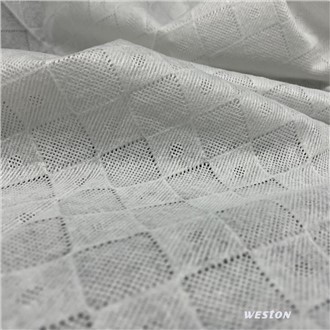
The conventional pitch for disposable hair wraps is "convenience." That framing undersells what is actually a materials-science achievement. Woven cotton relies on an interlaced grid of yarns - strong, but structurally repetitive, with predictable gaps that trap moisture and organic residue deep in the loop pile. Nonwoven fabric, by contrast, is built from a random three-dimensional web of fibers bonded through processes like hydroentanglement (spunlace) or thermal/air-laid bonding, rather than woven or knitted.
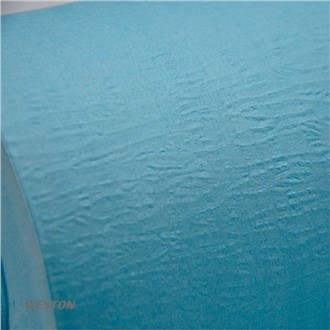
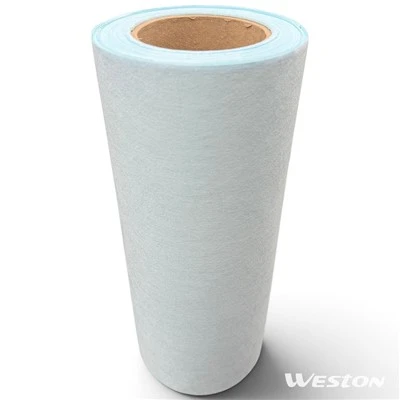
That randomness is the point. A disordered fiber network creates a much larger and more irregular internal surface area relative to its weight, which is what allows a nonwoven hair wrap to achieve high liquid uptake at a fraction of the basis weight (grams per square meter) of a terry towel. Spunlace nonwovens are already the dominant substrate for the wipes and personal-care industry precisely because hydroentanglement - fibers locked together with high-pressure water jets rather than needles, adhesives, or heat - produces a fabric that is simultaneously strong when wet and soft against skin, a combination that is notoriously hard to engineer. Weston's disposable hair wrap material sits inside this same fiber-science lineage: a viscose/polypropylene-type composite tuned so the wrap holds its shape and tensile strength around saturated hair, without the stiffness or scratchiness that plagues cheaper single-use substrates.
The Microbiology Nobody Puts on the Menu
Salon marketing rarely mentions microbiology, but the data is hard to ignore. Independent testing has found that some bacteria - including S. aureus, E. coli, and E. faecium - can survive on cotton towel fibers for up to 21 days, and that the looped pile structure of cotton terry actually traps organisms deeper into the fabric, making them harder to remove even with regular laundering. Separate industry testing found that roughly nine out of ten used barber towels carried coliform bacteria within 24 hours of use. Salon hygiene guidance links poorly laundered towels directly to transmissible conditions such as folliculitis and scalp ringworm - conditions that have nothing to do with the stylist's skill and everything to do with the substrate wrapped around a client's wet scalp.
This is where a single-use nonwoven wrap earns its place on genuinely different grounds than "it's more sanitary." It removes the reuse variable from the equation entirely. There is no laundering cycle to fail, no three-week-old towel accidentally pulled from the bottom of the stack, no biofilm accumulating on a loop pile that visually still looks clean. For salons, spas, and hospitality groups operating under increasingly strict infection-control expectations, a disposable wrap is less a convenience upgrade and more a structural fix to a cross-contamination risk that traditional laundering protocols were never fully able to close.
The Hidden Ledger: A B2B Cost Argument, Not an Environmental Slogan
Sustainability messaging tends to dominate disposable-product marketing, but for a hotel group, salon chain, or spa operator, the more persuasive argument is financial. Cotton towels carry a full lifecycle cost that rarely appears on a single line item: purchase price, industrial laundering water and energy, detergent and chemical costs, staff time for sorting and folding, and a replacement cycle driven by fiber degradation from repeated hot-water washing and chemical exposure. Operators already know that daily washing - the minimum standard recommended for salon towels - accelerates fiber breakdown and shortens the usable life of every towel in rotation.
A disposable nonwoven wrap converts that recurring, semi-hidden operating cost into a fixed, predictable per-use cost with zero laundering overhead. For high-volume operations, that shift in cost structure - not the "eco-friendly" label - is usually the deciding factor in a procurement conversation. It's also a scalable argument: the global market for disposable nonwoven products was valued at roughly USD 20 billion in 2023 and is projected to grow at close to 6.5% annually through 2032, largely on the back of exactly this kind of institutional cost logic in hygiene-sensitive sectors.

The Psychology of "Obviously New"
There's a behavioral angle here too. A folded, sealed, visibly unused nonwoven wrap functions as a trust signal in a way a folded cotton towel never can - even a genuinely clean one. Consumers can't verify a towel's wash history by looking at it, but they can visually and tactically confirm that a disposable wrap has never touched another person's hair. That single-use, "obviously new" texture works the same way disposable dental bibs or sealed slippers do in other personal-care contexts: it converts an invisible hygiene claim into a visible, felt one, which matters more to post-pandemic consumers than most operators give it credit for.
Engineering for the Real World, Not the Lab
None of this works if the product performs poorly in practice. The functional design questions that separate a good disposable hair wrap from a gimmick are practical: does the elasticated edge hold on different head sizes and hair volumes; does the fabric dry quickly enough to avoid trapping heat against the scalp; can the material be customized in weight, embossing, or branding for different service tiers. These are the same engineering trade-offs spunlace producers navigate across the broader hygiene category - balancing absorbency, breathability, and wet strength - just applied to a narrower, more specialized use case.
Where This Goes Next
The same substrate logic extending into salons is already visible in surgical and pre-op settings, where single-use nonwoven materials are standard precisely because reused textiles are an unacceptable infection vector. Pet grooming, wellness retreats, and short-term hospitality are the next plausible frontiers. As nonwoven manufacturing scales and per-unit costs continue to fall, the disposable hair wrap looks less like a niche salon amenity and more like the leading edge of a broader material substitution - one driven less by marketing language around sustainability, and more by fiber science, infection-control data, and a cost ledger that finally has a line item for what a shared towel actually costs.