In an era defined by climate urgency and ecological reckoning, the choices we make in material science carry profound consequences. Spunlace nonwoven fabrics, once overlooked in the grand tapestry of sustainable innovation, are now emerging as a pivotal player in the transition toward a circular economy. But what does their environmental footprint truly look like? How do they fare in the twin battles against waste and pollution? At WestonNonwoven, we don't just ask these questions-we dissect them with scientific rigor, unflinching honesty, and a commitment to redefining what "sustainable manufacturing" can mean. This is not a superficial exploration; it's a deep dive into the lifecycle of spunlace nonwoven, from raw material to end-of-life, and how products like Multi-Purpose Water & Oil Absorbent Pads, Washable Lazy Dishwashing Cloth, and Marine Oil Absorbent Pads are rewriting the rules of environmental responsibility.

The Myth of "Disposable": Biodegradability Beyond Buzzwords
The textile industry's dirty secret lies in its love affair with permanence-plastics masquerading as fabrics, products designed for single use, and waste streams that outlive generations. Traditional nonwovens, often derived from petroleum-based polymers like polypropylene, contribute to this crisis, lingering in landfills for centuries. But spunlace nonwoven is cut from a different cloth-literally.
The Power of Plant-Based Foundations
At the core of WestonNonwoven's philosophy is a rejection of fossil fuel dependency. Our spunlace nonwoven materials are built on pulp bamboo fiber, wood pulp, and other natural cellulosic fibers-materials that carry the mark of the earth, not the oil rig. Unlike synthetic fibers, these plant-based substrates possess an inherent ability to biodegrade, breaking down into harmless organic matter when their useful life ends. But let's be clear: not all "biodegradable" claims are created equal. Many industries greenwash with vague terms, ignoring the critical factors of time and conditions.
WestonNonwoven's spunlace nonwovens degrade exponentially faster than their plastic counterparts. In industrial composting facilities, where heat and microbial activity thrive, our materials can lose 80% of their mass within 90 days-a stark contrast to the 100+ years required for polypropylene to break down. Even in natural environments, such as soil or marine ecosystems, the cellulosic structure decomposes without leaving microplastic fragments, a plague plaguing synthetic textiles. This is why our Marine Oil Absorbent Pads, deployed in delicate ocean environments, don't just solve immediate pollution crises-they vanish responsibly, leaving no secondary environmental burden.
The Fallacy of "Single-Use"
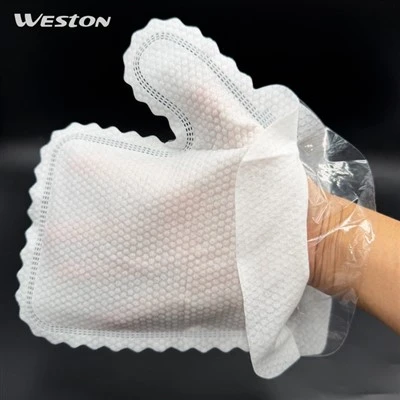
The greatest environmental win of spunlace nonwoven may be its defiance of the disposable mindset. Take our Washable Lazy Dishwashing Cloth, for example. Crafted from durable spunlace nonwoven, it replaces hundreds of single-use paper towels or plastic sponges over its lifespan. Each wash rejuvenates its structure, maintaining absorbency and cleaning power without degrading-proof that sustainability isn't about sacrifice, but smarter design. By prioritizing reuse, we transform "waste" from an inevitability into an impossibility.

Recycling Redefined: Closing the Loop on Nonwoven Waste
Biodegradability is a vital first step, but true sustainability demands a circular system-one where waste is just a misplaced resource. The recycling potential of spunlace nonwoven shatters the myth that nonwovens are a one-way ticket to the dump.
The Science of Material Reclamation
Spunlace nonwovens, especially those made from 100% natural fibers, are inherently recyclable. The mechanical bonding process (the "spunlace" technique, which uses high-pressure water jets to entangle fibers) creates a structure that can be disintegrated and repulped without chemical harshness. At WestonNonwoven, we've pioneered closed-loop systems where post-industrial waste-trim scraps, testing samples, and production offcuts-is collected, processed, and reincorporated into new products. This reduces raw material demand by up to 30% and eliminates landfill contribution from our manufacturing footprint.
But the magic doesn't stop at factory walls. Post-consumer recycling is where the real challenge-and opportunity-lies. Our Multi-Purpose Water & Oil Absorbent Pads, used in industrial spills or household cleanup, can be collected, sanitized, and repurposed into lower-grade nonwovens for applications like packaging or agricultural mulch. Unlike synthetic nonwovens, which degrade in quality when recycled (a phenomenon called "downcycling"), natural-fiber spunlace maintains its integrity through multiple lifecycle iterations, creating a truly circular economy.
Confronting the Recycling Paradigm
Critics argue that recycling infrastructure for nonwovens is underdeveloped. They're not wrong-but at WestonNonwoven, we don't wait for systems to catch up; we build them. We collaborate with waste management partners to create collection streams for our products, educate consumers on proper disposal, and invest in R&D to make recycling easier and more efficient. Sustainability isn't a slogan; it's a supply chain revolution, one fiber at a time.
Manufacturing as a Force for Good: Redefining "Sustainable Practices"
The environmental impact of a product begins long before it reaches the consumer. At WestonNonwoven, we treat our manufacturing facilities as laboratories for ecological innovation, where every process is scrutinized for its carbon, water, and energy footprint.
The Water-Wise Revolution
Spunlace nonwovens are made using water-jet technology, a process that historically consumed vast amounts of H2O. We flipped the script. Our facilities recycle 98% of the water used in production, treating it through a closed-loop filtration system that removes contaminants without harsh chemicals. The water reenters the production cycle cleaner than when it arrived, reducing our freshwater intake by 70% compared to industry standards. This isn't just good for the planet; it's a testament to what's possible when innovation meets intention.
Energy: From Guzzler to Guardian
Traditional textile manufacturing is a fossil fuel guzzler, but WestonNonwoven runs on renewable energy-100% of the electricity in our facilities comes from wind and solar sources. Even our heating systems utilize waste heat from production processes, turning what was once a liability into an asset. These changes didn't happen overnight; they're the result of years of reengineering, reimagining, and refusing to accept "this is how it's always been done."
Chemicals: The Silent Pollutants
Many textile factories drown fibers in toxic dyes and finishing agents, but our spunlace nonwovens are different. We use only chemical free natural dyes and biodegradable binders, ensuring no harmful chemicals leach into ecosystems or touch human skin. Our Washable Lazy Dishwashing Cloth, designed for daily kitchen use, is a testament to this-safe for your family, safe for the planet.
The Ripple Effect: Spunlace Nonwoven in Global Sustainability
The environmental benefits of spunlace nonwoven extend far beyond individual products. Consider our Marine Oil Absorbent Pads, deployed in oil spill emergencies. Unlike plastic-based absorbents that sink or fragment, our pads float efficiently, absorb 10x their weight in oil, and biodegrade afterward-turning an ecological disaster into a manageable crisis without creating long-term pollution. In agriculture, our nonwovens are used as mulch films that decompose alongside crops, eliminating the need for plastic mulch that litters fields for decades.
These applications prove that sustainability isn't a niche; it's a necessity. And WestonNonwoven is not just meeting standards-we're raising them, showing that profitability and planet can coexist when innovation is guided by purpose.

A Call to Action: Join the Sustainable Revolution
The question isn't whether spunlace nonwoven is sustainable-it's whether we have the courage to embrace the change it represents. For brands, it means choosing materials that align with your environmental values, not just your bottom line. For consumers, it means demanding products that respect both your needs and the planet's.
WestonNonwoven's Multi-Purpose Water & Oil Absorbent Pads, Washable Lazy Dishwashing Cloth, and Marine Oil Absorbent Pads are more than products; they're proof that sustainability can be powerful, practical, and profitable. They're built on a foundation of scientific rigor, innovation, and a relentless commitment to doing better-for you, for your customers, and for the only home we have.
The time for half-measures is over. The environmental impact of spunlace nonwoven isn't just a report; it's a revolution. Be part of it.
For partnerships, bulk orders, or technical inquiries:
info@westonmanufacturing.com