PLA, Wood Pulp, Paper or Polypropylene: Which Nonwoven Material Is Actually Better for the Planet?
When choosing sustainable nonwoven materials, there is no single winner for every application. PLA, wood pulp, paper, and polypropylene (PP) have different raw material sources, performance characteristics, manufacturing requirements, and end-of-life options. A material that performs well in one application may create unnecessary environmental trade-offs in another.
For buyers of wipes, hygiene products, packaging, and industrial cleaning materials, the better question is not simply which material is biodegradable or recyclable. It is which material can deliver the required performance with the lowest overall environmental burden under realistic production, use, and disposal conditions.
This distinction matters because a lighter material may require more layers to achieve the same strength, while a highly absorbent material may reduce the number of wipes needed for a cleaning task. Likewise, a compostable material offers limited practical benefit when suitable collection and composting facilities are unavailable.
Understanding these trade-offs helps buyers select materials based on evidence rather than environmental labels alone.
Before Comparing Materials, Understand What They Actually Are
PLA, wood pulp, paper, and PP are often discussed as alternatives, but they do not belong to exactly the same material category.
PLA (polylactic acid) is a polymer that can be manufactured from renewable biological feedstocks. Its environmental performance depends on its production route, energy requirements, product construction, and disposal conditions.
Wood pulp is a cellulose-based raw material obtained from wood. It is used in paper production and in various absorbent products, including certain nonwoven structures.
Paper is a finished sheet material generally made from cellulose fibers. Its characteristics depend on the fiber source, manufacturing process, coatings, additives, and whether recycled fibers are used.
Polypropylene (PP) is a thermoplastic polymer commonly produced from fossil-based feedstocks. It is widely used in nonwoven materials because its properties can be tailored to different product requirements.
Another distinction is equally important: spunlace is a manufacturing technology in which high-pressure water jets entangle fibers to form a nonwoven web. It is not a separate raw material.
A spunlace fabric may contain viscose, cotton, PLA, wood pulp combined with other fibers, or different fiber blends, depending on its construction. Paper, by contrast, is manufactured through a different sheet-forming process.
This means buyers should compare materials at the correct level. A wood pulp fiber is not directly equivalent to a finished paper sheet, and a polymer's environmental characteristics do not automatically describe the performance or disposal options of a complete nonwoven product.
What Actually Determines the Environmental Impact of a Nonwoven Material?
Raw material sourcing is only the beginning
Renewable resources can reduce dependence on fossil raw materials, but renewable origin alone does not establish that a product has a lower overall environmental impact.
Buyers should consider how the feedstock is produced, what land and water resources are required, how it is processed, and whether its source can be traced.
For example, two materials derived from plant sources may have different manufacturing processes and energy requirements. Similarly, the environmental performance of wood pulp depends partly on forest management, fiber processing, and the characteristics of the final product.
The same principle applies to recycled materials. Recycled content can reduce demand for virgin resources, but its benefits depend on collection, processing, material quality, and the product it replaces.
Manufacturing can change the comparison
Fiber preparation, web formation, water-jet entanglement, drying, finishing, and converting all contribute to the footprint of nonwoven products.
A comparison that considers only the raw material while ignoring manufacturing may therefore give an incomplete answer.
Water consumption, energy sources, production yield, and material waste should be considered where relevant. Buyers comparing suppliers should also check whether environmental figures cover only the raw material or the complete manufacturing process.
The most useful comparison is based on the same function
One of the most overlooked purchasing mistakes is comparing one kilogram of one material with one kilogram of another without considering what each material can do.
For a disposable cleaning wipe, a more meaningful comparison might be the material required to absorb a specified amount of liquid, clean a defined surface area, and retain sufficient strength throughout the task.
This approach follows the logic of life cycle assessment (LCA), which evaluates environmental impacts across a defined product system. The International Organization for Standardization's ISO 14040 framework addresses the principles and structure of LCA.
In practical terms, buyers should ask:
How much material is needed to perform the same task?
Does one material require additional layers or reinforcement?
How much waste is generated during production and use?
Can the finished product enter a suitable recovery or disposal system?
The answers often reveal more than a simple comparison of material names.
PLA Nonwoven Fabric: Is Bio-Based Always Better?
PLA has become an important option for manufacturers exploring alternatives to conventional fossil-based polymers. However, its environmental advantages need to be assessed against the intended application and end-of-life route.
Where PLA can make sense
PLA can be produced using renewable biological feedstocks, offering an alternative to polymers derived entirely from fossil resources.
It may also be suitable for products designed to meet specific compostability requirements, provided the finished product satisfies the applicable criteria and a compatible disposal system is available.
For brands developing new nonwoven products, PLA provides another material option when renewable feedstock content or verified compostability is part of the product specification.
What buyers should not assume
Bio-based does not automatically mean biodegradable, and biodegradable does not automatically mean compostable.
The European Commission makes these distinctions in its guidance on bio-based, biodegradable, and compostable plastics. It also stresses that environmental benefits should be assessed across the life cycle rather than inferred from the material's origin.
PLA's environmental performance may be affected by agricultural inputs, feedstock processing, manufacturing energy, and the waste-management route available after use.
Industrial compostability also requires specific conditions. A product designed for industrial composting should not automatically be described as suitable for home composting, ordinary soil, or marine environments.
Which documents should buyers request?
Buyers should verify the actual PLA content, relevant test reports, applicable certification, and the scope of the supporting documentation.
For example, ASTM D6400-26 addresses plastics and plastic products designed for aerobic composting in municipal or industrial composting facilities under specified conditions. It should not be interpreted as proof that every PLA-containing raw material or finished product is compostable.
The central purchasing question is whether the specific product is suitable for the intended disposal route, not simply whether PLA appears in its composition.
Wood Pulp Nonwoven Fabric: A Practical Choice for Absorbent Products
Wood pulp is widely valued as a source of cellulose fibers and can be useful in applications where liquid absorption is important.
Depending on the product structure, pulp-based materials may be used in wipes, absorbent layers, hygiene products, and other disposable applications. However, the properties of a finished nonwoven depend on more than the presence of wood pulp alone.
Absorbency must be considered alongside strength
An absorbent material may take up liquid effectively but still be unsuitable if it loses its integrity too quickly during use.
For cleaning wipes and other wet applications, buyers should examine both absorption and retention, as well as wet tensile strength. These properties influence how much material is needed and whether the wipe remains usable throughout the task.
Where wood pulp is combined with other fibers, the blend can be designed to balance different performance requirements.
For example, wood pulp combined with PP can bring together the absorbent characteristics of cellulose fibers and the structural properties of PP. Whether this combination is suitable depends on the intended use and the actual formulation.
The trade-off in mixed-fiber structures
A mixed-fiber nonwoven may offer useful performance, but its composition can complicate end-of-life management.
The presence of wood pulp does not mean that an entire wood pulp–PP product will biodegrade or compost. Its behavior depends on the complete composition, including synthetic fibers, binders, coatings, and other additives.
Buyers should therefore request the precise fiber percentages and assess the finished product rather than relying on the name of its main raw material.
For sourcing decisions, three questions are particularly useful:
What percentage of the product is wood pulp?
What performance advantage does each additional fiber provide?
What realistic disposal or recovery option exists for the complete material?
These questions connect environmental goals with practical product development.
Paper: Is Recyclability Enough to Make It the Greener Choice?
Paper is often considered an environmentally preferable option because cellulose fibers can be recovered through established paper-recycling systems. This can be a reasonable choice for suitable applications, but recyclability alone does not establish overall environmental superiority.
Paper can be useful for dry packaging, lightweight wrapping, and other applications where its strength and moisture resistance are adequate.
Its environmental and practical performance depends on the fiber source, production process, material weight, transportation, and end-of-life system. Coatings, laminations, adhesives, and contamination can also affect whether paper is accepted by local recycling facilities.
When paper is worth considering
Paper may be a sensible option when the application requires a simple sheet material, the product remains relatively dry, and an established recycling pathway is available.
However, a paper product that loses strength when wet may require more material, additional reinforcement, or replacement during use. In these circumstances, its performance should be compared with that of the alternative, not assumed to be equivalent.
The same caution applies to paper bags and plastic bags. The United Nations Environment Programme has reviewed life cycle assessments of these alternatives and found that their environmental performance varies by impact category and use scenario. Neither paper nor plastic automatically wins every comparison.
For nonwoven buyers, the practical lesson is straightforward: compare paper and spunlace materials only after defining the required function, strength, weight, and disposal pathway.
Polypropylene Nonwoven: Can a Fossil-Based Material Still Be a Practical Choice?
PP is primarily associated with fossil-based raw materials, and conventional PP should not be presented as biodegradable or compostable without specific supporting evidence.
Nevertheless, excluding PP from every sustainable material strategy would be too simplistic.
Depending on its construction, PP nonwoven can offer a useful combination of strength, low weight, moisture resistance, and manufacturing consistency. Those properties may be important for wipes, hygiene products, packaging components, and industrial applications.
Why performance matters
Consider two wipes designed for the same cleaning task. If one requires several sheets to absorb the target liquid while another performs the task with less material, comparing only their raw material sources would miss a significant part of the decision.
This does not prove that PP is always the better choice. It demonstrates why the required function, actual material consumption, and disposal route must all be considered.
What about recycled PP?
Recycled PP may help reduce demand for virgin polymer, depending on its source and processing. Buyers should check recycled-content evidence, material consistency, and whether the resulting product meets performance requirements.
They should also establish whether the product can realistically enter the target market's recycling system. A theoretically recyclable material offers less practical benefit where collection or processing infrastructure is unavailable.
The right question is not whether PP is inherently sustainable. It is whether its performance and material efficiency justify its use for the intended product, and whether a realistic recovery strategy exists.
PLA vs. Wood Pulp vs. Paper vs. PP: A Practical Comparison
The following table provides an initial screening guide. It is not a universal environmental ranking; actual results depend on material specifications, manufacturing, use, and end-of-life conditions.
|
Evaluation factor |
PLA |
Wood pulp |
Paper |
PP |
|
Material category |
Polymer |
Cellulose fiber raw material |
Finished sheet material |
Polymer |
|
Main potential advantage |
Renewable feedstock options |
Useful absorbent properties |
Established recycling in suitable systems |
Strength and moisture resistance |
|
Key environmental question |
Is the product suitable for the intended disposal route? |
How is the fiber sourced and what else is in the product? |
Can the finished sheet be effectively recovered? |
Can material use and end-of-life impacts be managed? |
|
Absorbency |
Depends on fiber form and construction |
Often useful in absorbent structures |
Depends on paper grade and design |
Depends on web structure and formulation |
|
Wet strength |
Requires product-specific testing |
Depends on structure and fiber blends |
Varies by grade and treatment |
Depends on web construction |
|
End-of-life considerations |
Requires a suitable and verified route |
Depends on full composition and local facilities |
Depends on contamination, coatings, and local recycling |
Depends on collection, product design, and recycling facilities |
|
What buyers should compare |
Composition, test evidence, and disposal conditions |
Fiber sourcing, blend, and absorption |
Material use and recycling compatibility |
Performance, recycled content, and recovery options |
The comparison points to an important principle: the best material depends on the job it must perform and the system in which it will be used and discarded.
A meaningful sustainability claim should therefore be supported by product specifications and, where available, comparable life cycle evidence-not just a list of desirable material characteristics.
Which Material Should Buyers Choose for Different Applications?
A material that works well for one category may be unsuitable for another. The following recommendations can help buyers narrow their options before requesting samples and test reports.
Wipes and Absorbent Cleaning Products
Focus on liquid absorption, retention, wet tensile strength, linting, and the amount of material required per task.
Wood pulp blends may be worth evaluating where absorption is important, while PP-containing structures may be suitable where wet strength is a priority. PLA and other fibers should be assessed against the same functional requirements rather than selected solely because of their material origin.
For industrial wipes, also consider chemical compatibility, wiping efficiency, and the contamination of the used product, which may influence how it can be managed after use.
Hygiene Products
Hygiene applications may require softness, liquid management, skin-contact suitability, structural integrity, and consistent production quality.
Material selection should reflect the function of each layer. A component intended to remain soft against the skin has different requirements from an absorbent core or an outer structural layer.
The environmental assessment should consider the complete product composition, not just the most prominent fiber.
Packaging
For packaging, evaluate strength, moisture resistance, transport conditions, material weight, and the recycling or composting systems available in the target market.
Paper, PLA, and PP-based structures may each be relevant for different packaging applications. Buyers should verify that the material is suitable for the intended packaging function and that any environmental claims are supported by the finished product's evidence.
Industrial Applications
Industrial applications often place greater emphasis on durability, liquid uptake, chemical compatibility, and consistent performance.
The best material may be the one that minimizes waste while reliably completing the specified task. Where contamination affects end-of-life options, buyers should also account for how the product will be handled after use.
In every category, testing against clear performance requirements is more reliable than choosing a material by label alone.
Beyond Four Materials: Exploring Alternative Plant-Based Nonwoven Fibers
PLA, wood pulp, paper, and PP represent useful starting points, but they do not cover the full range of materials available for nonwoven product development.
For some applications, alternative plant-derived or cellulose-based fibers may offer additional ways to adjust softness, absorbency, texture, or product positioning.
At Weston Nonwoven, buyers can explore nonwoven material options including PLA, Lyocell, bamboo fiber, 100% pure cotton, and seaweed-fiber materials. The suitability of each depends on the application, the precise fiber composition, and the technical requirements of the finished product.
Lyocell: A Regenerated Cellulose Option
Lyocell is a regenerated cellulose fiber. Buyers may consider it when developing products that require a particular balance of softness, absorption, and fiber structure.
Its environmental performance should be assessed using evidence relevant to the actual fiber-production route and finished nonwoven, rather than inferred from the name of the fiber alone.
Bamboo Fiber: Verify the Actual Fiber Type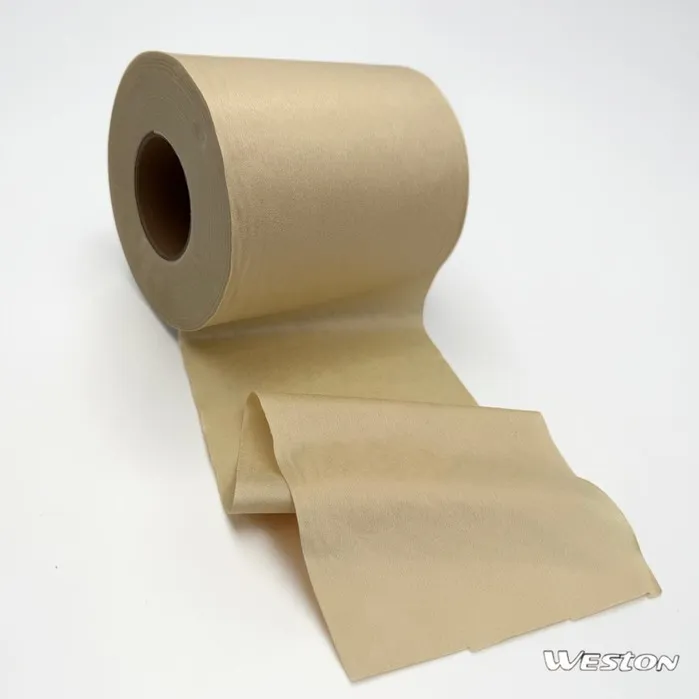
Bamboo-derived materials can be attractive to buyers seeking alternative cellulose sources. However, the term "bamboo fiber" does not tell the whole story.
Buyers should confirm whether the material is mechanically processed bamboo fiber, regenerated cellulose, or another fiber construction, because different processes may have different environmental impacts.
100% Pure Cotton: A Natural Fiber with Its Own Trade-Offs
Cotton may be suitable where softness and a natural fiber composition are important. Its environmental performance also depends on cultivation, water and other agricultural inputs, processing, and how much material the product requires.
Natural origin alone does not guarantee a lower footprint, so the actual product requirements and sourcing evidence remain important.
Seaweed-Fiber Materials: An Option for Specific Product Development
Seaweed-fiber materials can provide another avenue for manufacturers exploring alternative feedstocks and specialized material concepts.
Before making an environmental comparison, buyers should confirm the exact fiber composition, manufacturing route, available performance data, and applicable documentation. Any biodegradability or compostability claim must apply to the relevant finished product and its actual composition.
How Weston Nonwoven Can Support Material Selection
For buyers developing new wipes or nonwoven products, access to several fiber options can make it easier to investigate different combinations of performance and material sourcing.
Weston Nonwoven's range of plant-fiber material options gives buyers alternatives to evaluate when developing products for different applications. The objective should be to match the material to the product requirements, rather than assuming that one fiber is the best solution for every order.
For procurement teams looking for a Biodegradable spunlace nonwoven fabric supplier, the key first step is to clarify what the biodegradability claim covers, which conditions apply, and whether supporting documentation relates to the actual material or the complete finished product.
A supplier's available fiber range is a useful starting point, but material composition, production specifications, test results, and environmental claims should all be verified during product development.
What Should Buyers Ask a Nonwoven Supplier Before Placing an Order?
A well-defined request for information can prevent costly misunderstandings, especially when sustainability claims influence product specifications or customer requirements.
Before approving a material, buyers should request the following information.
1. Exact material composition
Ask for the fiber or polymer percentages, including relevant binders, coatings, finishes, and other components.
2. Performance test data
Request data relevant to the intended use, such as basis weight, absorbency capacity and rate, wet and dry tensile strength, linting, or chemical compatibility.
3. Environmental claim evidence
If a material is described as biodegradable, compostable, recyclable, or bio-based, ask which standard or test supports the statement and whether it applies to the raw material or finished product.
4. Raw-material sourcing information
Where sourcing is important to the project, request available evidence of fiber origin, recycled content, or other relevant claims.
5. End-of-life feasibility
Confirm whether the product can realistically enter a suitable recycling or composting system in the country where it will be sold and used.
6. Comparable lifecycle evidence
Where available, review life cycle assessments or product carbon-footprint data. Check the study boundaries, comparison basis, assumptions, and data quality before drawing conclusions.
7. Total cost per functional unit
Compare the cost of completing a defined task rather than relying only on the price per kilogram. A more expensive material may be economically competitive if it reduces the number of sheets required, product failure, or material waste. This should be demonstrated through testing rather than assumed.
One final distinction is essential: a factory's quality management certification does not automatically certify every product it manufactures as biodegradable or compostable. Each document needs to be interpreted according to what it actually verifies.
Frequently Asked Questions
Is PLA more environmentally friendly than polypropylene?
Not in every situation. PLA can use renewable feedstocks and may be suitable for specific compostable applications, while PP can provide useful performance and material efficiency. A fair comparison must consider production, the quantity needed for the same function, and the actual end-of-life route.
Is wood pulp nonwoven fabric biodegradable?
Cellulose fibers can biodegrade under suitable conditions, but the behavior of a finished nonwoven depends on its complete composition, including other fibers, binders, coatings, and additives. Buyers should verify claims for the actual product.
Is paper always more sustainable than plastic?
No. Paper and plastic have different production requirements, material weights, performance characteristics, and recovery pathways. The better option depends on the specific application and the environmental impacts being evaluated.
Can PLA nonwoven fabric be composted at home?
Industrial compostability does not establish home-compostability. Buyers should check the applicable product certification and test conditions rather than assuming the material will break down effectively in a household compost bin.
Can wood pulp and PP nonwoven materials be recycled or composted?
The answer depends on the composition and construction of the finished product, as well as the capabilities of local waste-management systems. The presence of wood pulp alone does not make a wood pulp–PP blend compostable.
Which nonwoven material is best for absorbent wipes?
It depends on the required liquid uptake, retention, wet strength, linting, and cost per cleaning task. Wood pulp-containing structures may be worth testing for absorbency, while other fiber blends may be better suited to different performance requirements.
What documents should buyers request when sourcing sustainable nonwoven materials?
Start with the exact material composition, relevant performance reports, and evidence supporting environmental claims. Depending on the application, additional documents may include raw-material traceability, product-specific certifications, and comparable lifecycle assessment data.
The most reliable way to select a sustainable nonwoven material is to define the required function first, compare technically suitable options on the same basis, and verify the environmental claims made for the finished product. For buyers and manufacturers alike, that approach is more useful than relying on the label of any single raw material.