How to Reduce Cross-Contamination in Commercial Kitchens?
Most guidance on kitchen cross-contamination starts in the same place: keep raw meat away from ready-to-eat food, wash your hands, use separate cutting boards. All of that is correct. But it misses something that shows up again and again in food-safety research - the tool used to clean the kitchen is frequently the thing spreading contamination through it.
A UK Health Protection Agency survey found that more than half of the cleaning cloths sampled from restaurant and takeaway kitchens carried unsatisfactory levels of bacteria - a direct indicator of poor hygiene and active cross-contamination risk. A separate NSF household survey found similarly uncomfortable numbers: 77% of sponges and dish cloths tested positive for coliform bacteria, 86% showed yeast and mold growth, and 18% carried Staphylococcus. These aren't fringe findings. They point to a structural problem: the object staff reach for to make a surface "clean" is, statistically, one of the dirtiest things in the room.
That reframing matters, because it means reducing cross-contamination in a commercial kitchen isn't purely a training or behavior problem. It's also a materials and systems problem - and the wiping tool deserves the same scrutiny as knives, cutting boards, and gloves.
How Contamination Actually Travels
Food-safety training usually emphasizes the direct pathway: raw protein touches a surface or a hand, which then touches ready-to-eat food. That pathway is real and well documented. But there's a second, less-discussed pathway that research keeps circling back to - the indirect, vehicle-mediated route, where a cloth or sponge picks up pathogens at one station and redistributes them across every surface it subsequently touches.
A Kansas State University study used video observation to track how kitchen staff actually behaved during food prep, not how they said they behaved. The result: staff repeatedly touched a shared towel before handwashing, or after washing inadequately, and then went on to recontaminate themselves and surfaces they touched next. Even when handwashing was done correctly, reaching for the same towel afterward undid it. A separate study of a commercial restaurant kitchen in China identified handling practice - including improper cloth use - as a critical control point in the transmission of Campylobacter throughout the kitchen line, meaning the cloth wasn't a side detail in the outbreak pathway; it was one of the main routes.
Put together, these findings describe a cloth functioning less like a cleaning tool and more like a shuttle - picking up contamination at one stop and dropping it off at the next, often while everyone in the kitchen believes the surface has just been made safer.
Why Traditional Reusable Cloths Structurally Fail
Part of the problem is fiber behavior, not staff behavior. Woven cotton cloths and cellulose sponges hold moisture inside their fiber structure, and that trapped moisture creates a small, warm, humid environment where bacteria multiply between uses - especially in the temperature range typical of a working kitchen.
Research out of southern Brazil measured this directly: cleaning cloths collected from food-service kitchens showed high aerobic bacteria counts, and nearly all of them tested positive for coliform contamination - even in kitchens that were following standard disinfection protocols. That detail matters. The failure wasn't a lack of effort or a skipped step; the fabric itself was retaining bacteria faster than the disinfection routine could clear it.
This produces what might be called the "washed but still dirty" paradox. Studies on cotton kitchen cloths have found that pathogens like Salmonella can survive overnight even in cloths that were rinsed and visually appeared clean, which undercuts a common assumption in commercial kitchens - that a cloth that looks clean and smells fine is safe to reach for again. Add to this the practical reality of color-coding systems: red for raw meat, blue for seafood, green for produce, and so on, is the accepted best practice for preventing cross-contamination. But color-coding only works if staff comply with it under time pressure, and reusable cloths make it easy to grab whatever's within arm's reach mid-shift rather than the correctly assigned one. Laundering reusable cloths at hospital-grade temperatures is also expensive and time-consuming, which means in high-volume kitchens it's often the first corner to get cut - creating a persistent gap between documented best practice and what actually happens on the line at 7 p.m. on a Friday.
The Material Science Angle: Why Fiber Structure Matters
This is where the more useful, less-discussed part of the conversation happens - because the industry has started addressing cross-contamination at the fiber level, not just the training level.
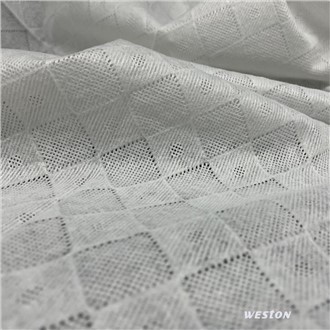
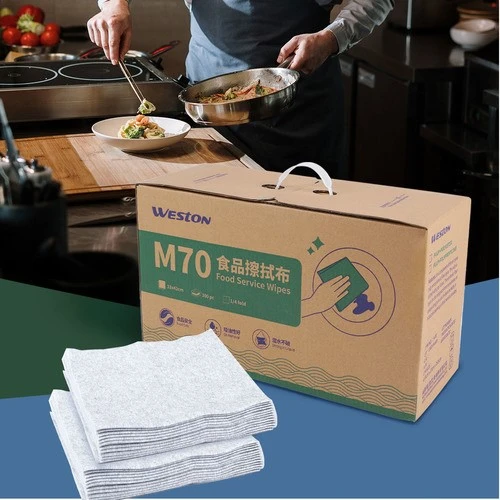
Most modern disposable kitchen wipes are made from spunlace, or hydro-entangled, nonwoven fabric. Instead of being bonded with adhesive or heat, the fibers are locked together using high-pressure water jets. That process produces a material that is simultaneously more absorbent, more tear-resistant when wet, and less prone to harboring bacteria in glue or binder residue than heat- or adhesive-bonded alternatives - a meaningful difference compared to woven cotton or cellulose sponge, both of which trap moisture in ways that favor bacterial regrowth.
Research has pushed this further into antimicrobial chemistry embedded directly into the fiber. A USDA-affiliated study on spunlaced cotton nonwovens treated with ascorbic acid formulations found measurable antimicrobial and antiviral activity, driven by enhanced hydrogen peroxide generation at the fiber surface - an example of hygiene performance being engineered into the material itself, rather than sprayed on as a surface-level afterthought. Manufacturers also tune several other variables specifically for kitchen-use cases: GSM (fabric weight), mesh or aperture pattern (which affects wiping friction and lint-free performance on stainless steel and glass), and fiber blend - viscose-polyester, pure cotton, or bamboo - each trading off absorbency, durability, and cost differently depending on the task.
There's also a lifecycle argument that's easy to overlook. A single-use spunlace wipe sidesteps the "washed but still contaminated" problem entirely, simply by removing the reuse cycle where bacteria regrow between shifts. That reframes disposability as a hygiene feature in its own right, not just a matter of convenience.
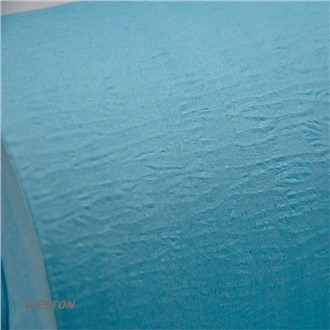
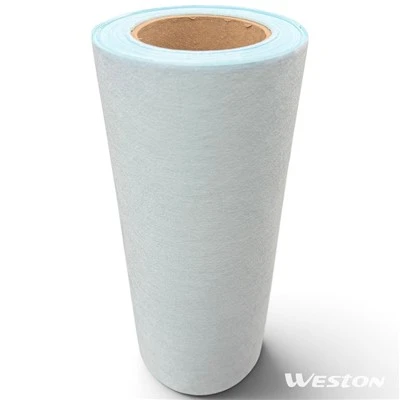
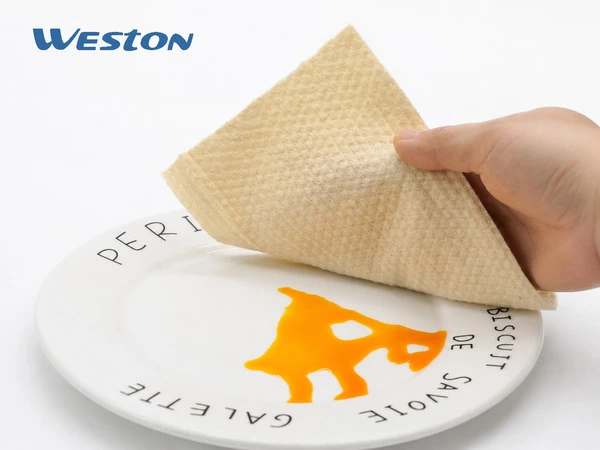
This is also where you start to see specialized manufacturers treat kitchen wipes as their own engineering problem rather than a generic cut of whatever fabric is used for baby wipes or cosmetic pads. Weston Nonwoven, for instance, produces a line of Colored Spunlace Kitchen Wipes - color-coded by design so that zone separation is built into the product itself rather than left to staff discipline - alongside a Biodegradable Kitchen Paper Towel aimed at kitchens trying to combine single-use hygiene with a lighter environmental footprint. It's a useful illustration of where the category is heading: fabric R&D, not just cleaning protocol, is becoming part of the cross-contamination solution set.
Operational Systems That Convert Better Material Into Better Outcomes
None of the above matters much if the operational systems around it are weak. A few practices consistently show up in food-safety guidance as the difference between a material advantage on paper and an actual reduction in contamination on the line:
Color-coded, task-dedicated wipes. Pairing single-use wipes with a strict color system closes the "grab whatever's nearby" failure mode described above - especially when the color-coding is manufactured into the product rather than added afterward with tape or markers.
Zone-based cleaning discipline. Restrooms, floors, and food-contact surfaces should never share a tool. A mop used in a restroom should never touch a kitchen floor, since contaminants it carries can become airborne and land on prep surfaces and equipment - the same logic applies to cloths moving between stations.
Chemical application discipline. Spraying degreaser or sanitizer directly onto a surface, instead of applying it to a cloth first, spreads contaminants rather than containing them.
Verification, not assumption. ATP (adenosine triphosphate) testing lets a kitchen confirm a surface has actually been sanitized, not just visually cleaned - directly addressing the "washed but still dirty" gap.
HACCP/NSF alignment. Framing these practices around documented food-safety audit requirements, rather than treating them as informal best practice, makes them easier to enforce and easier to defend during inspection.
The Sustainability Trade-Off
The obvious objection to single-use wipes is waste, and it deserves a fair hearing rather than a dismissal.
Reusable cloths do produce less solid waste, but they carry a real cost on the other side: hospital-grade laundering at high temperature uses significant water and energy, and - as the Brazilian study showed - even that process doesn't fully eliminate contamination risk. Disposable spunlace wipes remove the re-contamination cycle entirely, but they do generate more solid waste over time, which is a legitimate concern for kitchens trying to reduce their environmental footprint.
The middle path that's emerging is biodegradable or eco spunlace nonwoven material - wipes made from plant-based or wood-pulp fiber blends that decompose naturally, aiming to deliver single-use hygiene without the same disposal burden as a fully synthetic product. In other words, the "paper towel vs. cloth" debate isn't as binary as it used to be; material innovation is narrowing the trade-off rather than forcing kitchens to pick a side.
A Practical Checklist
Assign color-coded wipes to specific zones or tasks, and make the system visible - dedicated bins, dispensers, and signage, not just verbal instruction.
Default to single-use, task-specific wipes for high-risk zones: raw protein prep, allergen stations, and anywhere cross-contact would be hardest to detect.
Never apply cleaning chemicals directly to a surface - apply them to the wipe first.
Verify sanitation periodically with ATP testing rather than relying on visual inspection alone.
If reusable cloths are still in use, launder them at a validated high temperature after every shift, not simply "when they look dirty."
Choose wipe materials backed by documented antimicrobial or hygienic performance data, rather than relying on packaging claims alone.
Conclusion
Reducing cross-contamination in a commercial kitchen is really a three-layer problem: staff behavior and training, operational systems like color-coding and zoning, and - the layer that gets the least attention - the material science of the tool itself. Most existing guidance stops at the first two layers. But the research is fairly consistent on one point: a cloth that looks clean, has been rinsed, and even followed a documented disinfection routine can still be actively spreading bacteria, simply because of how its fibers hold moisture and organic residue.
That's the layer worth paying more attention to. The next meaningful improvement in kitchen hygiene may come less from a new training module and more from what's actually in a line cook's hand when they wipe down the prep table.