Eco-Warrior or Heavy-Duty Hero? Dual Strengths Of Bamboo Spunlace Industrial Wipes
Can a wipe save the planet and still survive a factory floor?
It sounds like a trick question - the kind that forces you to pick a side. Green, or tough. Biodegradable, or bulletproof. For decades, industrial cleaning supplies have been built on that exact trade-off: synthetic wipes that shrug off oil and solvent but sit in landfills for centuries, or "eco" wipes that feel good on paper but fall apart the moment they meet real grease, metal shavings, or a wet workbench.
Bamboo spunlace industrial wipes reject that choice entirely. And the more closely you look at the material science behind them, the more obvious it becomes: sustainability and toughness were never opposites. They're the same engineering outcome, just viewed from two different angles.

Bamboo Fiber vs. the Rest: A Quick Reality Check
Before getting into why bamboo performs the way it does, it's worth putting it side by side with the materials it's replacing.
Cotton nonwoven is soft and absorbent, but it's thirsty to grow, pesticide-heavy in conventional farming, and loses strength fast once wet - not ideal for anything involving oil or solvent.
Polyester and polypropylene nonwovens are strong and cheap, but they're petroleum-derived, shed microplastics, and can take hundreds of years to break down.
Wood-pulp blends are biodegradable but usually too weak on their own for industrial-grade wiping, which is why they're often reinforced with synthetic fiber anyway - quietly reintroducing the plastic problem.
Bamboo fiber, by contrast, grows fast with minimal water and no pesticides, biodegrades naturally, and - critically - has a fiber structure strong enough to be spun into a nonwoven sheet that doesn't need synthetic reinforcement to hold up under stress.
That last point is the hinge the entire article turns on. Bamboo isn't a compromise material. It's a material that happens to satisfy both demands at once.
The Eco-Warrior Case
Bamboo is one of the fastest-renewing plants on earth, often ready for harvest in three to five years without replanting, and it typically requires far less water and far fewer chemical inputs than cotton. When it's processed into spunlace nonwoven fabric, the resulting sheet biodegrades under the right conditions instead of persisting as plastic waste for generations.
This isn't a new discovery dressed up as a trend. Bamboo fiber has quietly earned trust in far more sensitive applications long before it showed up on a factory floor. It's the same fiber family used in Bamboo Fiber Sanitary Napkins, chosen precisely because it's gentle enough for direct, prolonged skin contact. If a fiber is trusted against skin, it's already cleared a much higher bar than "safe to wipe down a workbench." The eco credentials here aren't marketing gloss - they're chemistry with a track record.
The Heavy-Duty Hero Case
Here's where most people expect the story to fall apart. Surely something this gentle can't handle an oil spill, a machine shop, or an aerospace maintenance bay?
It can - and the reason comes down to how the fabric is made. Spunlace, or hydroentanglement, doesn't glue fibers together with chemical binders. Instead, high-pressure water jets physically interlock the fibers, creating a sheet that's mechanically strong from the inside out. No adhesive to break down. No resin to weaken under solvent exposure.
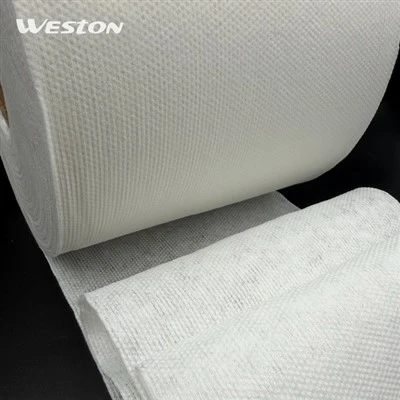
The result is a fabric with real tensile strength, solid wet-strength retention, and tear resistance that holds up under repeated, aggressive wiping - exactly what's needed in auto repair bays, marine engine rooms, machine shops, and aerospace maintenance lines, where a wipe that disintegrates mid-task isn't just inconvenient, it's a liability. This is the domain of Bamboo Spunlace Nonwoven Industrial Wipes - built for the exact conditions synthetic wipes were once considered the only option for.
And here's the twist that ties the whole argument together: the same hydroentanglement process that makes the fabric strong is what keeps it biodegradable. Because there's no synthetic binder holding the sheet together, there's nothing artificial that needs to be stripped out or left behind after the wipe breaks down. Strength and sustainability aren't fighting each other in this fabric - they're built from the same decision.
The Secret Weapon: Bamboo Charcoal Spunlace
If bamboo spunlace is the baseline, bamboo charcoal spunlace is the upgrade - and it's not an additive bolted on afterward. It's a genuine evolution of the fiber blend.
Bamboo charcoal carries a micro-porous structure, similar in principle to activated carbon, that gives the fabric enhanced odor absorption, natural antibacterial performance, and a noticeably faster grip on grime and oil. Picture two wipes side by side on the same greasy surface: the standard spunlace wipe cleans effectively, but the Bamboo Charcoal Spunlace wipe pulls oil and odor out faster and holds it, thanks to that porous internal structure doing extra work at a microscopic level.
This is the point where "eco-friendly" and "industrial-grade" stop being two separate selling points and become one fiber blend, doing both jobs simultaneously.
Why the Debate Is the Wrong Question
Step back, and the framing in the title starts to look like a false premise. Eco-friendly and heavy-duty were never in competition - they're both downstream of one thing: fiber engineering quality.
A wipe that's genuinely well-engineered doesn't need synthetic reinforcement to survive tough conditions, and it doesn't need to sacrifice performance to stay biodegradable. In fact, the strongest wipe on the market is often, by necessity, also the most efficiently made - less material waste in production, no over-engineering with plastic backing just to compensate for a weak base fiber. Efficiency and durability turn out to be allies, not rivals.

Behind the Scenes: Why the Factory Matters as Much as the Fiber
Even the best raw material is only half the story. Bamboo fiber has the right properties on paper - but turning that potential into a wipe that performs consistently, batch after batch, order after order, depends entirely on the manufacturing partner behind it.
This is where facilities like Weston Nonwoven matter. A factory built around customization gives buyers control over the variables that actually determine real-world performance:
Flexible GSM (gram weight) options, so the fabric can be tuned lighter for general wipe-down tasks or heavier for aggressive industrial cleanup.
Custom width, roll length, perforation, and embossing patterns, tailored to specific dispensing systems and workflows.
OEM/ODM support, including private labeling and custom packaging for brands that need the product to carry their own identity.
In-house R&D on fiber-blend ratios - bamboo, bamboo charcoal, and polyester blends adjusted to hit the exact balance of softness, strength, and absorbency a given industry needs.
Consistent quality control systems, ensuring that batch 500 performs exactly like batch 1 - a non-negotiable for industrial buyers who can't afford inconsistency.
None of this is a sales pitch bolted onto the end of a technical article. It's the explanation for why the wipe performs the way it's supposed to in the first place. A great fiber without a great manufacturing process is just potential. Customization is the variable that turns raw material advantage into product advantage.
Redefine the Category
This isn't a wipe that splits the difference between green and tough. It's proof that the two were never separate goals to begin with - just two views of the same well-engineered fiber.
As more industries face pressure to cut their environmental footprint without giving up an inch of performance, materials with this kind of dual identity stop being a niche alternative and start becoming the obvious standard. The question was never eco-warrior or heavy-duty hero. It was always going to be both - for anyone paying attention to the fiber, and the factory, behind the wipe.